
The Surrender Problem
Published June 23, 2026 • Read time: 8m
What Japan in 1945 Can Teach Washington About Iran Today
The United States may have ended the shooting war with Iran, but it has not yet solved the Iran problem. The question is no longer simply whether Tehran can be pressured into accepting nuclear limits. The harder question is whether the Islamic Revolutionary Guard Corps can be made to see nuclear compromise as survival rather than surrender.
That distinction matters now. Recent reporting shows U.S.-Iran diplomacy circling around ceasefire extension, reopening the Strait of Hormuz, sanctions relief, and the fate of Iran’s enriched uranium. Reuters reported June 7 that Washington is pressing the International Atomic Energy Agency to demand Iran account for its bombed nuclear sites and enriched uranium stockpile. Reuters also reported that much of Iran’s enriched uranium is believed to have survived the strikes, including uranium enriched up to 60 percent.
That is the trap. A deal that reopens Hormuz but leaves the nuclear-material problem unresolved would ease the immediate crisis while preserving its cause. A deal that demands nuclear surrender without giving Iran’s power structure a survivable political story may be rejected by the institution that appears to hold the veto. Reuters reported in April that wartime pressure has concentrated Iranian decision-making in the Supreme National Security Council, the Supreme Leader’s office, and the IRGC, with the Guard holding leverage over Hormuz, the nuclear file, and the pace of talks.
There is a useful historical echo, though it must be handled carefully. In August 1945, Japan was beaten. Okinawa had fallen. Hiroshima had been destroyed. The Soviet Union had entered the war. Nagasaki had been bombed. Yet surrender still almost failed because elements of the Japanese military viewed capitulation not merely as defeat, but as institutional and cultural suicide.
The lesson is not that the United States should seek “another Nagasaki.” The better lesson is that wars end when external pressure is joined to an internal mechanism that allows the losing side to reinterpret compromise as national preservation. Japan surrendered because pressure destroyed the military’s remaining alternatives and enabled Emperor Hirohito to make surrender executable. Historians still debate what mattered most, but the immediate political problem was internal deadlock.
Iran has no equivalent of Hirohito. If the IRGC is not merely executing Iranian policy but substantially defining it, then Washington cannot negotiate only with Iran’s diplomats. It must negotiate against the IRGC’s veto.
Having spent a career around military planning, intelligence, acquisition, and deterrence questions, I am wary of historical analogies that become slogans. This one is useful because it exposes the hardest question in war termination: how does one end a conflict when the faction with veto power believes compromise threatens its identity, authority, and survival?
For the United States and its partners, Iran’s nuclear program is a proliferation danger. For the IRGC, nuclear latency may serve as shield, symbol, and bargaining chip. A threshold capability can be framed internally as proof that resistance works, that Iran cannot be coerced, and that the Guard — not the civilian government — is the true defender of the revolution. Giving up that pathway is therefore not just a technical arms-control concession. For the IRGC, it may look like surrendering the central deterrent that justifies its power.
Indeed, the IRGC could point to recent history to justify this perspective. Libya gave up its nuclear program and its regime later collapsed. Ukraine surrendered Soviet nuclear weapons and was later invaded. North Korea kept its nuclear program and survived. To the IRGC, those examples may appear to prove that nuclear capability is the ultimate insurance policy. Any U.S. strategy must therefore make the opposite case credible: Iran’s continued nuclear pursuit now threatens the regime more than a verified settlement would.
This does not mean the United States should accommodate an Iranian nuclear weapons option. Quite the opposite. It means Washington should separate two different tasks that are too often blended together: applying pressure and making compliance politically executable. Pressure without an off-ramp may harden the very faction whose consent is required. An off-ramp without pressure may reward delay. The art is combining the two.
The bargain should be sovereignty-preserving but capability-denying.
Iran should be allowed to claim peaceful nuclear dignity under the Non-Proliferation Treaty. It should have access to civilian nuclear power, medical isotopes, research activities, and internationally guaranteed reactor fuel. But it should not retain sovereign control over the fuel-cycle elements most relevant to weaponization. The formula should be simple: peaceful nuclear sovereignty, yes; sovereign enrichment pathway to a bomb, no.
That requires clarity about nuclear material, not merely enrichment levels. Iran would have to export, surrender, or downblend enriched uranium outside internationally supervised civilian channels. Any remaining nuclear material for legitimate civil, medical, or research purposes would have to be declared, inventoried, sealed, and monitored under IAEA safeguards. Challenge-inspection authority would have to verify that undeclared material, conversion, enrichment, or weaponization work is not continuing elsewhere. The IAEA’s February safeguards report underscored concerns about access, declarations, and verification, while Reuters reported June 7 that Washington was pressing a draft IAEA resolution demanding more precise information about Iran’s nuclear material and affected sites.
There should be no fallback that permits Iran to retain unsupervised nuclear material or an independent fuel-cycle capability that could be reconstituted into a weapons pathway. That requirement is where past inspection and negotiation efforts with Iran have repeatedly broken down. The question is whether Iran retains the materials, infrastructure, and inspection-denial options that would allow it to sprint later.
Nor should this be framed as America “granting” Iran civilian nuclear power. Iran already has civilian nuclear power at Bushehr under safeguards and Russian fuel arrangements. The actual offer is different: guaranteed peaceful nuclear access without sovereign control of the fuel-cycle elements that enable weaponization. Iran could claim it preserved nuclear dignity. It could not claim the right to produce, retain, or manipulate weapons-usable nuclear material outside international control.
This is the knife-edge bargain. Iran retains a story of sovereignty, but not the technical means to sprint to a bomb. The IRGC could claim it preserved the revolution, avoided national ruin, and forced recognition of Iran’s peaceful nuclear rights. The United States could claim it denied Iran a nuclear weapons pathway without requiring national humiliation or regime collapse.
That bargain will not work through reassurance alone. The IRGC must also believe that delay worsens its position. Continued refusal should mean deeper economic isolation, renewed international sanctions, pressure on illicit revenue networks, maritime containment, and the demonstrated risk that reconstituted nuclear infrastructure will again be targeted. The choice presented to the IRGC must be stark but survivable: accept a verified settlement that preserves the state, or continue a path that threatens the institution more than compromise does.
A broader regional framework could reinforce this bargain, but it cannot substitute for it. The Financial Times reported that Saudi Arabia has explored a Middle Eastern non-aggression pact with Iran, modeled loosely on the 1970s Helsinki process. Such a framework could help Iran claim it preserved sovereignty and won regional recognition rather than capitulated to American pressure. But a non-aggression pact would be credible only if built on nuclear substance first: removal or dilution of enriched uranium, enforceable limits on enrichment, restored IAEA access, and mechanisms to address missiles, drones, and proxy destabilization. A Helsinki-style process, or a temporary Hormuz arrangement, may help package compliance. It cannot replace compliance.
For Washington, this means three things.
First, the nuclear issue cannot be deferred. Any effort to trade maritime de-escalation, temporary calm in the Gulf, sanctions relief, or regional dialogue for postponed nuclear substance would repeat the central mistake. It would relieve pressure while preserving the cause of the crisis.
Second, relief should be phased and conditional. Sanctions relief, regional security guarantees, and broader normalization should follow verified nuclear actions, not promises. Sequencing matters because the IRGC’s strongest move will be to split the immediate crisis from the nuclear problem.
Third, the United States should be precise about where it will and will not compromise. It can recognize peaceful nuclear rights. It can support civilian nuclear access. It can allow Tehran a public sovereignty narrative. But it should not accept unsupervised nuclear material, independent enrichment that enables rapid breakout, denial of inspection access, or a vague promise to address weaponization later.
The United States does not need to humiliate Iran to deny it a bomb. But it does need to make clear that the only survivable off-ramp is one that removes the weapons pathway. If Iran refuses that constraint, Washington should not soften the nuclear requirement. It should tighten the pressure and make clear that maritime, sanctions, and regional-security relief remain unavailable until the nuclear-material problem is resolved.
Wars end when the losing side can finally say yes. Strategy is the art of making that answer possible without sacrificing the terms that made the conflict necessary.
That is the surrender problem. And it is now America’s Iran problem.
Stan G. Harmon is a retired U.S. Air Force fighter pilot and national security professional with experience as an R&D engineer, program manager, Pentagon acquisition professional, and Air Staff intelligence leader.
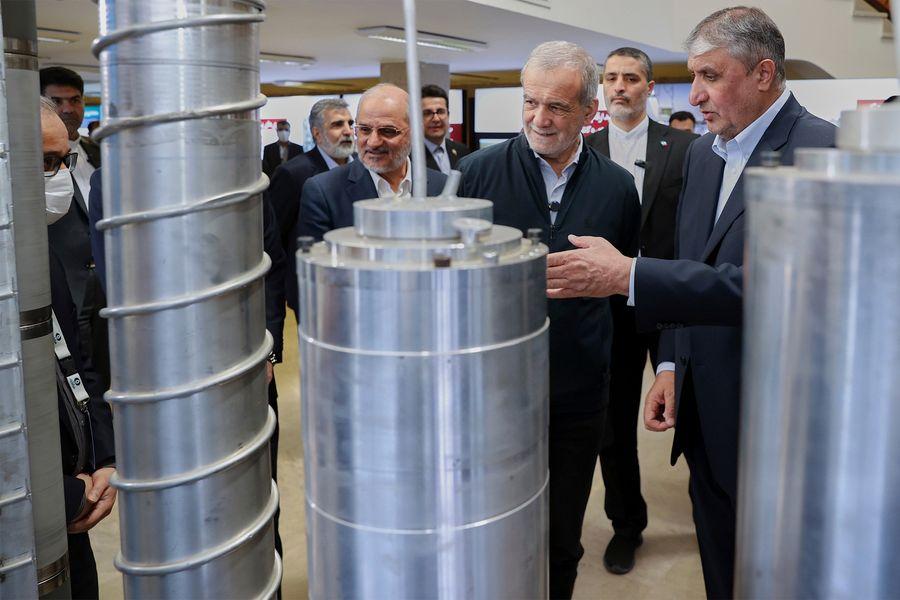
image: In this photo released by the Iranian Presidency Office, President Masoud Pezeshkian, second right, listens to head of Atomic Energy Organization of Iran Mohammad Eslami as he visits an exhibition of Iran's nuclear achievements, in Tehran, Iran, April 9, 2025. (Iranian Presidency Office via AP, File)

South Korea’s Nuclear-Powered Submarines After the Midterms
By Jihoon Yu • RealClearDefense
Why Build a Billion-Dollar Warship if a Cheap Drone Can Sink It?
By Ege Can Gün • RealClearDefense
Megaspeed Proves: Congress Must Act on Chip Security
By Michael Groen • RealClearDefense
Creating a MEF Insurance Policy
By Steven Bancroft • RealClearDefense
Operation Epic Fury and the Illusion of Victory
By Stephen D. Cook • RealClearDefense
South Korea’s Nuclear-Powered Submarines After the Midterms
By Jihoon Yu • RealClearDefenseWhy Build a Billion-Dollar Warship if a Cheap Drone Can Sink It?
By Ege Can Gün • RealClearDefenseCreating a MEF Insurance Policy
By Steven Bancroft • RealClearDefense
U.S. Navy Used Expired Munitions During Iran War
By Riley Ceder, Navy Times
The Coast Guard Icebreaker Nobody Wanted
By David Roza, Task & Purpose