
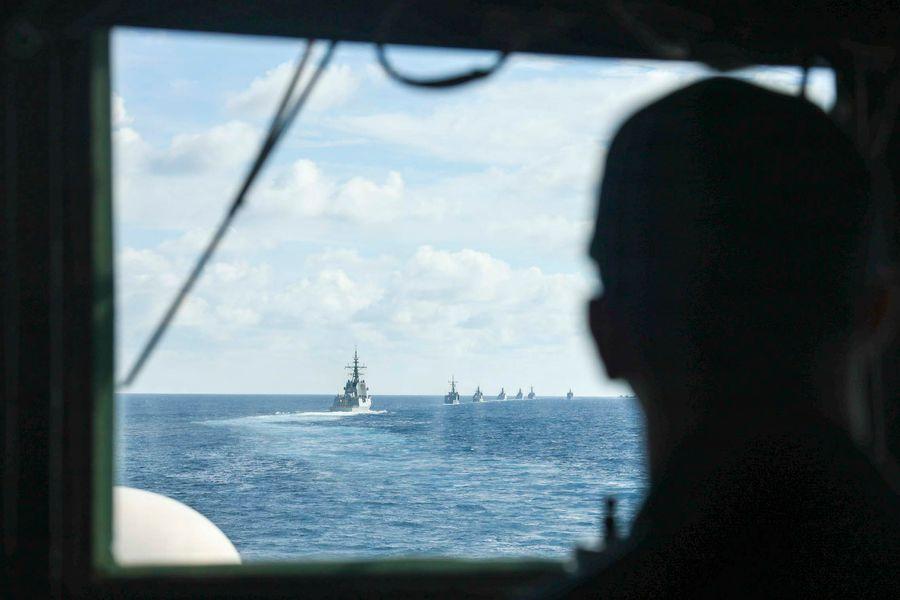
Ensign Thomas Murray observes a formation of ships while serving as connoting officer aboard Arleigh Burke-class guided-missile destroyer USS Bulkeley (DDG 84) as part of Exercise Mavi Balina in the Mediterranean Sea. Mavi Balina is an international anti-submarine warfare exercise led by Turkish Naval Forces to provide realistic operational training in surface and submarine warfare and promote friendship, mutual understanding and cooperation. Bulkeley is a forward-deployed naval asset assigned to the U.S. 6th Fleet area of operations to support the warfighting effectiveness, lethality and readiness of U.S. Naval Forces Europe-Africa and defend U.S., Allied and partner interests in the region. (U.S. Navy photo by Mass Communication Specialist 2nd Class Leon Vonguyen)
The U.S. and its Allies Need a Collective Maritime Strategy
Published Nov. 28, 2026 • Read time: 12m
Join the Conversation
0Military developments in the Western Hemisphere and the Persian Gulf demonstrate that the U.S. military remains a premier force with impressive global reach and multi-domain capabilities. However, Washington’s protracted conflict against Tehran exhibits significant military strain stemming from extended deployments, depleted interceptor stockpiles, and a reputational crisis. This military overextension is nowhere more apparent than with the U.S. Navy, whose sailors are enduring record deployments, while naval assets remain tethered to the Gulf. The present U.S. Navy is reportedly too small to sustain long conflicts, and remaining naval capabilities are inadequate for deterrence in other theaters. In face of growing maritime ambitions by peer adversaries, the United States must produce numerical increases to its fleet to confront future naval challenges. Washington’s calls for a maritime coalition in March to reopen the Strait of Hormuz are a direct symptom of this, yet no allies heeded the call. Nonetheless, U.S. allies are dependent upon increasingly threatened sea lanes and still outsource maritime security burdens to the U.S. Navy. On a separate interconnected point, had the U.S. Merchant Marine been maintained, the Merchant Marine Act of 1936 could have been invoked to have the fleet sail into the warzone to ensure market stability and global access to Gulf resources. When holistically considered, the United States and its allies are collectively facing a naval crisis.
Although the current U.S. administration has initiated a plan to overhaul its maritime industrial base, it remains questionable if such expansive designs are truly attainable. What is thus required is not only a shift in U.S. naval strategy, but a collective Western maritime strategy that properly shares naval burdens between Washington and its partners. Western maritime security can benefit from a strategic shift spearheaded by rebalancing the U.S. Navy. Maritime-minded U.S. allies will complement this change by focusing on their comparative advantages and by increasing their aggregate shipbuilding capacities.
End the Jones Act Waiver
The U.S. Needs Its Own Grey-Zone Tactics in the South China Sea
How Beijing Could Throttle Taiwan Without Firing a Shot
In the South China Sea: 'Not One Square Inch'
The present political reality is that although the United States and its allies have implemented impressive increases in military spending and re-armament, naval expansion has remained an incredibly expensive and technical endeavor. Fiscal limits and increases in debt service costs indicates that the collective West must find innovative, cost-efficient ways to revamp their shipbuilding industries.
The most recent developments in Middle East waters show that large vessels, carriers, and expensive technological systems are not the most efficient means of securing maritime communications. Instead, as analysts ranging from service members to experts have posited, a rebalanced naval force that is more sustainable from a fiscal, industrial, and personnel perspective is required. Leading Western nations, including the United States, will likely find futility in attempting to immediately reacquire their lost industrial capacities and build a fleet with traditional large warships. The optimal solution proposed would entail rebalancing the fleet by creating a flexible force within the capacity of the current defense industrial base through scalable formations. This rebalanced fleet would include a core general-purpose force consisting of less large surface combatants, and crucially, high-tech tailored specialized formations termed as “hedge forces” that combine unmanned platforms, robotic, and autonomous systems to combat rapid response scenarios (the terms tailored offsets and tailored forces are specific U.S. Navy concepts related to/for hedge forces).
Just prior to the launch of Operation Epic Fury, U.S. Navy Admiral Daryl Caudle published his strategic vision via the U.S. Navy Fighting Instructions, outlining the necessity of incorporating advanced technologies as a cost-effective way to ready the force for future challenges. Noting that the U.S. Navy must redouble its efforts to enhance its C-C5ISRT capabilities (counter-command, control, communications, computers, cyber, intelligence, surveillance, reconnaissance, and targeting)—crucial in gaining a critical advantage during a war at sea—Adm. Caudle articulates that the service must develop a mechanism to allow commanders to demand and integrate robotic and autonomous systems (RAS) capabilities to meet needs in a timely manner. Treating RAS as novel undermines the force’s ability to wield them at scale, and as Hudson Institute senior fellow Bryan Clark wrote, such systems offer greatly reduced procurement and sustainment costs. RAS capabilities are considered imperative for the creation of forward-deployed hedge forces that can achieve military objectives without having to risk the strategic-level general-purpose fleet. Adm. Caudle states that the addition of RAS augmented hedge forces avoids “a brittle single-purpose force that is either overbuilt for high-end fights and then underused day to day, or optimized for low-end crises and then gets overmatched when it counts.” This is all possible while balancing “cost-effective, scalable, risk-worthy mass with the most advanced multi-mission platforms.”
Importantly, by forward basing the hedge forces, they can prevent enemy action by demonstrating the potential for immediate automatic response in case of aggression. Such formations would be capable of deterring adversaries or blunting the initial stage of maritime aggression while reinforcements are assembled from elsewhere. Incidentally, the creation of a more refined escalatory ladder at sea could be possible to threaten adversaries with a calibrated process of escalation. The current U.S. Navy suffers from being a strategic-level instrument that struggles with handling numerous concomitant conflicts without the addition of more ships. Furthermore, depending on the situation, the deployment of a naval fleet runs the risk of provoking an escalation and hostile response, rather than achieving deterrence. Such a scenario has already occurred during the Korean War, where the deployment of the U.S. Seventh Fleet into the Taiwan Strait factored considerably into China’s decision to assist North Korea.
The utilization of hedge forces could provide immediate responses to address regional crises through measured actions without committing the political prestige of a carrier group. It must also be noted that the choice of deployment signals intent. The deployment of renewable low-cost attritable forces will still likely signal firm defensive intent while being economically and politically cheap via the non-commitment of significant forces or personnel. Adversaries would have the opportunity to de-escalate, and should they refuse, time would have nevertheless been gained to prepare an adequate response. The logic here follows the rationale proposed by experts for the acquisition of tactical-level nuclear weapons by Britain and France. The possession of only strategic-level nuclear weapons by European NATO allies and the decline of the U.S. tactical-level arsenal could hypothetically lead Russia to engage in limited aggression—for instance, a “Hamburg Grab”-esque seizure of the alliance’s territory—in the belief that NATO would not risk nuclear armageddon over a restricted assault. The existence of more lower-yield nuclear weapons would complicate further aggression via the existence of a refined escalatory ladder to threaten Russia without jumping to the top rung of cataclysmic responses. The same reasoning applies in the proposal for a rebalanced fleet, and hedge forces can potentially offer lower threshold means to combat threats ranging from maritime gray-zone tactics to sudden seizures of geostrategic insular positions along sea lanes.
All this is not to say that there is no further need for a force resembling a traditional naval fleet. On the contrary, the hedge forces are a supplement that enables the navy to flexibly challenge peer adversaries and manage a credible global presence. The main general-purpose force should still be a capable fighting force, but as argued by Bryan Clark and others, be rebalanced towards becoming economical through a reduction in operations and sustainment funding. A special report from Jane's Navy International postulates that a fleet design with increased numbers of destroyers, aircraft carriers, and aviation assets would result in disproportionate costs to build and maintain in the near-term. The current shipbuilding industry would reportedly also struggle to deliver increased production of large surface combatants. The solution is to instead build more small surface combatants to numerically increase available vessels at far less than what it would cost to achieve the same numbers with large warships. Nonetheless, this is far easier said than done, especially when holistically considering the severely atrophied state of Western shipbuilding. Thus, a critical aspect to achieving the rebalanced fleet is the focused expansion of military shipbuilding relative to peer adversaries to ensure the future viability of the general-purpose force.
Today, the gravest example of declining shipbuilding capacity is the United States. Once the number one global producer of new vessels, the United States has currently declined to a mere 0.2% of commercial shipbuilding production by tonnage, while a single Chinese shipyard outproduces the entire U.S. shipbuilding industry. Current projections make it clear that even with the new ambitious shipbuilding plan, the U.S. Navy will have to operate under a reduced number of warships well into the next decade. Prospects for creating a new battleship class thus create serious questions surrounding tradeoffs and cost-efficiency. The latter is of significant importance in a potential scenario in which the People's Liberation Army Navy can outmatch the U.S. Navy in terms of numerical quantity. Optimizing the use of total naval assets consequently becomes paramount. If unaddressed, the U.S. Navy risks becoming a cost-inefficient fleet vis-à-vis its adversaries. From a tactical-operational perspective, the vessels in most need—especially in a potential future Taiwan Strait crisis—are nuclear attack submarines, missile-armed corvettes, unmanned vessels, and frigates. Developments such as the partial cancellation of the Constellation-class frigate program in late-2025 jeopardizes the future effectiveness of the U.S. Navy. Likewise, Admiral John Aquilino, former commander of the U.S. Indo-Pacific Command, stressed the importance of unmanned autonomous vessels back in 2023, with them only engaging in naval action against Iran from July following bureaucratic delays.
Evidently, the United States should primarily focus on rebalancing its fleet by (1) increasing the production of submarines and (2) increasing the production of lightweight warships and RAS. However, as seen from the recently published U.S. Navy Shipbuilding Plan and America’s Maritime Action Plan, Washington intends to expand military and commercial shipbuilding concurrently. Although reviving the entire maritime industrial base is the primary objective, it has been debated if such grand designs are truly feasible when both private shipbuilders and Navy yards face huge backlogs. Commercial ships also remain prohibitively expensive to build. This is compounded by the fact that military vessels, such as submarines and RAS, require specialized shipyards that are incompatible with commercial yards. Ideally, Washington should avoid overstretching its resources. Nevertheless, the revival of commercial shipbuilding and the U.S. Merchant Marine are a national security prerequisite, with the latter critical in enabling wartime sealift capabilities and the former sustaining it. Resultantly, the necessity for acquiring both commercial and military shipbuilding capabilities must be remedied somehow.
One possible solution to this nautical conundrum is the proper division of labor between the United States and its allies. A fiscally realistic answer that accounts for current shipbuilding issues suggests that Washington would benefit from a division of labor. Similar to the newly instituted “Finland Model” for the construction of certain naval vessels, the United States could establish comparable, or more expansive, interim measures to delegate commercial shipbuilding and merchant fleet burdens to allies. This should be pursued concurrently with promoting allied investment into the U.S. maritime industrial base to enable domestic shipyards to concentrate on rebalancing the U.S. Navy short-term, while promoting the long-term goal of restoring domestic maritime power.
Specifically, key players of today’s maritime industry, such as Japan, South Korea, and Greece can assist the United States’ naval revival. The aforementioned nations foster strong maritime traditions and crucially already possess the necessary industrial infrastructure, technological expertise, and talent. For example, Greek mariners have an extensive maritime history and tradition going back to the Napoleonic Wars of breaking blockades and transporting cargo to dangerous waters. Greece ranks first in terms of global fleet capacity, and when taking into account Japan and South Korea as well, they collectively own nearly 30% of the global commercial merchant fleet's carrying capacity based on deadweight tonnage. Britain, once the world’s greatest seapower, is reportedly seeing its stagnant shipyards revived by European rearmament. The return of British and broader European shipbuilding would be a welcome addition to bolstering collective naval efforts. Consequently, the United States would see benefits in collaboration with its allies through measures such as joint ship production, allowing the utilisation of allied mariners in war, encouraging investments into rail-port infrastructure, and more. Policies that could inject healthy competition through friend-shoring against current protectionist cabotage measures may help address immediate merchant fleet gaps in the short-term, while supporting the long-term revitalization of the U.S. Merchant Marine and maritime industrial base.
A prudent strategy that takes account of the necessary trade-offs means that the United States will need to focus and invest primarily in the production of smaller surface combatants, streamlining repairs and modernization, and expanding yards. Revamping the commercial shipbuilding industry is expensive and the limited long-term positive spillovers towards military warship production from an increase in commercial shipbuilding indicates that it is more efficient for the United States to temporarily delegate this to allies. Marine-oriented allies already possess a comparative advantage in this sector, and this arrangement would distribute burdens and benefit both collectively. Furthermore, their dependence on the continued maintenance of freedom of navigation and maritime security for their national well-being incentivizes participation in such initiatives.
This takes into account the limited resources that Western navies have to deal with and the fact that even the largest navy in the world is currently suffering from operational overstretch. The solution is to turn towards smaller, cheaper, and more operationally flexible warships that can be rapidly produced. This new general-purpose force will be augmented by forward-deployed hedge forces to protect sea lanes. Meanwhile, this will be combined with collective efforts to bolster Western maritime power. U.S. allies can play an important supporting role by expanding their own fleets and supporting the United States via their pre-existing strong commercial shipbuilding capacities and investing into the U.S. maritime industrial base.
Antonios Marios Giannakopoulos is a researcher for the Turkish & Eurasian Studies Lab and holds a BA in International Relations and European Studies from the University of Piraeus in Greece. His work and research have been published by the Adam Smith Institute, VoegelinView, the Austrian Economics Center, and more.
Maximilien Hachiya is an MPhil in Modern Chinese Studies student at the University of Oxford and holds a BA in War Studies from King’s College London.

When the Warfighter Becomes the Sensor
By Elise G. Annett • RealClearDefense
The U.S. and its Allies Need a Collective Maritime Strategy
By Antonios Marios Giannakopoulos • RealClearDefense
Making Maneuver Great Again
By Gary Anderson • RealClearDefense
Ending the Conflict with Iran
By Anthony Cowden • RealClearDefense
Going After the Cyprus Money Laundering Hub
By Lise Korson • RealClearDefense
Making Maneuver Great Again
By Gary Anderson • RealClearDefense
Coast Guard’s Updated Force Design Plan Includes Maven Smart System
By DS
F-22 Raptor Commands MQ-20 Avenger From the Cockpit
By K. Osborn, Warrior M.
ULA’s Vulcan Rocket Is Grounded for Third Time
By I. Klotz, V. Machi, Aviation Week
Tragedy That Convinced the Coast Guard It Needed Rescue Swimmers
By WATM