
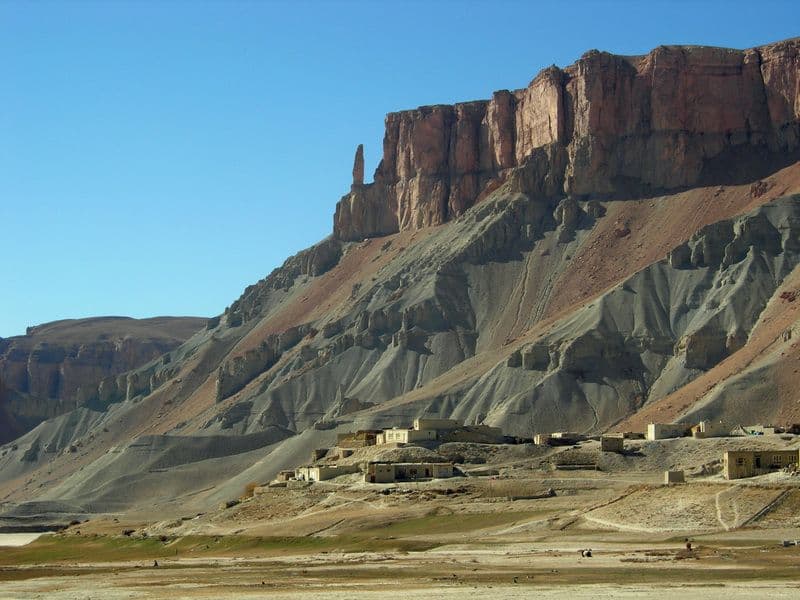
The United States and Southwest Asia
Last updated 05:30 PM EDT • Read time: 5m
The dynamics of Southwest Asia are in many ways distinct from those of neighboring South Asia and the Middle East, although they’re connected to what’s happening both to the east and west of it. The United States is an important part of these dynamics because of its involvement in multifarious ways in the three main countries of the sub-region—Afghanistan, Pakistan and Iran.
Afghanistan forms the centerpiece of U.S. strategy in Southwest Asia because American troops are engaged in fighting the Taliban insurgency and propping up shaky Afghan governments. The Pentagon disclosed a few months ago that it has 11,000 troops in Afghanistan, with 4,000 more expected under President Donald Trump’s new strategy for the war in that country.
Pakistan has been an integral component of American calculations relating to Afghanistan since the Soviet invasion in 1980. Pakistan acted as the main conduit for the supply of American arms to Afghan insurgents fighting the Soviet-supported government. Islamabad benefited immensely from that relationship because part of the arms shipments went into Pakistan’s armory, shoring up its conventional capabilities against India, its larger neighbor and historic enemy. Furthermore, Washington turned a blind eye to Pakistan’s clandestine nuclear program as a quid pro quo for Islamabad’s support for the American-sponsored insurgency in Afghanistan.
Pakistan’s strategies began to diverge from those of the U.S. after the Soviet withdrawal from Afghanistan in 1989. While the U.S. basically left Afghanistan to its anarchical fate, Pakistan allied itself with a faction of Pashtuns—mostly products of religious schools in Pakistan—known as the Taliban (literally, students) that eventually came to power in Kabul in 1994 with the support of Pakistan’s army.
Islamabad was forced to go along with the invasion of Afghanistan in 2001 after the Bush administration threatened to bomb Pakistan into the Stone Age. But it secretly continued to support Taliban factions and other terrorist networks fighting American forces because it considered them potential assets in its Afghan policy, as well as in its dispute with India over Kashmir.
It’s this disjuncture in U.S. and Pakistani objectives that underpins the severe tensions that have now surfaced in Washington’s relations with Islamabad. Those tensions came to a head early this month. In his first tweet on New Year’s Day, Trump singled out Pakistan for harsh criticism. Three days later, the U.S. announced that it was freezing nearly all security aid to Pakistan, amounting to U.S.$1.3 billion annually.
Iran also has major interests in Afghanistan. Tehran wouldn’t like a Sunni fundamentalist regime, such as the Taliban, in Afghanistan. At the same time, it’s interested in minimising—and, if possible, eliminating—the American presence in Afghanistan because of Washington’s hostility towards Tehran, which is reflected above all in Trump’s stance on the nuclear deal with Iran. Left to himself, Trump would have reneged on the deal a year ago when he came to power. He’s constrained by the fact that it’s a multilateral agreement that the other members of the P5+1 find beneficial. Moreover, Tehran has scrupulously carried out its part of the bargain according to the IAEA. Nonetheless, Trump is clearly interested in jettisoning the deal if it isn’t changed to suit his administration’s, and the Israeli lobby’s, interests.
Tehran has its own surrogates in Afghanistan, especially in Shia Hazara–populated central Afghanistan, and in Herat in western Afghanistan. These groups can make life difficult for American forces in Afghanistan. It has also made tactical alliances with factions of the Sunni Taliban, although they are anathema to Shia Iran ideologically, providing them with weapons, money and training as a part of its design to force American troops to leave Afghanistan.
For the moment, America’s policies in Southwest Asia appear to be failing. Afghanistan is sliding into chaos despite years of American military and financial support. The Taliban are taking advantage of the Afghan government’s inability to provide legitimate and efficient governance to extend their territorial control. American relations with Pakistan are at an all-time low because of Washington’s inability to understand that it can’t use Islamabad for its own purposes in Afghanistan while simultaneously building a close strategic relationship with Pakistan’s nemesis, India.
Finally, instead of using the nuclear deal as the first step to improve relations with Iran, the pre-eminent power in the energy-rich Gulf, Washington under Trump is engaged in discrediting Iranian president Hassan Rouhani’s moderate government that’s committed to holding up Iran’s part of the bargain. The U.S. is thus providing ammunition to Rouhani’s hardline anti-American opponents by constantly deriding the nuclear agreement, imposing further sanctions on Iran unrelated to the nuclear issue, and preventing average Iranians from enjoying the economic benefits they’d expected from the nuclear deal.
Washington is likely to be left with one failed state, Afghanistan, that’s thoroughly infiltrated by anti-American groups, and two hostile ones, Pakistan and Iran. With Russia and China waiting next door to expand their influence in this sub-region through cleverly crafted economic and military deals, the U.S. is likely to find itself at great strategic disadvantage in Southwest Asia.
Mohammed Ayoob is a senior fellow at the Center for Global Policy in Washington D.C. and University Distinguished Professor Emeritus of International Relations at Michigan State University.
Eight Months of Epic Fury and Still No Internal Alternative
By Stephen D. Cook • RealClearDefense
The Readiness Cliff: Pacific Lessons Drawn from the Middle East
By Brian McSorley • RealClearDefense
The Pentagon’s Real Modernization Problem Is Time, Not Technology
By Bruce Allen Lubbering • RealClearDefense
The World His Mother Opened
By Carlo J.V. Caro • RealClearDefense
Wake Island Lessons for Expeditionary Advanced Base Operations
By Brian J. Dunn • RealClearDefense
Wake Island Lessons for Expeditionary Advanced Base Operations
By Brian J. Dunn • RealClearDefense
U.S. Navy Expands Unmanned Mine Hunting
By Global Defense News
MRF-SEA Will Maintain Continuous Presence in the Philippines
By Mahadzir, USNI News
Space Force Weighs Proliferated Cislunar Satellite Constellation
By C. Albon, A&SF
America-Class Amphibs Enable New Ship-to-Shore Attack Strategies
By Warrior M.