
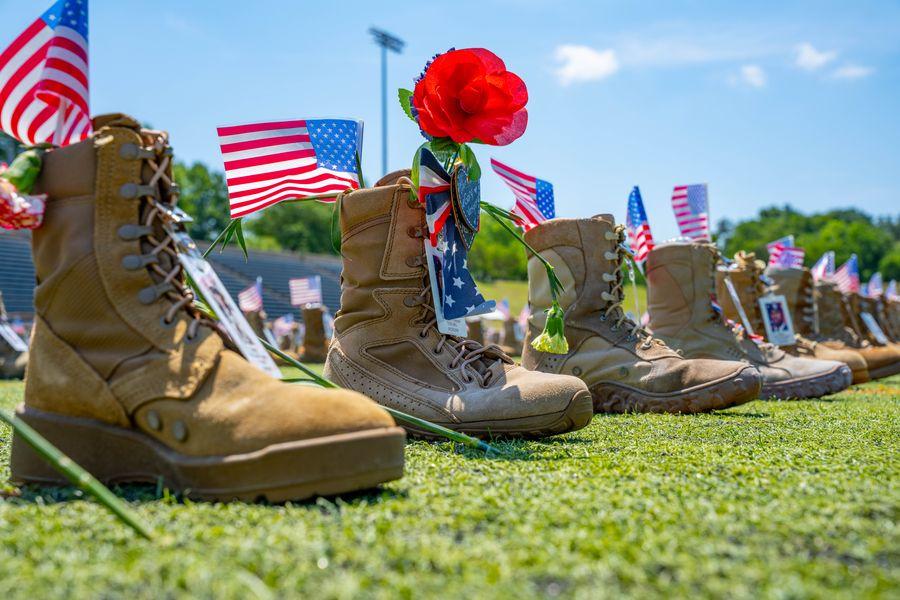
Congress Can't Just Mandate Better Boots
Published June 9, 2026 • Read time: 7m
A recent op-ed in RealClearDefense urged Congress to support NDAA Amendment 6638, a revival of the BOOTS Act that would restrict servicemembers from wearing certain optional combat boots made by American companies but manufactured abroad. Worse, the campaign behind it suggests an unregulated U.S. military cabal is buying Chinese-made boots while American manufacturers are left out in the cold.
That is false. It is a Washington narrative built for an easy sell: close a loophole, support domestic manufacturing, reduce foreign dependence, and call it readiness.
Although today’s fight is with the Department of War, the law enforcement community and countless other agencies are also back in the crosshairs. The HOPR Act was just the beginning.
For the casual reader, this “Buy American” argument sounds rational, even necessary. Yet for anyone who understands procurement, or for the men and women who have already had to wear American-made “blister boots,” it reveals a fundamental misunderstanding of defense acquisition and the real state of the American defense industrial base.
Over the last several weeks, I have spent time with law enforcement officers during Police Week, Devil Dogs at Modern Day Marine, and special operators from across the Services at SOF Week in Tampa. Although they wear different uniforms and take on different missions, a basic reality stood out across every community: the right gear will make or break the mission.
No one needs to explain “Buy American” to these communities. They are among the most patriotic people in the country. They care about the flag, they want American industry to succeed, and they want to take pride in wearing gear made here at home. If American-made gear performs, is available, and is priced within reach, who wouldn’t choose it every time?
Stand Proud of the Force
After the Silence
One Year Later: The U.S. Military Continues Quartering Charlie Kirk Assassination Celebrants
The Uniform Doesn't Come With a First Amendment Waiver
But patriotism does not create surge capacity by legislative command. It does not solve material shortages, train skilled workers overnight, guarantee quality control, or make an unavailable, unaffordable, or ill-fitting boot mission ready.
Worse still, it does not retroactively turn the millions of taxpayer dollars spent during the Global War on Terrorism (GWOT) into the innovation the domestic base failed to deliver. Too much of that money stayed in the C-suite, and now the same industry voices are back asking you, the taxpayer, for another payday.
That is the problem with the BOOTS Act: it treats a domestic-only mandate as a substitute for readiness, then frames those who question that mandate as anti-American or soft on China. But the people raising concerns are not trying to outfit troops and law enforcement officers from cheap Chinese sources, as the article seemed to suggest. They are trying to preserve the options that are filling gaps the domestic base failed to solve with their GWOT profits.
Why, then, would Congress narrow footwear options when the domestic base has already acknowledged the very capacity, quality, and availability gaps the BOOTS Act ignores?
For a retiring legislator like Rep. Golden, one has to wonder whether the answer is a soft landing at New Balance, a major employer in his home district and a company that stands to benefit from this legislation. For others, I’ll help you follow the money.
Golden is a former Marine, but his apparent nostalgia for American-made GWOT-era boots belongs to a different time. Now, as his final act, he has a chance to protect service members instead of forcing them into a narrower set of outdated, lower-quality options.
At Modern Day Marine, Marine officials described approving a TAA-compliant boot with carbon-fiber technology — a capability no U.S. manufacturer currently offers. That kind of innovation is not cosmetic. It can reduce impact injuries, improve performance, and give Marines better tools for the fight ahead.
Rep. Golden should listen to his own Corps before he leaves Washington. If he wants to lead on this issue, he should help build the American industrial base without cutting Marines off from the innovations they need right now.
But let’s be clear: the American military is not buying Chinese boots. The last time an American boot manufacturer tried to pass off Chinese-made footwear as compliant for U.S. troops, its CEO went to prison.
The core problem is not a lack of demand for domestically made boots. America should make more boots, and it should make a lot more. The problem is that the current domestic boot industrial base has not shown it can consistently deliver enough of the right boots, at the right quality, at the right price, when the force needs them. The BOOTS Act does not solve that problem. It simply cuts off the market alternatives that are helping fill the gap.
That is backwards. If Congress believes the domestic boot base is too weak, it should fix the domestic boot base. It should move now to expand capacity, strengthen materials supply chains, train the workforce, improve quality control, and build surge production. Defense Production Act Title III was made for exactly this kind of industrial base challenge.
What Congress should not do is force our servicemembers and police officers into a narrower set of options before real, reliable American-made alternatives are available at scale here at home.
The quality risk is not theoretical. Marine Corps Systems Command recently reported that after deficient U.S.-made footwear was identified, an enterprise inspection with Marine Corps Exchange partners resulted in nearly 25 percent of the affected boots being returned to American manufacturers before Marines could buy substandard gear. This has real life consequences.
At Modern Day Marine, I met a Marine who had recently returned from a training exercise in Norway, where cold-weather gear is a prerequisite to survival. He told me he had experienced boot failures firsthand and described the problem with cold-weather boots failing in the field as “rampant.” In the High North, that kind of failure can become dangerous fast, turning a gear problem into a frostbite risk.
When his unit’s American-made intermediate cold weather boots failed, they had no choice but to buy Norwegian boots so they could stay on mission.
Retired Marine Corps Master Sergeant Michael MacKay, a Marine Corps special operations veteran with eight overseas deployments, put it bluntly in a recent article: “If your feet are torn up and you’re halfway through a mission, you’re slower, more vulnerable to infection, and a liability. Why would we even consider taking away that kind of footwear flexibility, especially when the commercial market is willing and able to provide it?”
In discussions with multiple operators at SOF Week, one 20-year special forces veteran admitted, “I’ve never worn a U.S.-made boot on mission. The quality, comfort, and performance is just not there.” Thinking about the recent successful Delta Force operation in Venezuela, I’d wager the operators on that mission were wearing what worked, not what pleased the footwear lobby. The world’s most lethal force is literally voting with its feet, and Congress should be listening.
The BOOTS Act’s supporters frame this as a choice between American boots and Chinese dependence. That is a false choice, and an intellectually dishonest way to frame the narrative. Congress can and should distinguish between adversary-controlled supply chains and trusted allied or Trade Agreements Act-compliant sourcing. A resilient supply chain may require domestic production, allied production, prepositioned stockpiles, and multiple verified sources of supply.
Ultimately, Congress should strengthen American manufacturing. It should invest in domestic capacity, require transparent sourcing, and demand real performance from every vendor. If American manufacturers can meet the full requirement at the right price, quality, and scale, they should prove it in the market and in the field.
Until then, Congress should not impose a domestic-only mandate unless DoD can certify that it will not reduce availability, raise out-of-pocket costs, limit access to mission-appropriate footwear, or degrade readiness. The goal should be more American capacity and better boots for the force, not fewer choices before the industrial base is ready.
Kyle S. Reyes is the owner of The 1776 Project, which owns Law Enforcement Today, Blue Lives Matter, and The Police Tribune. He is also the founder and CEO of The Silent Partner Marketing and a leading voice in pro-law-enforcement media and advocacy.
When the Warfighter Becomes the Sensor
By Elise G. Annett • RealClearDefense
The U.S. and its Allies Need a Collective Maritime Strategy
By Antonios Marios Giannakopoulos • RealClearDefense
Making Maneuver Great Again
By Gary Anderson • RealClearDefense
Ending the Conflict with Iran
By Anthony Cowden • RealClearDefense
Going After the Cyprus Money Laundering Hub
By Lise Korson • RealClearDefense
Making Maneuver Great Again
By Gary Anderson • RealClearDefenseMaking Maneuver Great Again
By Gary Anderson, RealClearDefense
Bandwidth as a Service for Naval Forces
By Brandan R. Schofield, CIMSEC
The Army and the Marine Corps in a Pacific War
By Van Horrick & Bancroft, MWI
Coast Guard’s Updated Force Design Plan Includes Maven Smart System
By DS