
Armies Can't Win Wars Alone
Last updated 06:26 AM EDT • Read time: 13m
The Straw Man of “Airpower Alone” and the False Claim of Ground Force Primacy
The claim that wars can only be won by conquering and occupying ground has become one of the most durable clichés in American defense commentary. It is repeated so often that many treat it as settled truth. If winning wars was all about controlling ground, victory would have been readily attainable in places like Vietnam, Afghanistan, and Iraq. Reality is far more complex and demands a far broader assessment—one that focuses on an ends, ways, and means assessment.
What makes the argument for the primacy of ground forces especially misleading is that it usually begins by attacking another false proposition, that wars can be won by “airpower alone”—a position no serious modern airmen hold. No thoughtful strategist believes war is waged only in one domain—not on land, not at sea, not in the air, not in space, not in cyberspace. Modern military campaigns succeed by integrating capabilities across domains in pursuit of defined political objectives. The real question is not whether actions in one domain can act “alone” to secure victory, but how should capabilities in every domain be integrated to best accomplish a desired end-state.
That is why the latest insistence that “stand-off strikes shape conflicts” but do not “finish them,” and that the United States “cannot achieve durable outcomes in war without controlling terrain, populations, and political end states,” gets the problem backward. Those propositions smuggle in an assumption that many campaigns neither require nor seek. Not every war aims at occupation. Not every use of force seeks to govern foreign populations. Not every successful military campaign demands territorial conquest or long-term political control. When commentators define “victory” so narrowly that it only means occupation and control, they do not clarify strategy; they rig the argument in favor of land power from the start.
Wars are won by the degree that they contribute to achieving desired political objectives. Sometimes that requires the conquest and control of terrain. Sometimes it does not. Sometimes land forces are indispensable—like during the Battle of the Bulge and the Inchon Invasion. Sometimes they are supporting—like during Operations Desert Storm and Provide Promise. Sometimes they are unnecessary—as with the Battle of the Coral Sea, Allied Force, and Operation Midnight Hammer. History offers ample evidence for each case. The issue is not that armies are unimportant. The issue is the categorical claim that only armies can deliver strategic success.
Jointness Is Not Equal Billing
Part of the confusion comes from a persistent misunderstanding of jointness. Jointness does not mean several services deploy to the same theater, align under one commander, and then each receive an equal share of the action. It does not mean homogeneity. It does not mean institutional fairness. It means that the Department of War’s/Defense’s separate services provide a menu of specialized capabilities to a joint force commander, whose job is to apply the most appropriate capabilities for the contingency at hand. And every contingency will be different, requiring different mixes of service force components to succeed.
That may produce a campaign in which land forces dominate. It may produce one in which aerospace power does. It may produce one in which naval, cyber, space, or special operations capabilities play the predominant role. There is nothing un-joint about such asymmetry. In many cases, that is the clearest expression of real jointness.
Separate services are not an obstacle to jointness; they are a prerequisite for it. It takes decades to cultivate the judgment required to command a division on land, a battle group at sea, or a joint force air or space component. These are not interchangeable arts. The duty of the joint force commander is not to blur them together, but to exploit them in combination.
That is why the decisive service cannot be determined by institutional tradition. It must be determined by the objective.
The Real Distortion
Defense arguments that presuppose domain centrality before a challenge is identified and analyzed should instantly raise red flags as they likely have more to do with winning budget battles in the Pentagon than prudently assessing what is best for national security in each situation. Purveyors of that approach generally distort these conversations from the outset by defining victory so narrowly that only land-centric campaigns can qualify. Ground-power absolutists begin with the assumption that unless a war ends with armies occupying terrain, controlling populations, and imposing political order through prolonged presence, it has not truly been won. From there, the conclusion takes care of itself: if “winning” is defined as occupation, then of course armies become indispensable. But that is not analysis. It is circular reasoning. They also tend to throw out red herring arguments like “airpower cannot do it alone”—and in so doing, accuse others of what they are in fact trying to achieve themselves.
Ground-power absolutists also love to quote T.R. Fehrenbach’s assertion that if one wishes to win a war, one must do so “on the ground . . . in the mud.” But the irony is that Fehrenbach was writing about Korea—a war that land power failed to successfully conclude and remains unresolved 73 years after the shooting stopped. The 1953 agreement was an armistice rather than a peace treaty. Korea remaining divided as two hostile states illustrates that land power has limitations. Armies can fight, hold, and bleed for years without delivering final political settlement. If anything, Korea is a warning against confusing battlefield endurance on land with decisive strategic success. That case becomes even more compelling when combined with the results land power failed to deliver in Vietnam, Afghanistan, and Iraq.
The reality is that wars are not fought for the sake of controlling a single domain, whether that be land, sea, air, space, or cyber. They are fought to achieve political objectives within circumstances that are complex and multi-faceted. Sometimes those objectives require territorial control, regime removal, or long-term stabilization, in which case land forces may indeed be essential. But many successful campaigns seek something else entirely: to compel an adversary to stop an activity, to force a withdrawal, to halt atrocities, to abandon a course of action, to degrade a military program, to paralyze command structures, or to impose costs sufficient to change behavior. In such cases, coercion, denial, disruption, and punishment may be enough to achieve the desired end without conquest or occupation. In fact, “owning the ground” can also drive owning too many liabilities.
This is why claims that only armies can “finish” wars are so misleading. They create a definition of success that privileges land warfare from the outset and then present that definition as if it were an objective truth about warfare itself. But the fact that armies are necessary for some kinds of political ends does not make them necessary for all political ends. To treat land power as the default measure of strategic success is not realism. It is a category error—one that confuses one important way of winning with the only way of winning.
Desert Storm: Airpower Did the Decisive Work
Operation Desert Storm remains one of the clearest modern refutations of the claim that land forces are always the decisive arm. Yet it is still too often described in a way that obscures what actually happened.
The war lasted 43 days. For roughly 90 percent of it, coalition ground forces performed in a supporting role as a blocking force while airpower dismantled Iraq’s military capacity. Coalition air forces paralyzed Saddam Hussein’s command and control, crushed Iraqi air defenses, destroyed the Iraqi air force, severed logistics, and devastated Iraqi ground formations before coalition ground forces entered the fight. By the time ground operations began on day 39, the Iraqi military had been rendered largely ineffective—specifically their ground forces.
The subsequent coalition ground action lasted only 100 hours. It was necessary, yes—but necessary for what? To secure the terrain of Kuwait and collect the remnants of an Iraqi army already broken by airpower, including soldiers seeking someone to whom they could surrender other than drones. That does not diminish the value of land forces. It places them in proper context. In Desert Storm, land power was essential to complete the endgame, but it was not the principal instrument that broke Iraq’s warfighting machine. Airpower was.
This is exactly what real jointness looks like: using the right force, in the right place, at the right time, for the right objective. It is not a doctrine for guaranteeing equal participation to every service, every place, all the time. It is a methodology for achieving optimal results. In Desert Storm, the campaign’s decisive weight rested mainly on airpower, with land forces closing out the final phase. General Schwarzkopf—an Army 4-star general, and overall military commander—demonstrated what taking a joint approach really means.
Allied Force: No U.S. Ground Invasion, Yet Strategic Success
Operation Allied Force makes the point even more starkly. In 1999, NATO conducted a 78-day air campaign that coerced Slobodan Milošević into capitulation and halted Serbian abuses in Kosovo without a U.S. ground invasion. No American armored thrust into Belgrade or any other land force operations were required to achieve the campaign’s central objective. If wars can only be won through conquest of ground, then Allied Force should be impossible to explain. Yet it happened.
This does not mean airpower acted in a vacuum. It was embedded in diplomacy, alliance cohesion, intelligence, information operations, and the credible prospect of continuing escalation. But that is precisely the point: no serious airpower advocate claims otherwise. The question is which military instrument bore the principal burden of coercion. In Allied Force, aerospace power did. That is a matter of historical record, not theory.
Ground-power absolutists’ broader claims that stand-off strikes cannot impose outcomes simply do not survive contact with cases like this. They plainly can impose outcomes when the objective is coercion rather than occupation.
Nor are Desert Storm and Allied Force outliers. Consider the Berlin Airlift: air transport aircraft secured a major political victory over the Soviet Union in the opening days of the Cold War. The 1962 Cuban Missile Crisis, a combination of naval and air assets executed a blockade around Cuba, which proved instrumental in checking Soviet actions that sought to place nuclear weapons 90 miles from the U.S. In the 2000s, the Stuxnet computer virus netted a significant blow against Iran’s attempt to enrich uranium for nuclear weapons. These were effects-based campaigns that prioritized mission outcomes, not pre-baked obsession with a particular domain.
The Wrong Tool for the Wrong Objective
It is true that technology without a concept of how to translate it into usable combat power is not enough. But it is wrong to imply that the proper answer is to funnel the Pentagon’s new investments primarily into Army formations because land power is what “actually decides wars.” That is not analysis; it is service preference and parochialism disguised as strategic necessity.
The actual lesson of modern war is more demanding. One must match means to ends. If the objective is to occupy a country, overthrow a regime, and govern a population, then land forces are likely indispensable. If the objective is to halt ethnic cleansing, eject an invader, destroy a fielded force, paralyze command networks, degrade a nuclear program, or impose repeatable costs without occupation, then the dominant instrument may be aerospace power, perhaps supported by cyber capabilities, ISR, special operations, or indigenous partners. That is not anti-Army. It is strategic logic.
Operation Rising Lion was a campaign aimed not at regime change or occupation, but at delaying, disrupting, and degrading Iran’s nuclear and military capabilities. In less than two weeks, Israel flew over 1,500 sorties, conducted more than 600 aerial refuelings, struck roughly 900 targets, and achieved these effects without losing a single manned aircraft. The purpose was not to control Iranian territory. It was to impose strategic costs, create follow-on options, and sustain a denial-by-delay strategy. Those objectives could not plausibly have been accomplished by introducing Israeli ground forces into Iran.
That example directly rebuts the assumption that meaningful outcomes always require control of terrain and populations. Sometimes they do. Here, they plainly did not.
What Ukraine and Iran Actually Show
Some cite Ukraine and Iran as proof that land power remains unavoidable. That overreads both cases. Ukraine certainly demonstrates that where the object is territorial defense and recovery, land power is essential. But that is because the political objective in Ukraine is inherently territorial. The case proves that armies matter when armies are required. It does not prove that all wars, or even most strategic objectives, require the same solution.
Iran, likewise, does not prove the indispensability of armies. It proves the importance of aligning objectives with means. If the objective were to conquer and occupy Iran, then yes, airpower alone would be insufficient. But that was not the objective. The objective was to degrade Iran’s nuclear and military infrastructure, decapitate leadership nodes, gain freedom of action, and establish the basis for repeatable future coercion. Those are strategic effects, and they were pursued through a multi-domain campaign in which air and space power played the predominant roles.
That does not invalidate the utility of land forces. It simply means land forces were not the principal tools for the declared objective in this contingency. That distinction is exactly what most ground-power absolutes obscure.
Conclusion
The enduring lesson of modern war is that no single domain holds a unilateral lock on victory. Wars are won by applying the right capabilities to the right objectives under a genuinely joint concept of operations. To say that wars can be won only through conquest of ground are simply false. The same holds true for any other unilateral domain centric argument—air, space, sea, or cyber.
Desert Storm demonstrated that airpower could render an enemy military ineffective before the introduction of ground forces. Allied Force demonstrated that coercion could succeed without the use of U.S. ground forces at all. More recent campaigns reinforce similar principles: when objectives do not require occupation, land forces may be supporting instruments—or unnecessary altogether.
That is not a rejection of jointness. It is the essence of jointness.
The measure of military effectiveness is not whether every service gets equal use, nor whether analysts can force every campaign into a land-centric template. It is if, how, and when a joint force commander uses the most appropriate service component capabilities to contribute to the desired political result. Leaders who understand that will design campaigns for victory. Leaders that insist wars are only won on the ground will keep mistaking one important military function for the whole of war.
David A. Deptula is a retired Air Force Lt General who is the Dean of the Mitchell Institute for Aerospace Studies, and a senior scholar at the U.S. Air Force Academy’s Institute for Future Conflict. He has been Joint Task Force commander twice during a military career filled with involvement in combined/joint force operations.
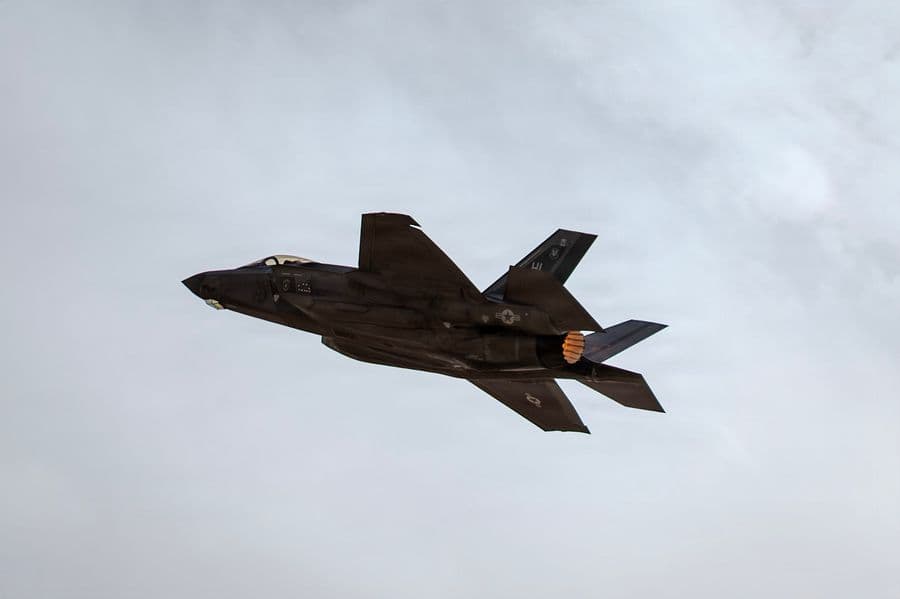
image: A U.S. Air Force F-35 Lightning II aircraft takes off during Operation Epic Fury, March 30, 2026. (U.S. Air Force photo)
Beyond Hormuz: What Washington Should Expect from a Frontline Ally
By Daewon Cho • RealClearDefense
Putin, Plague, and the America’s Biodefense Gap
By Ryan Kane • RealClearDefense
Patriot Delays Force a New Air Defense Doctrine on NATO’s Eastern Flank
By Jan K. Varga • RealClearDefense
How the Army Can Turn Plans into Combat Power
By Matt Russell • RealClearDefense
Is It Déjà vu All Over Again: The 2012 Report on Global Zero
By Peter Huessy • RealClearDefense

U.S. Marine Corps Attack Helicopters Set for Major Upgrade
By C. Jones, Defence Blog
How the Iran War Compounded the U.S. Navy’s Maintenance Crisis
By Hartung, NatInt
Fielding Forces for Full Mobilization
By Jon Hoffman, Proceedings
BAE’s New Launcher Lets Warships Deploy and Replenish Missiles at Sea
By NextGenD
Why Is the Navy Spending $19 Billion on ‘Flying Gas Stations’?
By Mark Thompson, RS