
Defense Networks Will Split. The Requirement Should Say Who Decides.
Published Aug. 10, 2026 • Read time: 5m
Join the Conversation
0Plans for conflict against a capable adversary increasingly assume that communications will be disrupted. Units train for disconnected, intermittent, and limited conditions, and programs advertise the ability to keep operating through them. What remains less clearly specified is not whether the software keeps running. The open question is what happens to delegated tasking authority while the network is divided, and how conflicting decisions are adjudicated when it reconnects.
Mission command provides a mature framework for the human side of that problem. It gives a disconnected subordinate a human and institutional framework for acting: commander's intent, mission orders, defined command relationships, disciplined initiative, and an obligation to report and explain decisions afterward. The framework is not perfect in practice, and officers argue about how well it is exercised. But it exists, it is taught, and it assumes that a decision taken out of contact will be accounted for once contact resumes.
Automated decision-support and allocation systems do not inherit that framework merely because they can continue processing local data. If the architecture permits both partitions to keep tasking or allocating shared resources, each side can act against the last common state it saw. The result can be two locally reasonable commitments against the same tanker, the same lift capacity, the same sensor window, the same munition stock. Neither node needs to be malfunctioning. The conflict can arise because the system was designed for local continuity without an equally explicit rule for divided authority.
U.S. and Australia Should Give ANZUS Teeth
How to Win Without Military Victory
Tailored Deterrence and Nuclear First Use in Europe
When Access Becomes the Fight
The harder problem arrives at reconnection. Two divergent records of tasking and allocation must be reconciled, and data consistency is not the same thing as command validity. Where reconciliation is left to a generic synchronization rule, whether last update, source priority, or automatic overwrite, the system can produce a clean database while concealing the operational disagreement that produced it. A technically consistent record can still preserve the wrong commitment, erase a decision that required review, or make two incompatible actions appear as though only one ever occurred.
Three requirements would address this, and none of them demands a scientific breakthrough, although implementing them may take architectural and testing work.
The first is a partition authority map. Every critical function needs a preauthorized rule identifying which node may commit which resources, within what limits, under what operational conditions. Authority does not have to divide the same way for every function: one node might remain authoritative for fuel allocation while another retains intelligence, surveillance, and reconnaissance retasking. Deciding that in advance converts an accident into a plan.
The second is bounded delegation. Delegated tasking rights should operate as leases, limited by time, function, resource quantity, confidence in local state, or mission phase, and unable to expand merely because communications remain unavailable. A system operating alone should not retain full delegated authority indefinitely. Its authority should narrow or expire according to preauthorized limits rather than continuing unchanged until somebody notices.
The third is reconvergence adjudication. Restoring the link should trigger a command-aware process that preserves both decision histories, identifies conflicting commitments, requires human review where consequences cannot be safely reversed, and records which decision prevailed and why. This step may be especially vulnerable to cost and schedule pressure, because it is unglamorous, slow, and difficult to demonstrate in a simple performance chart. It is also the most direct way to learn whether the answer the software gives is the answer the commander would give.
Exercises and test environments that already inject degraded communications can add a reconvergence objective without building an entirely separate scenario. Cut the link deliberately, let both sides operate, restore it, then audit which decisions stand, which are reversed, and who was informed.
Partition behavior therefore belongs in the requirement, stated as clearly as range or endurance: what the system may commit while disconnected, under whose delegated authority, for how long or under what conditions, and how incompatible commitments will be surfaced and adjudicated after reconnection. A requirement written that way is one a vendor can design against and a tester can measure.
Doctrine can accommodate decentralized execution. What it depends on is legible command relationships and accountable decisions. A network partition can leave two nodes holding locally valid but mutually incompatible commitments, and automatic synchronization can conceal that conflict rather than resolve it. More bandwidth will not fix it. Programs must decide in advance what each node may commit while disconnected, how that authority narrows as time or uncertainty grows, and which decisions require adjudication when the force is whole again.
Burak Oktenli holds an MBA and is completing an MPS in Applied Intelligence at Georgetown University. He writes on authority, autonomy, and assurance in defense systems.
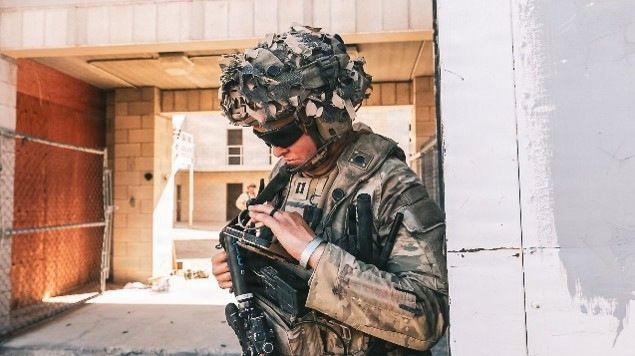
image: U.S. Army Capt. Alex Bayer, mechanized infantry company commander in the 4th Infantry Division, coordinates with her unit on a Next Generation Command and Control end-user device during Project Convergence-Capstone 6 (PC-C6) at Fort Irwin, California, July 24, 2026. PC-C6 is the premier Army-hosted experiment that allows the joint force, multinational allies and partners to integrate people, equipment, and technologies to support continuous transformation efforts aimed at aggressively shaping how future warfighters will operate in fast-paced, high-tech environments. (U.S. Army photo by Sgt. Nathan Arellano Tlaczani)

Iron Raven: Remembering Colonel Joseph B. Conmy, Jr.
By Louis Marano • RealClearDefense
Stand Proud of the Force
By Jay Rogers • RealClearDefense
How a Dying Agency Turned Fentanyl Into a Weapon of Mass Destruction
By Barry Angeline • RealClearDefense
The Pressure Is the Message: What Xi and Putin Faced in Shenzhen
By Emzari Gelashvili • RealClearDefense
China’s Revised Mobilization Law and the Expanding Reach of National Defense
By Muhammad Shoaib • RealClearDefense

Marine Corps Hero Under Federal Investigation
By Laporta, Burnham & Watson, CBS
A Postmortem of Maneuver Warfare in the U.S. Marine Corps
By Donald Vandergriff
U.S. Putting Weapons in Space: A Strategic Blunder?
By Ajey Lele • RealClearDefense
U.S. Senate Seeks to Exchange Shipbuilding Funds for More Munitions
By Naval News
F-35C Completes First Launch and Recovery Trials on a Ford-Class Carrier
By Navy T.