
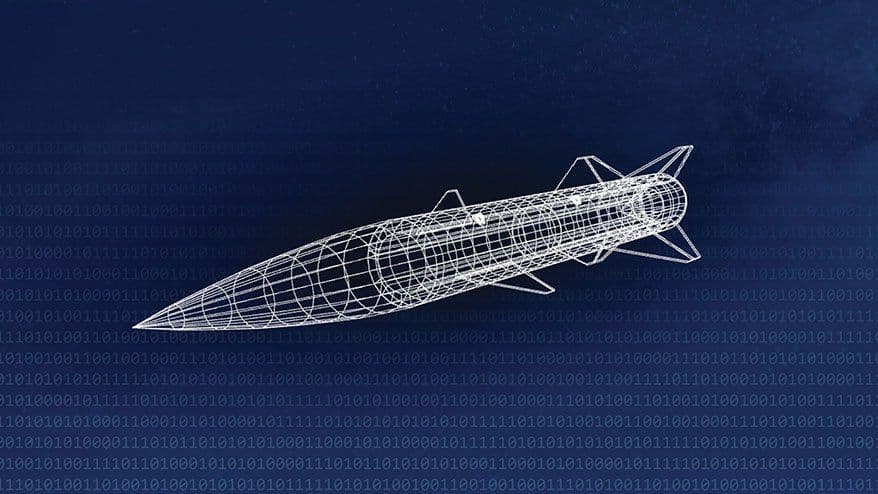
Hypersonic Missiles - A 21st Century Operational Need
Last updated 05:49 AM EST • Read time: 5m
Hypersonic missiles, capable of traveling at speeds in excess of Mach 5, will alter warfare’s strategic and operational environments in the 21st century. They are the technology that will drive and shape future near-peer or large-scale combat operations. Nations that possess hypersonic missiles will have a decisive advantage.
For the U.S., hypersonic missiles will provide Combatant Commanders with a responsive, precise, long-range strike capability—an invaluable capability which cannot be achieved today without placing a manned aircraft at risk. American-owned hypersonic missiles present a complementary capability that extends the limited reach of today’s strike or fires capabilities. They provide strategic reach, a new offensive layer that reduces sanctuary and redefines deep fires. The lessons of Ukraine affirm this need.
Time-sensitive targets—those fleeting, high-value, and high-payoff targets, which are often beyond the reach or responsiveness of today’s strike capabilities—will now be at risk of being rapidly targeted by hypersonic missiles. A hypersonic missile’s speed, coupled with a dynamic targeting process, will allow rapid response and effective fires to be placed on an adversary’s command and control systems or fleeting weapon systems.
Hypersonic missiles offer a solution to the anti-access/area-denial (A2/AD) strategy our primary adversaries have embraced. With hypersonic missiles, the U.S. will be able to penetrate and defeat an integrated air defense system from afar, as well as defeat an adversary’s long-range anti-ship capabilities, thereby enabling our air and naval forces the freedom to maneuver and mass fires at a time and place of our choosing.
A hypersonic missile’s speed and flight profile make it an extremely challenging target for a missile defense system. Knowing the U.S. possesses hypersonic missiles, which an adversary has little probability of defeating, will alter an adversary’s strategic calculus. Hypersonic missiles provide a credible, conventional deterrent to near-peer adventurism.
As the U.S. contemplates future strike capabilities, our adversaries are actively pursuing hypersonic weapons. Russia is developing its Avangard and Zircon hypersonic missiles and has demonstrated the value of long-range strike in Ukraine with its use of the Kinzhal, an air-launched ballistic missile. China is developing the DF-17, a hypersonic weapon to complement the DF-21, a foundational element of its A2/AD strategy.
North Korea and Iran are likely in the nascent stages of developing hypersonic weapons, and given their collaboration with Russia and China, technology transfer or wholesale export of hypersonic weapons may well be a future reality.
Too much is at risk for the U.S. to fall behind in our own development of these critical weapons. Each U.S. service has a hypersonic missile capability in development. The Army’s Long-Range Hypersonic Weapon (LRHW) will provide a land-based, responsive, flexible, and precision strike capability. The Navy’s Conventional Prompt Strike (CPS) will deliver a surface and sub-surface sea-based hypersonic weapon. The Air Force and Navy are developing air-launched hypersonic weapons: the Air Force’s HACM (Hypersonic Attack Cruise Missile) and the Navy’s HALO (Hypersonic Air-Launched OASuW or Offensive Anti-Surface Warfare Increment 2).
Collectively, the services’ capabilities offer a Combatant Commander a complementary strike package consisting of land, surface, sub-surface, and air-launched hypersonic missiles. The different launch domains are essential, as they provide the Combatant Commander flexibility, stealth, and rapid responsiveness to mass hypersonic fires across multiple attack azimuths, deep in the adversary’s rear areas, while complicating the adversary’s targeting processes and ability to defeat a strike.
The U.S. hypersonic missile programs are all promising initiatives that are long on optimism but short on test data and funding. The Army’s LRHW has recently had two successful flight tests after a series of 'no-test events,' but it is questionable if those are sufficient to support a planned 2025 fielding. The Navy will execute its first CPS sea tests on Zumwalt-class destroyers in 2027. Both cruise missile programs have spotty test records, with near-term fielding dates of 2027 for HACM and 2028 for HALO.
Rapid fielding is possible if programs have a comprehensive strategy that synchronizes efforts, compels cooperation and collaboration, and defines an aggressive test campaign that embraces failures as opportunities to learn. Hypersonic weapons are a new technological arena where a ‘test often fails fast, and learn’ mantra should be expected, embraced, and not feared.
The U.S. does not have the luxury of time or fiscal resources to squander on siloed development programs and timid test campaigns. The Department of Defense (DoD) requires a unified acquisition strategy to align the services’ efforts, leverage shared resources, and capitalize on insights from each service's program.
Congress must commit to a multi-year funding strategy for hypersonic weapons. Stable, predictable funding is essential to maintaining momentum in a high-tech, high-risk development effort. Hypersonic technology is critical to national security, and its funding is a strategic investment, not a discretionary expenditure. Predictable funding allows for sustained research, development, and robust testing of this game-changing capability.
To achieve and maintain its technological edge and assure national security, the U.S. must act quickly and decisively to formulate a comprehensive strategy for the development of hypersonic weapons. With the right strategy and funding, the U.S. can turn the challenges of hypersonic development into an opportunity to outpace competitors and secure its place as the global leader of the free world.
MG Francis G. Mahon (U.S. Army, ret.) is an independent aerospace defense contractor and an Advisor for Stellar Solutions, Inc. He previously served as Director for Strategy, Policy and Plans at North American Aerospace Defense Command and US Northern Command; Director for Test at the Missile Defense Agency; and Commanding General of the 32nd Army Air and Missile Defense Command.
Maj. Gen. Punch Moulton (U.S. Air Force, ret.) is a Senior Advisor at Stellar Solutions, Inc. after retiring from Vice President of Stellar Advisors. He previously served as the Director for Operations at US European Command, and as Director for the Standing Joint Force Headquarters at US Northern Command. He also served in multiple senior leadership positions both in US Forces Korea and US Forces Japan.

The Emerging SQUAD
By Muhammad Shoaib • RealClearDefense
Somebody Has to Hold the Ground
By Jay Rogers • RealClearDefense
U.S. Navy Shipbuilding: The Good, the Bad and the Ugly
By Brent Ramsey • RealClearDefense
The Services Do Not Need a Four-Star Autonomous Warfare Command
By Steven Wills • RealClearDefense
Honor Them While There Is Still Time
By Jeffrey Rosales • RealClearDefense

U.S. Military Gives Elon Musk’s SpaceX Access to Sensitive Tracking Data
By Guardian
USS McFaul Returns to Norfolk After 332 Day Deployment
By Sam LaGrone
The U.S. Shipbuilding Revival Is Taking Lessons Halfway Around the World
By WSJ
Hypersonic -Firing B-1B Lancer To Fly Into the 2040s
By Kris Osborn, Warrior MavenU.S. Navy Shipbuilding: The Good, the Bad and the Ugly
By Brent Ramsey, RCDefense