
Strategy Trumps Industry
Last updated 06:12 AM EDT • Read time: 8m
The United States is engaging in a dangerous exercise in bean-counting. The media hullabaloo over missile magazines and lengthy ship deployments is in fact a distraction from the real issue. American options to fight China, the premier power it faces, have narrowed so thoroughly as to make discussions of stockpiles grossly secondary to strategy. The U.S. must adopt a radically different posture to defeat China if war comes, one with the explicit expectation it will attack targets on the Chinese mainland. An offensive strategy, such as this, may secure deterrence, while fixating on the defensive approach of maximizing interceptor numbers, will raise the odds of war.
In the aggregate, the U.S. has expended a great deal of ordnance fighting Iran. According to open-source estimates, the U.S. has used roughly a quarter of long-range, air-launched cruise missiles (JASSMs) and anti-air and anti-ship Standard Missile 6s, a third of its Tomahawk cruise missiles, half of its Standard Missile 3 interceptors, and half or more of its remaining THAAD and Patriot interceptors. Concurrently, the U.S. has expended most of its short-range surface-to-surface missiles (ATACMS) and short-to-medium ground-launched missiles (PrSMs). The result, the commentariat tells us, is a catastrophe for Indo-Pacific deterrence.
Taking each system in turn, however, tells a different story when set against American military needs in Asia. The ATACMS and PrSM ground-launched missiles, for instance, have a limited role in an Asian conflict where U.S. strategy must aim to deprive China of its maritime capabilities. ATACMS is a ground-attack weapon, not an anti-ship ballistic missile. It lacks the range to hit Chinese targets unless deployed on Taiwan itself. Significant demand for ATACMS still exists – in Europe, where Ukraine and other European partners see it as a proven, reasonable-cost weapon for interdiction. PrSM has longer range. But it entered production only in 2023. Its use against Iran likely generated enormous quantities of mission data that enable modifications for a conflict in Asia.
More relevant are the Tomahawks, SM-6s, and JASSMs. These weapons are essential for degrading China’s surveillance and strike fortress, generated by its massive short-range missile arsenal. The former weapon is either ship or submarine launched. It moves relatively slowly and requires sequencing with other weapons. The SM-6, which can be used to intercept missiles and as an anti-ship missile alongside the more limited long-range anti-ship missile (LRASM), will degrade Chinese naval assets as would American submarines.
These weapons matter. But as relevant as “magazine depth,” the military term for how many remaining weapons are available, is the reality that these weapons are all designed to hit targets on or near the mainland. Just sinking the Chinese fleet is not enough. China’s fleet is already larger than the U.S. Navy. It operates near its bases and alongside ground-based missiles and land-based aviation. Indeed, the Chinese Navy is not simply its ships – it is this entire complex of weapons on the mainland that must be degraded.
It is here that discussion of interceptors becomes nonsensical.
The United States has a tremendous interceptor shortage. Its Middle Eastern allies and bases are exposed to Iranian missile and drone attacks because of it. This shortage has run across two administrations when viewed charitably, and more accurately has worsened every year since the Cold War’s conclusion. The shortage stems from familiar factors like sustained insufficient defense spending, and defense-sector consolidation that limits overall capacity. But it is also derived from bureaucratic reality: Army Air Defense Artillery is not a golden ticket to a high-ranking Joint Staff job, while naval surface warfare officers have multiple responsibilities, air defense being only one. Hence procurement, year-on-year, fell through the cracks.
Moreover, the interceptor issue is felt well beyond the Middle East. Ukraine is extremely exposed to Russian ballistic missile attacks for two reasons. The first is the lack of Patriot missile transfers to eminently capable Ukrainian air defense units. The second issue is the lack of offensive capacity to destroy Russian missile launchers, principally because the U.S. has restricted Ukraine from doing so.
The second issue is more illustrative than the first for the Indo-Pacific. China has 2,000-plus missiles that can hit targets across the First Island Chain, including the major U.S. base on Okinawa and other targets in Japan and the Philippines. The United States would not simply need another 1,000 Patriot interceptors to defend these bases. It would need another 10,000 at least – combined with new sensors to detect incoming munitions, new jammers to throw weapons off course, and extensive hardening of key facilities to prevent attacks on aircraft, munitions depots, fuel storage, and other crucial combat elements. Patriot production should reach 2,000 per annum by 2030, pushing the goal of 10,000 interceptors out to the mid-2030s at the earliest.
Under the best circumstances, missile defense is not an impenetrable shield. It is instead an effective parrying tool that must be combined with an offensive punch. A machine gun nest cannot be taken by protecting its assaulters in trenches: it must be actively destroyed by bomb or shell or infantryman. The United States demonstrated the fundamental soundness of its missile defense capabilities in the Iran War’s first six weeks. Despite a handful of successful strikes against American targets over 500 kilometers from Iran, the U.S. lost well under 100 total airframes, over half of which were unmanned systems. This overwhelming success stemmed from the pressure American and Israeli attacks put on Iranian missile launchers. Of course, Iran could hit installations along the eastern Gulf. But the Gulf is some 250 kilometers wide at most, compared to the distance from the Chinese mainland to the First Island Chain, which ranges from 150 kilometers to 700 kilometers.
American air defenses, therefore, are insufficient for close protection, but likely sufficient to defend specific high-value sites farther from China. The most obvious of these is Guam, the U.S.’ key logistics node in the Pacific. China has only a few dozen weapons that can reach targets at that range, making the so-called “air defense math” significantly more favorable for the defender. In turn, offensive attacks degrade launchers, not intercept missiles, thereby reducing the aggregate power of the adversary.
The Chinese understand this perfectly. This is why they have built both a layered offensive strike network and the world’s most dense air-defense system. They expect the United States, ultimately, to strike mainland targets. Thus, does any doubt about U.S. ability to destroy mainland targets multiply Chinese boldness.
The implication is that, rather than scrambling to buy interceptors at enormous scale – and discovering the supply chain for this expansion simply does not exist – the United States should focus on offense, not defense. Its current arsenal of SM-6, LRASM, JASSM, and Tomahawk is effective as a baseline. But three developments are necessary.
First, the U.S. should prioritize purchasing lower-cost standoff weapons like the Extended Range Attack Munition (ERAM) and other related missiles. Ukraine may be an enormous help here. Its intermediate and deep strike program leverages exactly these assets to hit exposed Russian targets, particularly using AI to improve tactical-level targeting by attacking the most vulnerable parts of a target. Some of these weapons may be ground-launched, delivered by U.S. Marine Corps Marine Littoral Regiments. Most, however, should be air-launched, by virtue of their improved physical characteristics and relative flexibility. The result is a need to ensure aircraft carriers remain in the fleet – the more flat-tops the U.S. has, the more sorties it can launch.
Second, the U.S. should supplement these low-cost missiles with many unmanned surface vehicles (USVs). These are dedicated anti-ship weapons, rather than anti-ship or ground-attack tools. But the USV, by virtue of its design, can carry a much higher proportion of explosives than a missile or aerial drone. Seeding these weapons along the First Island Chain in the hundreds, if not the thousands, presents a potent additional threat against the PLA Navy.
Third, and most important, the U.S. must make it a declaratory policy that it will begin any war with China by striking targets on the mainland. The only other alternative is a strategy of pure exhaustion, in which the U.S. engages in a long-term blockade and allows China to attack American allies in sequence, hoping that Chinese strategic hubris will simply exhaust itself over months rather than years.
Defensive tactics have brought relief to militaries since antiquity, for example the Spartans’ stand at Thermopylae. But only the Greek coalition’s offensives at Salamis and Plataea could turn back the Persian invasion. The same principle applies to a conflict in Asia: interceptors are necessary but not sufficient. Concern over the U.S. supply of interceptors must not distract from building the large arsenal of offensive missiles on which deterrence may, and victory must, depend.
Seth Cropsey is president of Yorktown Institute. He served as a naval officer and as deputy Undersecretary of the Navy and is co-author of Breaking the New Axis: A U.S. Grand Strategy for Eurasia published by the U.S. Naval Institute Press.
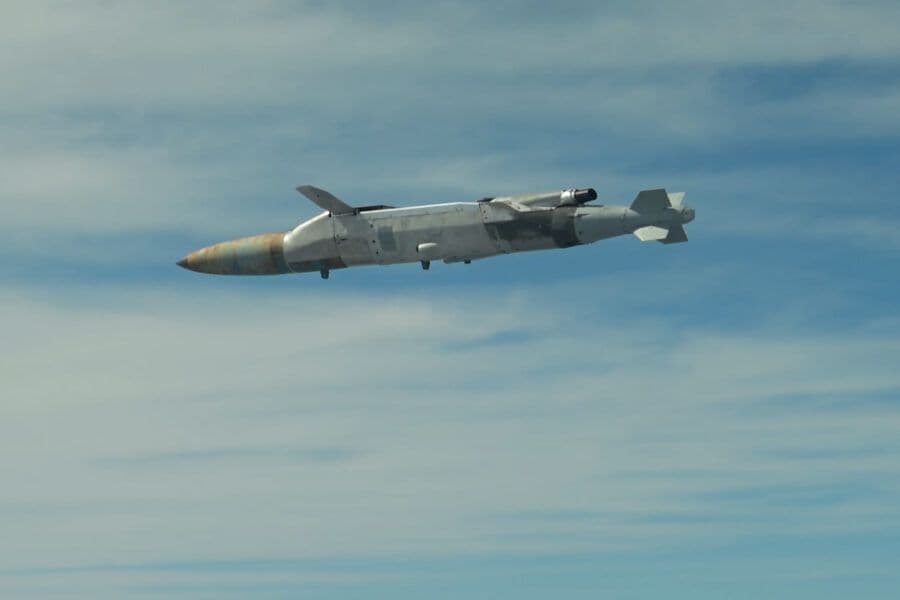
image: Boeing was awarded a $75 million production contract to begin supplying long-range JDAMs which will benefit pilots operating in contested environments. (Boeing)

ICE Is Not a Four-Letter Word
By Meda Parameswara Reddy • RealClearDefense
The U.S. Can Draw Down in the Middle East Without Going Blind
By Cudi Zerey • RealClearDefense
America Needs a Joseph Directive
By Jeff Ballabon • RealClearDefense
Partnering Decides Whether Flexible Military Construction Can Work
By Matt Russell • RealClearDefense
Eight Months of Epic Fury and Still No Internal Alternative
By Stephen D. Cook • RealClearDefense

GE Aerospace to Supply Engines for Two US Navy Flight III Destroyers
By Defense Post
U.S. Air Force Asks Industry for New Cruise Missile for Ukraine
By Michael Peck, DNews
First Flight II San Antonio-class Amphib Completes Builder’s Trials
By Mongilio, USNI N.
LGM-35 Sentinel ICBM on Track for 2030
By Kris Osborn, Warrior Maven
On American Destroyers, Avoid a Self-Inflicted Wound in Spain
By Defense News