
The Foundations of America's National Security Future
Last updated 06:59 AM EDT • Read time: 4m
As the United States strives to achieve its national security objectives around the world, it is becoming ever clearer that the foundations of its military strength must be steady and sure. In a world filled with challenging threats, anything else crumbles in the face of adversity.
The last four and a half years of war in Ukraine have unveiled the need for robust offensive drone capability and rigorous counter drone defenses. The conflict in the Middle East between the United States, Israel, and Iran has punctuated the need for the same.
Yet, the global situation has revealed that the United States is severely lagging while it seeks to affix itself to bedrock of national security success.
Amid its war for survival, Ukraine has created a dazzling industry of building drones and an amazing ecosystem of remaining on the cutting edge of drone technology. They are producing over four million drones a year for Ukrainian military forces while wreaking havoc on Russia’s military forces and economic underpinnings.
By comparison, the U.S. military has no such industry nor ecosystem. In fact, American forces only have 16,000 drones in its entire inventory, while Ukraine produces three hundred times more than that every single year.
If the United States is going to catch up to the cutting edge instead of fastidiously falling behind, then it needs to build and build fast. And all the needed industrial output needs to rest on cement foundations – safe, reliable, and responsive to American needs.
Similarly, U.S. weapon stockpiles have been depleted at a staggering rate, demonstrating a shortage to start with and a lack of military-related industrial capacity to keep up.
Even before the current war in the Middle East, a conflict over the Taiwan Strait would soon strain weapon stockpiles to untenable levels. In fact, expert analysis reveals the U.S. forces in the Western Pacific would burn through their high-end weapons in less than a week in such a conflict. Six months into the current war with Iran, the situation is now much worse than that.
Estimates from the Middle East indicate that the United States has used a significant portion of its worldwide weapon arsenal. Offense weapons, like Tomahawks, and defensive weapons, like Patriot and THAAD interceptors, are dangerously depleted.
Like with the drone industry, with conventional weapons the United States needs to build and build fast to replenish its stockpiles and to create a system of industrial production so that such shortfalls are quickly and irreversibly resolved. And once again, that industrial output needs to rest on cement foundations – safe, reliable, and responsive to American needs.
U.S. cement is a $150 billion industry, employing over a half a million American workers. Yet, policy shortfalls are eroding the U.S. market share, with foreign competitors tripling their foothold in the last decade. These competitors, including the Chinese cement juggernaut, offer a product that is often unsafe, unreliable, and unresponsive to America’s civilian and military needs.
The solutions are simple and long overdue. First, the Build America, Buy America Act must be amended to include cement alongside iron and steel in its federal building requirements. Second, on-going Section 301 investigations into anti-competitive foreign practices must thoroughly include a broader range of concerns that currently undermine America’s cement industrial foundations. These two policy prescriptions would level the playing field for American workers who are being undercut by harmful practices employed by overseas competitors.
The foundations of America’s national security future are perilously hinging on industrial capacity in both the drone industry and with respect to conventional military weaponry. Now is the time to ensure that those foundations are safe, reliable, and responsive to American requirements.
Brig Gen John Teichert (U.S. Air Force, ret.) is a leading expert on foreign affairs and military strategy. He served as commander of Joint Base Andrews and Edwards Air Force Base, was the U.S. senior defense official to Iraq, and recently retired as the assistant deputy undersecretary of the Air Force for international affairs. A prolific author and speaker, he can be followed at johnteichert.com and on LinkedIn.
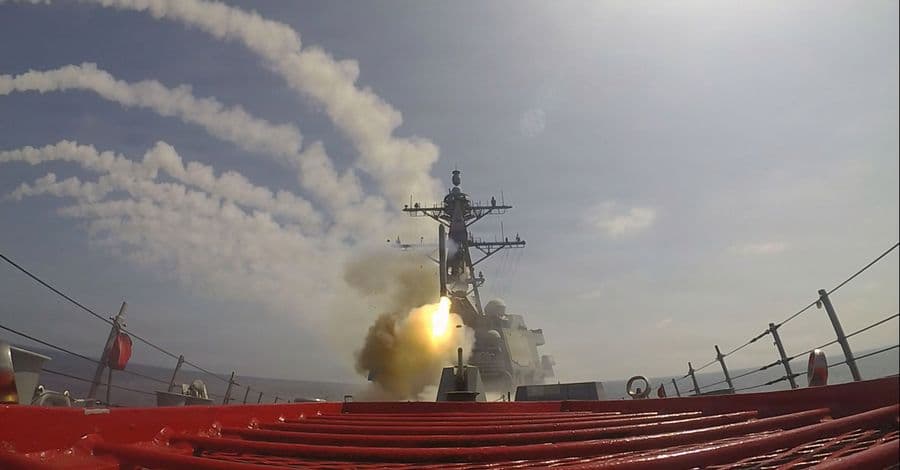
image: This image provided by U.S. Central Command shows the Arleigh Burke-class guided-missile destroyer USS Frank E. Petersen Jr. (DDG 121)) firing a Tomahawk Land Attack Missile (TLAM) in support of Operation Epic Fury, on Saturday, Feb. 28, 2026. (U.S. Navy via AP)

The Emerging SQUAD
By Muhammad Shoaib • RealClearDefense
Somebody Has to Hold the Ground
By Jay Rogers • RealClearDefense
U.S. Navy Shipbuilding: The Good, the Bad and the Ugly
By Brent Ramsey • RealClearDefense
The Services Do Not Need a Four-Star Autonomous Warfare Command
By Steven Wills • RealClearDefense
Honor Them While There Is Still Time
By Jeffrey Rosales • RealClearDefense

U.S. Military Gives Elon Musk’s SpaceX Access to Sensitive Tracking Data
By Guardian
USS McFaul Returns to Norfolk After 332 Day Deployment
By Sam LaGrone
The U.S. Shipbuilding Revival Is Taking Lessons Halfway Around the World
By WSJ
Hypersonic -Firing B-1B Lancer To Fly Into the 2040s
By Kris Osborn, Warrior MavenU.S. Navy Shipbuilding: The Good, the Bad and the Ugly
By Brent Ramsey, RCDefense