
The U.S. Military Could Have A Working Hypersonic Missile In Record Time
Published June 4, 2021 • Read time: 3m
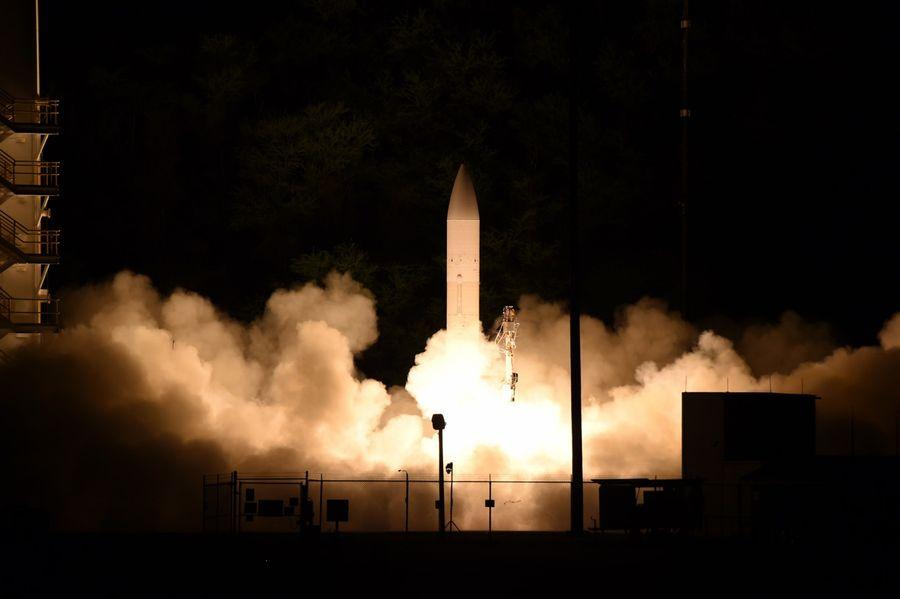
The U.S. Navy recently tested the motor that will power hypersonic missiles for both the Army and the Navy. The successful live-fire engine test paves the way for the Army’s Long Range Hypersonic Weapon and the Navy’s Conventional Prompt Strike to move forward.
“The first stage SRM will be part of a new missile booster for the services, and will be combined with a Common Hypersonic Glide Body (CHGB) to create the common hypersonic missile,” a Navy release stated. “Each service will use the common hypersonic missile, while developing individual weapon systems and launchers tailored for launch from sea or land. This successful SRM test represents a critical milestone leading up to the next Navy and Army joint flight test, which will take place in the first quarter of Fiscal Year 2022, and ultimately the fielding of the CPS and LRHW weapon systems.”
Both the Navy’s CPS and the Army’s LRHW programs aim to field a boost-glide hypersonic weapon, a type of hypersonic missile that like intercontinental ballistic missiles, requires a rocket booster to reach altitude, at which point the rocket payload — a glide body — would release and glide down to Earth. Gliding is a bit of a misnomer, however, as hypersonic glide bodies achieve blisteringly high terminal velocities in excess of Mach 5.
This class of weapons is noted for both the long-range and high altitudes they would achieve after launch, though the engineering challenges are enormous. Not only must hypersonic glide bodies survive high turbulence during reentry, but must also mitigate the incredible amount of heat generated when passing at hypersonic speeds through the Earth’s atmosphere, which increases with atmospheric density as altitude decreases.
U.S. and Australia Should Give ANZUS Teeth
How to Win Without Military Victory
Tailored Deterrence and Nuclear First Use in Europe
When Access Becomes the Fight
The potential advantages offered by fielding a viable hypersonic weapon are so great that a number of hypersonic missile programs in development throughout the United States military. One of these, the U.S. Air Force’s Hypersonic Attack Cruise Missile, would breathe new life into the United States incredibly long-lived B-52 bomber fleet by turning the old bombers into hypersonic missile-toting standoff platforms.
In contrast to some long-range hypersonic weapons like the joint Army-Navy endeavor, the Air Force’s HACM would rely on an air-breathing combustion engine — albeit a very high-performance engine. As the HACM is reliant on atmospheric oxygen for propulsion, it would in all likelihood have a shorter, lower flight profile when compared to longer-range hypersonic glide body-type missiles though would still reach hypersonic, Mach 5+ speeds.
“This live fire event is a major milestone on the path to providing hypersonic strike capability to the U.S. Navy and U.S. Army warfighters,” a Lockheed Martin press release stated. Hypersonics are one of the United States military’s top priorities and could enter service as early as the mid-2020s.
Caleb Larson is a defense writer based in Europe. He holds a Master of Public Policy and covers U.S. and Russian security, European defense issues, and German politics and culture.
This article appeared originally at 1945.

Iron Raven: Remembering Colonel Joseph B. Conmy, Jr.
By Louis Marano • RealClearDefense
Stand Proud of the Force
By Jay Rogers • RealClearDefense
How a Dying Agency Turned Fentanyl Into a Weapon of Mass Destruction
By Barry Angeline • RealClearDefense
The Pressure Is the Message: What Xi and Putin Faced in Shenzhen
By Emzari Gelashvili • RealClearDefense
China’s Revised Mobilization Law and the Expanding Reach of National Defense
By Muhammad Shoaib • RealClearDefense

Marine Corps Hero Under Federal Investigation
By Laporta, Burnham & Watson, CBS
A Postmortem of Maneuver Warfare in the U.S. Marine Corps
By Donald Vandergriff
U.S. Putting Weapons in Space: A Strategic Blunder?
By Ajey Lele • RealClearDefense
U.S. Senate Seeks to Exchange Shipbuilding Funds for More Munitions
By Naval News
F-35C Completes First Launch and Recovery Trials on a Ford-Class Carrier
By Navy T.