
No, NATO Does Not 'Need' Ukraine
Last updated 01:00 AM EDT • Read time: 4m
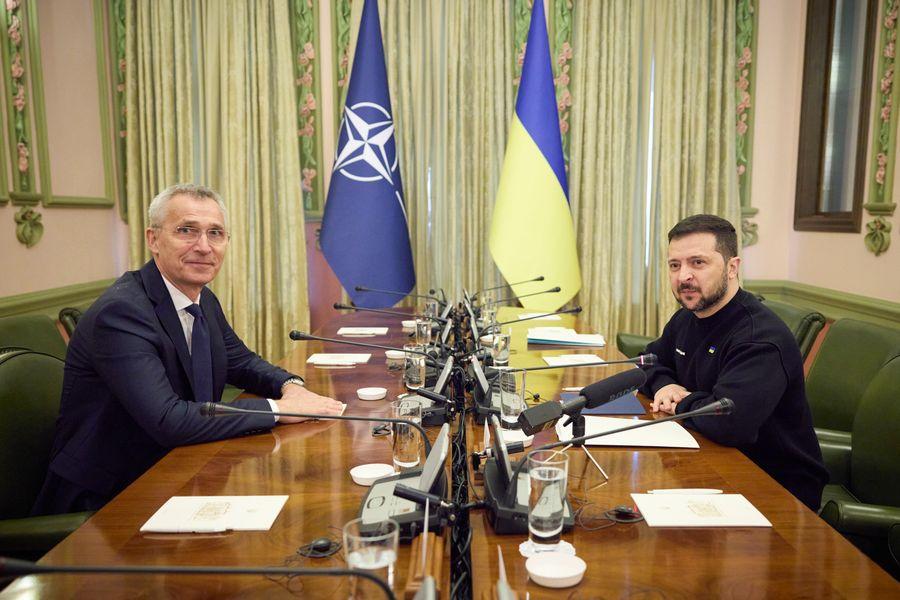
NATO Secretary General Jens Stoltenberg, left, and Ukrainian President Volodymyr Zelenskyy, right, during their meeting in Kyiv, Ukraine, Thursday, April 20, 2023. (Ukrainian Presidential Press Office via AP)
Ukraine’s Foreign Minister Dmytro Kuleba, writing in Foreign Affairs, calls upon the member states of NATO to issue a “clear written statement” that Ukraine will become a member of the alliance. Kuleba claims that “the best way to ensure Euro-Atlantic security is to welcome Ukraine into NATO.” NATO, he claims, “needs Ukraine” to preserve the “very foundations of the European security order formed after 1945.” Let’s subject the foreign minister’s claim to some logical scrutiny.
The post-1945 European security order pitted NATO’s original 12 member countries (who signed on in 1949) against the Soviet Union and its Warsaw Pact allies. Greece and Turkey joined NATO in 1952, West Germany became a member in 1955, and Spain joined in 1982. In the late 1940s-early 1950s, Ukraine was part of the Soviet Union along with the other 14 Soviet Socialist Republics. The Soviet-led Warsaw Pact--formed in 1955--included Poland, East Germany, Bulgaria, Romania, Albania, Hungary, and Czechoslovakia. That was the post-1945 European security order until the collapse of the Soviet Union and the dissolution of the Warsaw Pact in 1989-91. The U.S.-led NATO alliance did not “need” Ukraine to win the Cold War. Ukraine’s independence was a consequence of our Cold War victory.
Since 1999, NATO has added 19 countries to the alliance, including the former Soviet Socialist Republics of Estonia, Latvia, and Lithuania, and former Warsaw Pact members Poland, Hungary, the Czech Republic, Slovakia, Romania, Bulgaria, and Albania. In economic, military, and political terms, NATO--without Ukraine as a member--is far more secure today than it was during the 1945-1989 security order. Russian military power today--as evidenced by the difficulties they are experiencing in the Ukraine war--is far less formidable than Soviet military power was during the Cold War. Yet Foreign Minister Kuleba asserts that Ukraine’s admission to NATO is essential to the long-term security of the Euro-Atlantic community.
It is entirely understandable that Ukraine wants to join NATO and gain what Kuleba calls “the protection of Article 5, which requires members to treat an armed attack against one or more members in Europe or North America as an attack against them all.” And Ukraine’s defiance in the face of Russian aggression is admirable and praiseworthy. But neither of those facts prove that NATO “needs” Ukraine in order to preserve its long-term security.
Kuleba writes that Ukraine’s goal is “winning a just victory that guarantees peace and stability in Europe for generations to come.” A Ukrainian victory would surely be “just,” but it is doubtful that it would guarantee “peace and stability in Europe for generations.” Geography and history cannot be ignored.
George Kennan, who knew a thing or two about Russia, wrote in Foreign Affairs in 1951 that “Ukraine is economically as much a part of Russia as Pennsylvania is a part of the United States.” And in April 1997, Kennan wrote a letter to then-Deputy Secretary of State Strobe Talbot warning that Ukraine’s future relations with NATO were “pregnant with fateful consequences.” Kennan noted that recent NATO naval exercises with Ukraine in the Black Sea were viewed in Moscow as anti-Russian and undermined Western assurances that “the extension of the NATO borders toward the Russian frontier in Eastern Europe has no immediate military connotations.” After Russia invaded and seized Crimea from Ukraine in 2014, President Obama observed that Ukraine is a core interest for Russia, but not for the United States. Asia Times Deputy Editor David Goldman recently observed that “Russia regards [Ukraine’s] inclusion in NATO as an existential threat.”
Continually poking the nuclear-armed Russian bear with what it perceives as an existential threat to its security is not a recipe for “peace and stability in Europe.” It is, at best, a recipe for a costly, prolonged struggle in Europe reminiscent of the Cold War, and, at worst, a recipe for disaster.
Francis P. Sempa is the author of Geopolitics: From the Cold War to the 21stCentury, America’s Global Role: Essays and Reviews on National Security, Geopolitics and War, and Somewhere in France, Somewhere in Germany: A Combat Soldier’s Journey through the Second World War. He has written lengthy introductions to two of Mahan’s books, and has written on historical and foreign policy topics for The Diplomat, the University Bookman, Joint Force Quarterly, the Asian Review of Books, the New York Journal of Books, the Claremont Review of Books, American Diplomacy, the Washington Times, The American Spectator, and other publications. He is an attorney, an adjunct professor of political science at Wilkes University, and a former contributing editor to American Diplomacy. Mr. Sempa also writes a monthly column for RealClearDefense including his latest "Washington and Ike's Warning On Foreign Policy Greed"

Counterterrorism and the Growing Convergence in Homeland Security and Homeland Defense
By Austin Doctor • RealClearDefense
The Future of Space Power Depends on Integration
By Damian DiPippa • RealClearDefense
America Should Unleash Cyber Privateers
By Jacob Schelp • RealClearDefense
America Invented the Battery, but China Controls the Factory
By William Crane • RealClearDefense
A Defense Win for Americans and Israelis in Arkansas
By Bradley Bowman • RealClearDefense

F-16s Build on Iran Combat Lessons to Prepare for China Threat
By Rebecca Grant • Lexington Institute
Key Space Force Satellites Can’t Talk to Each Other
By T. Hitchens, Breaking Defense
Blue Angels Pilot Scott Laux Removed for Failing To Uphold Standards
By Johnson, PNJ
The Future of the Ground Reconnaissance Enterprise
By Joe Albano, The Connecting File
The Future of the ARG/MEU
By William Yale, Proceedings