
The Atlanticists Want America To Keep Its Dependent Child–Europe
Published May 17, 2024 • Read time: 6m
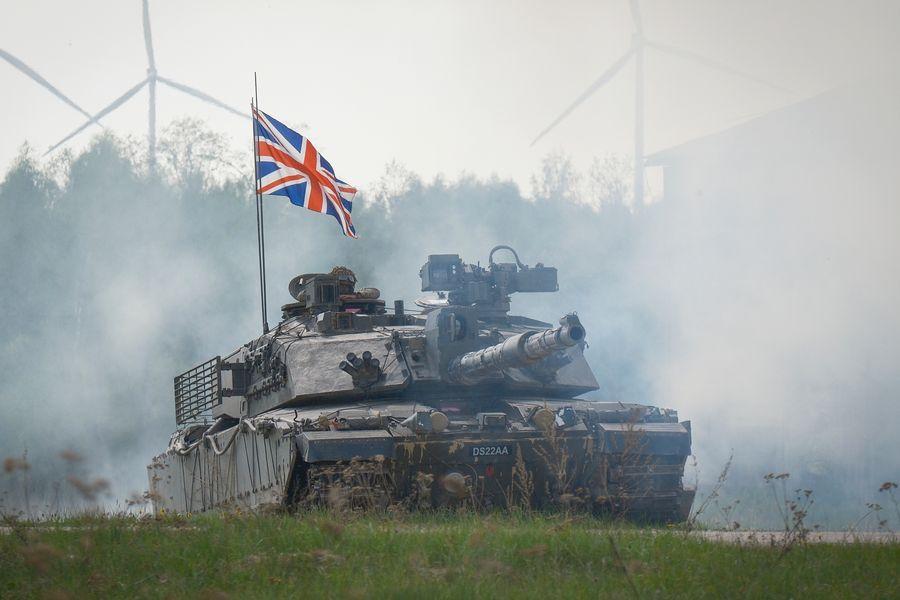
A Challenger 2 main battle tank of the British forces during the NATO's Spring Storm exercise in Kilingi-Nomme, Estonia, Wednesday, May 15, 2024. The Spring Storm exercise is taking place within the larger framework of the NATO Steadfast Defender exercise which is the largest NATO exercise since the end of the Cold War. (AP Photo/Hendrik Osula)
Three members of the Atlantic Council waded-in to the 2024 U.S. presidential campaign by declaring in Foreign Affairs that if Donald Trump returns to the White House the North Atlantic Treaty Organization (NATO) will die and European security will be at the mercy of Vladimir Putin’s Russia. “A second Trump presidency,” they write, “could have dire implications for European security.” Trump, they predict, will withdraw from the alliance and NATO will likely fall apart.
Hans Binnendijk, R.D. Hooker, Jr., and Alexander Vershbow have estimable credentials. Binnendijk served on the National Security Council staff under Presidents Ford and Clinton, and also served as Acting Director of the State Department’s Policy Planning Staff in the early 1990s. Before that, he served as a staffer for the Senate Foreign Relations Committee. Hooker served in the U.S. Army, including multiple combat tours, as an aid to the Chairman of the Joint Chiefs of Staff, and on the National Security Council staff. Vershbow served as Assistant Secretary of Defense for International Security Affairs and Deputy Secretary General of NATO during the Obama administration. All three are unabashed Atlanticists for whom NATO is, in their words, “the world’s most successful military alliance.” They take pride in celebrating NATO’s 75th anniversary, and if it is up to them NATO will endure for 75 more years. That is the way institutions and bureaucracies work. Their job never ends even, as in the case of NATO, when it accomplishes its mission which was to militarily defend its members from the Soviet empire.
NATO was formed in the wake of Europe’s devastation as a result of the Second World War and the very real looming threat of Josef Stalin’s Soviet Union. What Winston Churchill called the “iron curtain” had descended across Eastern and parts of Central Europe. The sovietization of that region, Soviet moves in Greece and Turkey, and Stalin’s efforts to force the Western powers from Berlin signaled a politco-military threat that had to be contained. If Western Europe were to fall into Stalin’s clutches, the global balance of power would shift in the Soviet’s favor. Importantly, the Soviet Union was a revolutionary power that sought to communize as much of Europe and the rest of the world as they could. The Cold War was, as the title of James Burnham’s memorable book asserted, a “struggle for the world.”
The Cold War struggle had two components: ideology and geopolitics. The latter, as both Richard Nixon and Ronald Reagan recognized, proved to be more important than the former. But the Soviet threat would not have been as existential were it not for the ideology of communism. That revolutionary ideology gained loyal adherents throughout the world, including inside the United States. And there was a very real threat of Soviet tanks and troops bludgeoning their way across Europe to the English Channel. As Edward Luttwak noted in his book The Grand Strategy of the Soviet Empire, Soviet conventional forces had overwhelming superiority in numbers vis-a-vis NATO and an offensive strategy designed to enable them to conduct a blitzkrieg-like attack that U.S. and NATO forces would have been unlikely to stop without the use of nuclear weapons. Russian/Soviet scholar Richard Pipes believed, however, that Soviet strategic doctrine counseled the first-use of nuclear weapons in the event of war with the West. NATO and the American nuclear umbrella were, therefore, essential in preventing the Soviet conquest of Western Europe.
The Soviet threat collapsed in 1989-1991. The communist empire dissolved as a result of systemic weaknesses made worse by Western pressure. Russia’s political future was fluid, but its geopolitical threat was gone. Its one remaining element of great power status was (and is) its nuclear weapons. The U.S. and Europe’s response to Russia’s greatly diminished power was to expand NATO. During the next 30 years, NATO doubled in size, pushing its eastern borders closer and closer to Russia. Today, Russia’s GDP is about 15 percent of Europe’s GDP. Russia has about one-third of the population of Europe. Yet, according to our Atlanticists, without the United States it is likely that NATO will collapse, and even if it doesn’t collapse a “rump NATO” would be no match for Russia, which the three Atlanticists characterize as “a major power bent on overturning the liberal international order.”
Even if Russia’s goal is to overturn the liberal international order, its failures in Ukraine demonstrate that it lacks the military capacity to do so. The European members of NATO have the population and resources to more than adequately counterbalance the Russian threat, but they lack the will to do so. For 75 years, Europe has been the dependent child of the United States, relying on American military might, including its nuclear umbrella, for its ultimate security. Dependency can become a habit even when objective conditions and circumstances would signal that it is no longer necessary. That has been the case with NATO for at least the last 30 years. As Rajan Menon and Daniel DePetris wrote last year, “Europe doesn’t need the United States anymore.”
As any parent knows, parting with your dependent children can be traumatic but it needs to happen for their own good. Seventy-five years of dependency is quite enough. If Donald Trump regains the presidency and withdraws from NATO, the world will not come to an end. Russia will still be bogged down in Ukraine. And any such U.S. withdrawal would likely be gradual, allowing for the dependent child to slowly gain its independence. During this transition, the parent will still help with support here and there, but eventually most dependent children find their own way to provide for themselves. Europe needs, for its own sake, to break the bonds of dependency and provide for its own security. Then, the United States can focus its resources on the real existential threat in the western Pacific.
Francis P. Sempa is the author of “Geopolitics: From the Cold War to the 21st Century” and “America’s Global Role.” Francis is also writes the montly Best Defense column for RealClearDefense. Read his latest: Ukraine and the Pity of War.
After the Midterms, the Right Strategy Against Iran
By Lance Gordon • RealClearDefense
The Color Revolution Came Home
By Emzari Gelashvili • RealClearDefense
When Access Becomes the Fight
By Richard Byno • RealClearDefense
What the 2026 Midterm Results Mean for U.S. Strategic Competition with Rivals
By Dean Chen • RealClearDefense
Measurable by Design: Project Meridian
By Alex Willard • RealClearDefense

New USAF Force Design Bets on Technology
By Stephen Losey, Air & Space Forces
DoD Pushes $450M in Loans To Bolster U.S. Space Companies
By Hitchens, BrDefense
The U.S. Navy Needs a New Battlecruiser. Will It Get One?
By Sadler & Ouellette, NatInt
U.S. Army Rehearses Rapid HIMARS Rocket Launcher Deployment
By Global Defense N.
Coding Commander's Intent into Unmanned Systems
By Thomas Baumstark, Proceedings