
China's Aircraft Carriers: Bark or Bite?
Published April 17, 2020 • Read time: 4m
Here's what we know.
While one of the United States’ aircraft carriers, the USS Theodore Roosevelt is dealing with a corona virus outbreak that has now become deadly, one of China’s aircraft carriers sailed past Taiwan in a show of force. Though Taiwan scrambled jets to intercept and monitor the sail-by, it was perhaps not the best moment for the U.S. Navy.
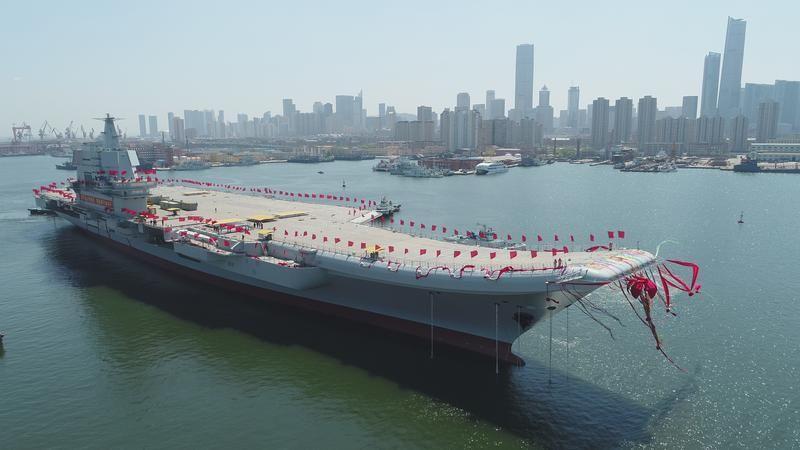
China currently has two carriers and a third in the shipyard, with a fourth planned. But what is the Chinese aircraft carrier program like? Here is China’s carrier fleet.
Yesterday’s Carriers, in Use Today
China currently has two aircraft carriers, with a third in early construction, and a fourth planned for sometime in the mid 2020 or 2030s. Their first carrier, the Liaoning was commissioned by the PLAN in 2012, though it was first laid down in the early 1990s. It was an unfinished Ukrainian carrier, inherited from the Soviet Union, which was then sold to China.
China’s second carrier, the Type 002, was essentially a copy of the Liaoning, though it did feature some incremental improvements including upgraded radar, and increased fighter capacity. Like the Liaoning, it features a large ski jump above the bow that helps launch jet fighters into the air.
Type 003
The Type 003 will be larger than both the Type 002 and the Liaoning, and have a steam catapult launch assist system similar to what the United States uses on aircraft carriers—and thus will likely dispense with the ski-jump bow launch assist platform.
In an interview with The National Interest, an expert on China’s naval abilities said that “the third carrier will be an attempt at…steam catapults and hydraulic arresting gear that will allow China to launch aircraft with heavier bomb loads and go longer ranges.”
The Readiness Cliff: Pacific Lessons Drawn from the Middle East
Not Like the Old Days: Modern Sea Control Will Be Episodic and Local
To Build Golden Fleet Frigate Fast, Two Shipyards are Needed
Building Durable Demand for American Ships
Another expert concurred, saying that “It [the Type 003] will also likely be larger than the Type 001 or the Liaoning, enabling it to carry more aircraft. The PLAN also wants to expand the range of their carrier-based aircraft, and more importantly, they need to be able to launch early warning and electronic warfare aircraft as well as larger fighter-bombers that can carry more weapons. They need catapults and arresting gear to deploy these kinds of aircraft.” So more fighters, and better armed.
Type 004
The Type 004 would be the most advanced of China’s aircraft carriers once completed and would be considered a third-generation aircraft carrier. In addition to electro-magnetic launch capabilities, the Type 004 would be the first aircraft carrier in China’s navy that would use nuclear propulsion. It would also have enough power output to power railgun or laser weapons that are currently in development and testing.
China reportedly spent over $3 billion researching a unique molten salt nuclear reactor that could be used to propel the Type 004. It purportedly generates more heat, which can be converted to electricity, and creates only a fraction of the radiation as uranium-powered reactors.
The first hull is expected in the late 2020s or possibly later, though details about the People’s Liberation Army Navy are notoriously difficult to come by.
Tomorrow’s Aircraft Carriers…Tomorrow?
China definitely still has a long way to go. Two aircraft carriers that are based on 1980s technology are in no way close to as capable as modern nuclear-powered carriers. Still, China has progressed in leaps and bounds. If the Type 003 and Type 004 can put their money where their mouth is—if they are as capable as projected by western analysts and as claimed by the Chinese—then they would indeed be a force to be reckoned with.
Caleb Larson is a Defense Writer with The National Interest. He holds a Master of Public Policy and covers U.S. and Russian security, European defense issues, and German politics and culture.

Iron Raven: Remembering Colonel Joseph B. Conmy, Jr.
By Louis Marano • RealClearDefense
Stand Proud of the Force
By Jay Rogers • RealClearDefense
How a Dying Agency Turned Fentanyl Into a Weapon of Mass Destruction
By Barry Angeline • RealClearDefense
The Pressure Is the Message: What Xi and Putin Faced in Shenzhen
By Emzari Gelashvili • RealClearDefense
China’s Revised Mobilization Law and the Expanding Reach of National Defense
By Muhammad Shoaib • RealClearDefense

Marine Corps Hero Under Federal Investigation
By Laporta, Burnham & Watson, CBS
A Postmortem of Maneuver Warfare in the U.S. Marine Corps
By Donald Vandergriff
U.S. Putting Weapons in Space: A Strategic Blunder?
By Ajey Lele • RealClearDefense
U.S. Senate Seeks to Exchange Shipbuilding Funds for More Munitions
By Naval News
F-35C Completes First Launch and Recovery Trials on a Ford-Class Carrier
By Navy T.