
Could Canada Contribute to Operation Epic Fury?
Published March 13, 2026 • Read time: 7m
The confrontation between the United States, Israel, and Iran is already pushing beyond the bounds of a limited exchange of strikes. Regional bases have taken hits. Shipping in the Gulf is beginning to feel the pressure. Conflicts in this part of the world rarely remain tidy once force enters the equation. They tend to widen—across proxy networks, across maritime chokepoints, sometimes across the alliance structures that sit behind them.
If the fighting continues to expand, allied governments will eventually face a practical problem. Regional wars generate operational demands that go beyond the forces directly involved. Maritime security missions have to be reinforced. Intelligence networks become more active. Logistics pipelines expand to sustain ongoing operations. The pressure for coalition participation tends to follow.
Canada is already tied into that system in practical ways that matter once a conflict starts to spread. The country is tightly woven into the operational networks that underpin Western military cooperation—intelligence sharing through Five Eyes, maritime security frameworks that operate in and around the Gulf, and the logistical systems that help sustain multinational deployments once they begin.
Which means the central issue is not whether Canada would want to take part in a widening confrontation with Iran. Political hesitation in Ottawa is easy to imagine. The more relevant question is what Canada could actually contribute if events, alliance expectations, or simple geopolitical gravity begin pushing things in that direction.
Canada is not a large expeditionary military power. It does not field the kind of combat formations that decide regional wars. What it does possess are several capabilities that tend to plug into coalition operations in more limited but still meaningful ways. Intelligence cooperation is one. Naval deployments are another. Logistical and enabling support form the third.
Those are the places where Canadian participation would most likely appear if the conflict widens. They are also the places where the limits of Canadian military power become visible.
Intelligence: Canada’s Quiet Role
Canada’s first contribution would almost inevitably come in the intelligence realm. Ottawa is firmly entrenched in the Five Eyes community, one of the most integrated intelligence-sharing networks on the planet. Via the Communications Security Establishment and associated organizations, Canada provides signals intelligence and analytical capability that flows directly into the operational picture available to commanders.
That role is easy to underestimate because it operates largely out of public view. Warships and combat aircraft dominate the headlines. Intelligence cooperation rarely does. Yet modern military campaigns depend heavily on the ability to track what an adversary is doing in real time—missile preparations, command networks, communications patterns inside military systems.
Signals intercepts and collaborative analysis help produce that picture. Canada is part of the machinery that generates it.
In a widening conflict with Iran those capabilities would matter. Tracking missile launches across the region and monitoring Iranian command structures depend on a dense intelligence architecture linking allied states. Canada is embedded in that architecture. Its role would not be the most visible part of the coalition effort, but it would be one of the earliest.
Naval Presence: The Visible Contribution
The most visible Canadian participation would likely be at sea. Shipping in the Persian Gulf and Strait of Hormuz is already being threatened. Coalition naval patrols will likely increase as a result. Safe passage has been a preoccupation during Gulf crises for decades, and multinational naval exercises are now common when tensions escalate.
One mechanism for that kind of cooperation already exists. The Combined Maritime Forces is a multinational naval coalition based in Bahrain. It works with member nations to help conduct security operations in the Arabian Sea, the Gulf of Oman, as well as the Persian Gulf. Scores of nations are involved with it in some form. Vessels are routinely rotated into and out of task forces that help patrol areas and keep shipping lanes open. Whenever there are tensions in the Gulf that require additional naval forces, it's usually within the coalition's framework that they operate.
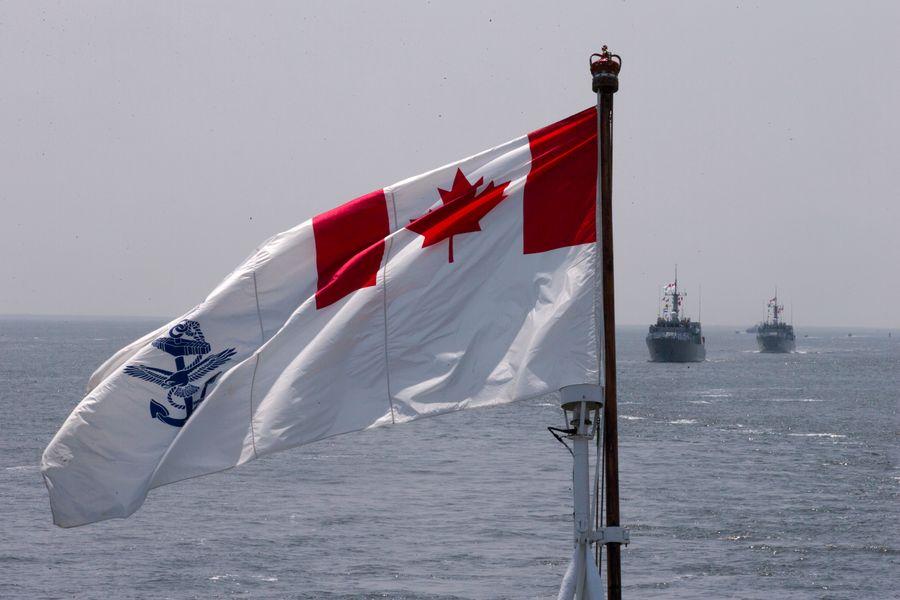
Canada has participated in these operations previously. RCN frigates have been intermittently committed to Operation Artemis, Canada's contribution to the counterterrorism / maritime security patrols performed by Combined Task Force 150. Canadian officers have also served in the coalition command structure in Bahrain.
If the current conflict expands further at sea, a similar contribution would be the most plausible form of Canadian military involvement. A Royal Canadian Navy frigate operating alongside American and partner vessels would therefore be the most obvious form of participation. Even a modest naval deployment would carry political weight. It would signal that Canada remains willing to share the burdens associated with maintaining maritime security in a volatile region.
But naval deployments also reveal the limits of Canadian capability. The Royal Canadian Navy operates a relatively small fleet of surface combatants, the majority of which are already committed to the North Atlantic and the Indo-Pacific. Given these pre-existing obligations, Canada could almost certainly contribute a ship to coalition patrols in the Gulf. What it could not easily do is maintain multiple deployments or a large operational footprint in the region.
Logistics and Support
Coalition warfare relies not just on fighting forces. Transport aircraft supply lines and logistical organization are vital to enable large-scale military operations. Without those systems even the most powerful combat formations struggle to operate effectively.
Canada could contribute to that infrastructure. Royal Canadian Air Force transport aircraft and support personnel could assist with moving equipment and personnel across the theater. These enabling roles have long been a feature of Canadian participation in multinational operations.
Such contributions rarely attract dramatic attention. They do not carry the symbolism of combat deployments. Yet they remain essential to coalition warfare. Military campaigns run on logistics as much as firepower. The ability to move supplies and rotate personnel while sustaining forward operations over long distances is what allows coalitions to function.
Canada has often participated in this quieter layer of military activity. A widening conflict with Iran would likely draw on those same capabilities.
The Limits of Canadian Military Power
Taken together, intelligence cooperation, naval deployments, and logistical support represent the most plausible forms of Canadian participation if the conflict expands. Each reflects an area where Canada retains useful capabilities. Each also points toward the structural limits facing the Canadian Armed Forces.
Canada maintains professional armed forces and specialized assets. What it lacks is scale. Years of procurement delays and aging equipment, along with relatively modest defense spending, have constrained the country’s ability to sustain large expeditionary operations far from home.
That reality has been discussed in Ottawa for years. A widening regional conflict would simply make it harder to overlook.
This creates a recurring tension in Canadian strategy. Ottawa remains politically aligned with Washington and deeply embedded in Western security institutions. Canada participates in NATO operations and contributes to Five Eyes intelligence cooperation while maintaining close operational ties with the United States across multiple domains. Yet when crises escalate into sustained military campaigns, Canada’s ability to shape events directly remains limited.
A War That Would Clarify Canada’s Role
If the confrontation with Iran widens further, Canada will almost certainly support its allies in some fashion. Intelligence sharing would intensify. A naval deployment might follow. Logistical contributions could expand alongside coalition operations. None of those steps would be insignificant.
But they would also highlight a broader reality about Canada’s place in the Western alliance system. Ottawa sits firmly inside the institutional architecture that organizes collective responses to global crises. When force is actually used, however, Canada’s role often lies closer to the margins of the battlefield than the center.
Wars have a way of clarifying those structural realities. A wider confrontation with Iran would make those realities harder to ignore.
Andrew Latham, Ph.D., a tenured professor at Macalester College in Saint Paul, Minnesota. He is also a Senior Washington Fellow with the Institute for Peace and Diplomacy in Ottawa and a non-resident fellow with Defense Priorities, a think tank in Washington, D.C.
End the Jones Act Waiver
By Mark H. Buzby • RealClearDefense
Prediction Markets Are Becoming a New Frontline for Military Operational Security
By Yang Yunke • RealClearDefense
Can Robots Bring Maneuver Warfare Back?
By Ayeza Areej • RealClearDefense
Buy Smarter, Fly More
By Jeff Kojac • RealClearDefense
Stop Gutting the Conventional Army
By R.D. Hooker, Jr. • RealClearDefense
Hung Cao Facing Contentious Confirmation To Become Navy Secretary
By Konstantin Toropin • Associated Press
U.S. Marines Expand M27 Rifle Contract
By Inder Singh Bisht
Kadena AFB Gets First F-15EX Eagle IIs
By Emily Ryan Miller, Defence BlogHung Cao Facing Contentious Confirmation To Become Navy Secretary
By AP
Fair Winds, Peacoat and Desert Camo: Navy Makes Big Changes to Seabag
By MTimes