
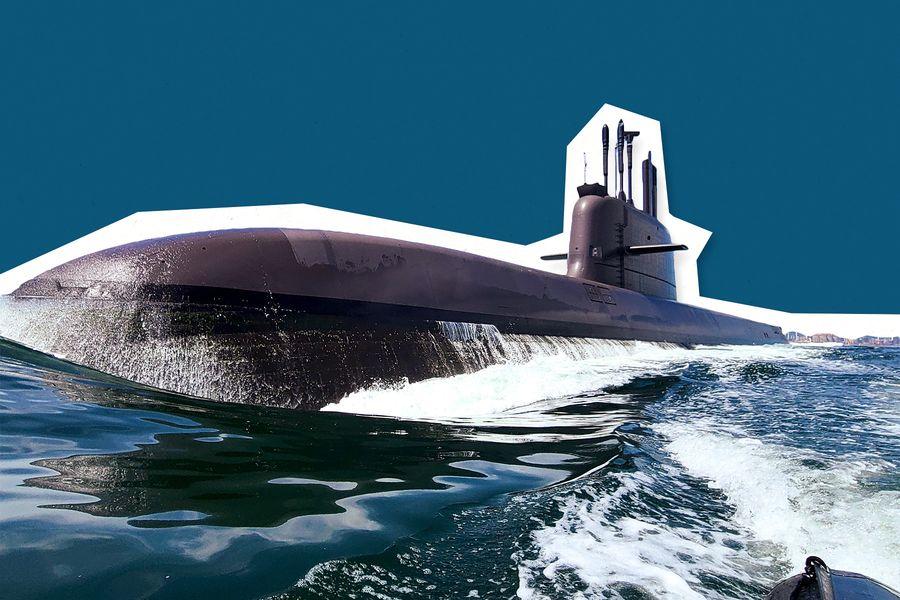
Undersea Drones and the Future of the Royal Canadian Navy
Published Feb. 24, 2026 • Read time: 6m
Canada’s long-anticipated move toward a new submarine fleet has pulled the undersea domain back into strategic focus. Range, endurance, and Arctic operability now sit near the center of naval recapitalization discussions. That shift is overdue. Submarines remain among the few platforms able to operate discreetly across the maritime approaches that shape Canada’s security environment.
But the debate unfolding in Ottawa is narrower than the problem it is meant to solve. It treats undersea security largely as a platform question when it is becoming something broader. Securing Canada’s Arctic and North Atlantic approaches will depend not only on the submarines it acquires, but on whether those boats operate inside a wider architecture of autonomous systems built to sustain awareness across the seabed itself.
Why Submarines Alone Cannot Secure the Domain
Even a modernized submarine fleet will operate under structural constraints. Hull numbers will be limited. Patrol cycles will rotate through maintenance and transit. Coverage across the Arctic Basin and the North Atlantic approaches will remain intermittent rather than continuous.
This is not a criticism of submarine capability. It reflects the operating realities of crewed platforms. Submarines concentrate immense capability in small numbers. They excel at stealth collection and deterrent signaling. They are less suited to maintaining constant watch over fixed infrastructure or wide seabed corridors.
Presence can be established. Persistence is harder to sustain.
Enter the Autonomous Layer
Uncrewed underwater vehicles begin to alter that operational geometry. Autonomous systems extend surveillance reach without imposing crew risk or sustained patrol overhead. They can remain deployed longer. They can operate beneath ice. They can revisit mapped terrain repeatedly rather than episodically.
Canadian defense research has already edged into this space. Work conducted through Defence Research and Development Canada has examined underwater sensor deployment, under-ice detection, and the use of autonomous vehicles in Arctic monitoring missions. Field trials such as the Canadian Arctic Underwater Sentinel Experiment (CAUSE) placed surveillance technologies in ice-covered transit corridors to test their performance in real conditions — less as stand-alone platforms than as part of a wider effort to improve awareness in waters where crewed patrols remain intermittent. These efforts remain developmental, but they signal the direction of travel.
The issue now is less about whether these systems will be useful and more about how deeply they will be embedded once submarine recapitalization moves from concept to fleet reality.
The Seabed as Strategic Terrain
The undersea contest is not confined to submarine tracking. It extends downward to the infrastructure that carries financial data, military communications, and civilian connectivity across the Atlantic and into Arctic corridors. Fiber-optic cables form the circulatory system of the digital economy. Their vulnerability has shifted from theoretical concern to operational planning factor.
Allied attention to seabed infrastructure protection reflects that change. Sabotage can occur below traditional thresholds of armed conflict. Attribution is slow. Repair timelines stretch. Strategic effects accumulate quietly rather than explosively. Monitoring these networks requires sustained seabed awareness, not periodic patrol passage.
Civilian research infrastructure already operates in this environment. Sensor arrays managed by Canadian institutions such as Ocean Networks Canada collect acoustic and environmental data for scientific purposes. Their presence underscores how much of the seabed is already wired and observed.
The military implication follows naturally. Infrastructure corridors will require monitoring regimes able to detect interference early rather than after disruption has occurred.
Arctic Sovereignty Beneath the Ice
The Arctic amplifies every one of these pressures. Surface patrols remain constrained by ice and distance. Aerial surveillance can provide coverage overhead, but not below. Submarines can operate under ice, yet they cannot maintain uninterrupted presence across the full expanse of Canada’s northern approaches.
Autonomous systems offer one of the few scalable methods of extending awareness into this environment. Under-ice vehicles can survey seabed routes, revisit choke points, and relay anomalies back to crewed assets. They do not replace submarines. They widen the surveillance envelope those submarines operate within.
Sovereignty becomes less episodic when sensing becomes continuous.
Mine Warfare as Operational Proof
Autonomy in the undersea domain is not theoretical. It is already entering operational use through mine countermeasure missions. Canada has participated in allied exercises integrating uncrewed systems into mine detection roles, including multinational trials tied to NATO’s evolving autonomous mine warfare toolkit. These systems conduct seabed surveys and identify hazards before sailors are placed at risk.
Mine warfare offers a useful adoption pathway. It begins in mission sets where autonomy provides immediate operational advantage. Over time, those systems migrate into broader surveillance and infrastructure security roles. Canada’s involvement in autonomous mine countermeasures places it within that evolutionary stream rather than observing from the sidelines.
Allied Integration Pressures
Canada’s undersea posture does not exist in isolation. NATO has elevated seabed infrastructure protection within its maritime security agenda. Allied navies are experimenting with autonomous platforms designed to monitor cable routes and energy corridors. Data-sharing frameworks are evolving alongside these efforts.
Geography assigns Canada a role whether it seeks one or not. North Atlantic infrastructure routes intersect Canadian areas of responsibility. Arctic approaches form part of the wider transatlantic security envelope. Integration of autonomous capabilities will be driven partly by alliance interoperability demands as much as by national procurement timelines.
Experimental Phase, Not Operational Maturity
None of this suggests Canada already fields a mature robotic undersea force. Current activity remains concentrated in research streams, trial deployments, and limited mission integration. There is no large autonomous fleet. Dedicated seabed warfare doctrine has yet to fully emerge.
Surveillance remains episodic rather than sustained.
That gap defines the policy hinge. Canada is neither absent from undersea autonomy nor fully invested in it. It occupies an intermediate phase where technological feasibility has been demonstrated but procurement scale has not caught up to strategic exposure.
Procurement Implications
Submarine acquisition will dominate near-term naval spending. That reality is unavoidable given the scale of recapitalization required. But treating submarines as the sole solution risks building a force optimized for signaling rather than infrastructure security.
Autonomous systems offer cost-efficient persistence. They expand surveillance coverage without proportionate increases in crewed patrol demand. Industrially, they also sit within a technological band where Canada can participate meaningfully in development. Robotics, sensing technologies, and maritime AI applications align with domestic innovation capacity in ways heavier platforms often do not.
Sovereignty Has a Seabed
Canada’s naval future will still be shaped by the submarines it acquires. Crewed platforms remain indispensable instruments of deterrence and intelligence collection.
Yet control of the undersea domain is migrating downward toward infrastructure, sensors, and persistent awareness networks.
Autonomous systems will not displace submarines. They will extend their reach and anchor them within a broader surveillance fabric stretching from the Arctic Basin to the North Atlantic seabed. The debate now underway in Ottawa is therefore larger than fleet recapitalization. It concerns whether Canada will build an undersea security architecture proportionate to the geography it must defend — or continue to operate capable submarines inside a domain it only intermittently observes.
Andrew Latham, Ph.D., a tenured professor at Macalester College in Saint Paul, Minnesota. He is also a Senior Washington Fellow with the Institute for Peace and Diplomacy in Ottawa and a non-resident fellow with Defense Priorities, a think tank in Washington, D.C.
End the Jones Act Waiver
By Mark H. Buzby • RealClearDefense
Prediction Markets Are Becoming a New Frontline for Military Operational Security
By Yang Yunke • RealClearDefense
Can Robots Bring Maneuver Warfare Back?
By Ayeza Areej • RealClearDefense
Buy Smarter, Fly More
By Jeff Kojac • RealClearDefense
Stop Gutting the Conventional Army
By R.D. Hooker, Jr. • RealClearDefense
Hung Cao Facing Contentious Confirmation To Become Navy Secretary
By Konstantin Toropin • Associated Press
U.S. Marines Expand M27 Rifle Contract
By Inder Singh Bisht
Kadena AFB Gets First F-15EX Eagle IIs
By Emily Ryan Miller, Defence BlogHung Cao Facing Contentious Confirmation To Become Navy Secretary
By AP
Fair Winds, Peacoat and Desert Camo: Navy Makes Big Changes to Seabag
By MTimes