
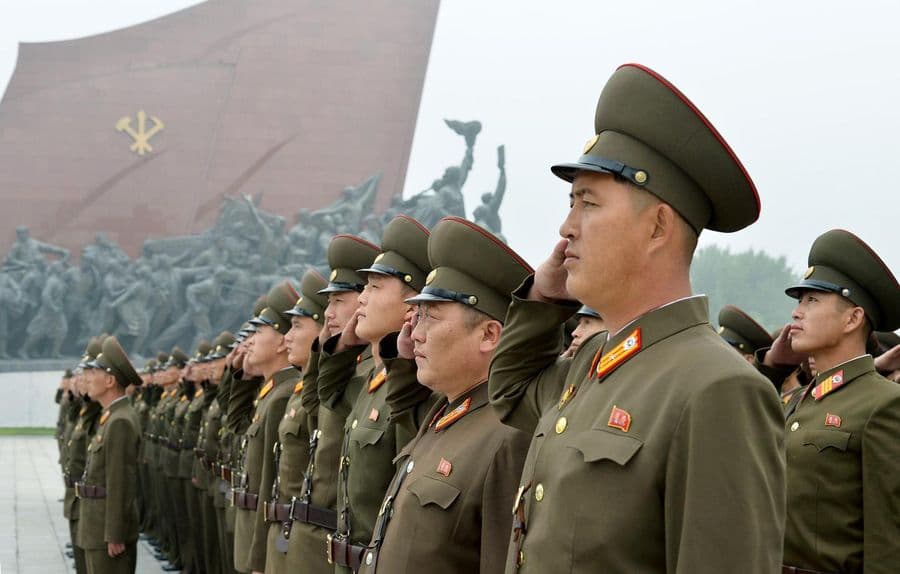
Exploit the North Korean Military to Find Peace
Last updated 05:01 PM EDT • Read time: 5m
After two unproductive summits between President Donald Trump and North Korean dictator Kim Jong-un, complete denuclearization of the Korean peninsula is nowhere to be found - let alone peaceful Korean reunification. By offering accommodation to the ruling Kim kleptocracy, both the South Korean Moon administration and the American Trump administration seek to find a path toward some peaceful co-existence with North Korean regime that thus far is proving impossible.
But dealing with North Korea is not like dealing with a typical country. The DPRK, as North Korea is officially known, is ruled more like a medieval feudal lordship than a 21st-century nation-state. Direct negotiations with Kim Jong-un is fruitless. The U.S. should re-orientate its foreign policy and find a path toward peace and reunification of Korea via the DPRK military.
Historically, most the effective means of maintaining, as well as the quickest path toward changing, an authoritarian regime lies via the country's military. The reason is simple. The military has the guns to keep a dictator in power and typically is the only institution with the capacity to oust a dictator. Whether is it the removal of Hosni Mubarak in Egypt or the potential removal of Nicolas Maduro in Venezuela, the military leadership holds the key to the maintenance or removal of power. The DPRK is no different.
The Kim family, of course, recognizes this problem. Like a baron from the middle ages, Kim Jong-un relies upon his DPRK generals to keep his family in power. In return, these North Korean generals and their families are richly rewarded not only financially, but also with social prerogatives akin to nobility in North Korea.
The DPRK military does not operate like a typical armed force in the West. Instead, it operates more similar to a feudal aristocracy. The North Korean generals control thousands of citizens via mandatory military conscription, much as a medieval lord would demand service from peasants on his fiefdom. These conscripted soldiers are then utilized not just for national defense, but also for enterprise. The DPRK generals don't only operate the tanks and guns of North Korea, they also operate the country's coal mines and harvest the crops – typically over areas granted to military families as a reward for loyalty to the Kim family.
This symbiotic relationship where the North Korean military gives the Kim family complete authoritarian power in exchange for the perks and privileges associated with a feudal lord has worked well for the Kim dynasty for generations. The Kims, ruthlessly protect this system that works to their immense benefit with regular purges and execution of general officers who even hint of disloyalty.
That the common people of North Korea lack sufficient food to survive is irrelevant to North Korean politics. What matters in the DPRK is sustaining the Kim dynasty by preserving the benefits owed to the DPRK generals who protect the regime.
But the tightened sanctions against North Korea is placing stress upon this relationship within the DPRK. Passing out perks of Western goods and extra financial privileges to North Korean generals and their families is becoming harder and harder as the West increasingly isolates North Korea.
The U.S. and Japan well document the dangerous, and illegal, night-time, open sea, ship-to-ship transfer of fuel using ships with altered identification. These extreme lengths that North Korea today uses to obtain petroleum are a testimony to how much sanctions are cutting into North Korean daily life and disturbing the comfort DPRK generals usually are accustom to.
The path to altering the state of affairs on the Korean peninsula will not come with building some new personal relationship with Kim Jong-un. The path to change will be found by disturbing the cozy relationship between Kim and his generals.
Strengthening and tightening sanctions is a start. The next step is to manipulate jealously amongst the generals by covertly allowing certain key generals to evade the West's sanctions and obtain Western goods and supplies. Then, exploit this scheming by publicizing to the rest of the generals who fail to receive such goods, that certain key DPRK families are benefiting more than others to sow jealousy. Finally, increasing the U.S. military posture in Korea, rather than eliminating military training exercises as the Trump administration has chosen to do, adds pressure to the DPRK generals. When the U.S. military presence in Korea is stronger, the DPRK generals have to take their soldiers away from money-making activities and redirect them to actual military duties.
Without having to use kinetic force, the U.S. can seed internal division within North Korea and bring about a change in the regime. When the DPRK military starts to see they have more to gain by interacting with the West than protecting Kim Jong-un, dramatic change on the North Korean peninsula becomes possible.
The Kim family that rules North Korea is a vicious and despotic nuclear-powered regime that brings misery to millions and instability to North-East Asia. The Kim regime shows a callous disregard for the poverty of its people and a disturbing comfort with the use of murder, even of its family members, as a tool to maintain power. Today there is an opening to change the dynamic of this awful regime. But it will not come from flashy photo-op summits between Trump and Kim. It will come by adroitly exploiting the sanctions regime, strengthening the U.S. military presence in Korea and then dividing the DPRK military leadership away from Kim. It is via the DPRK military, not Kim Jong-un that a Korean peninsula peace becomes possible.
Charles K. Djou is a former U.S. Representative who served on the Armed Services Committee. He is an Afghanistan war veteran, a Lieutenant Colonel in the Army Reserve and teaches political science at Hawaii Pacific University.
The views expressed in this article are those of the authors and do not reflect the official policy or position of the Department of the Army, the Department of Defense, or the U.S. government.
Eight Months of Epic Fury and Still No Internal Alternative
By Stephen D. Cook • RealClearDefense
The Readiness Cliff: Pacific Lessons Drawn from the Middle East
By Brian McSorley • RealClearDefense
The Pentagon’s Real Modernization Problem Is Time, Not Technology
By Bruce Allen Lubbering • RealClearDefense
The World His Mother Opened
By Carlo J.V. Caro • RealClearDefense
Wake Island Lessons for Expeditionary Advanced Base Operations
By Brian J. Dunn • RealClearDefense
Wake Island Lessons for Expeditionary Advanced Base Operations
By Brian J. Dunn • RealClearDefense
U.S. Navy Expands Unmanned Mine Hunting
By Global Defense News
MRF-SEA Will Maintain Continuous Presence in the Philippines
By Mahadzir, USNI News
Space Force Weighs Proliferated Cislunar Satellite Constellation
By C. Albon, A&SF
America-Class Amphibs Enable New Ship-to-Shore Attack Strategies
By Warrior M.