
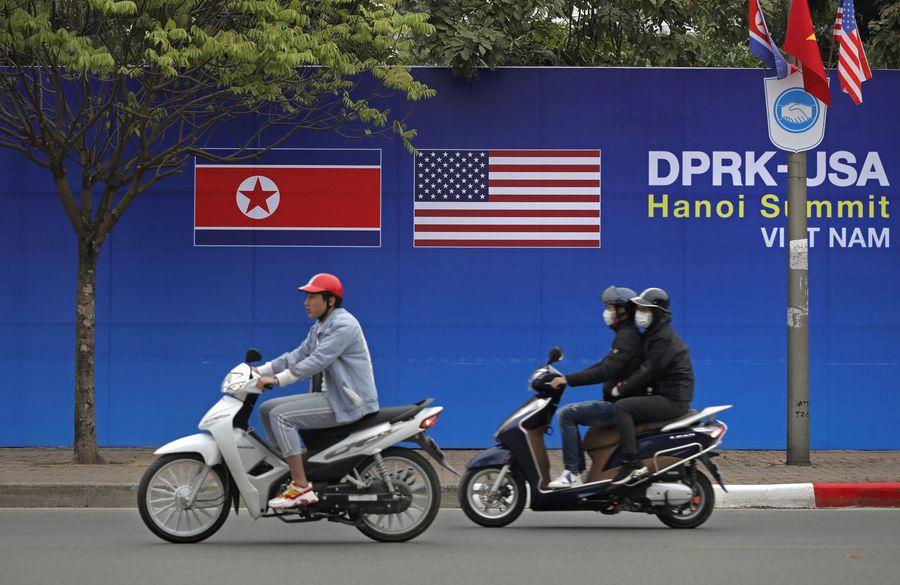
President Trump Seeks Peace in Korea
Published Feb. 26, 2019 • Read time: 4m
A new statement from the White House foreshadows the likely outcome of next week’s summit in Hanoi, where Donald Trump and Kim Jong-un will meet for the second time. After almost sixty-nine years, the U.S. and North Korea will declare the end of the Korean (Civil) War. Yet a formal declaration ending the war on the peninsula in no way brings or ensures peace. On the contrary, securing this kind of declaration supports Kim’s political warfare strategy, whose objective is to break the Republic of Korea (ROK)/U.S. alliance. If the White House understands and mitigates the risks of the premature declaration, it can prevent Kim (as well as Xi Jinping, Vladimir Putin, and others) from exploiting it.
The very first line of the White House’s new statement signals the president’s intention: “As part of a bold new diplomacy, we continue our historic push for peace on the Korean Peninsula.” At dawn on June 25, 1950, the North invaded the South, conquering almost the entire peninsula by August. The United Nations recognized the North as the aggressor while the U.S. and 15 other “sending states” answered the UN call to help defend the ROK. The armistice that suspended the war in July 1953 has remained in place ever since.
The most important line in the White House statement telegraphs the president’s intent for Hanoi: “This summit aims to make further progress on the commitments the two leaders made in Singapore: transformed relations, a lasting and stable peace, and the complete denuclearization of the Korean Peninsula.”
Russian help would make North Korea’s missile-test flurry worse news
North Korea Launches 2 Ballistic Missiles and Dials Up Pressure on the U.S.
What's Behind Seoul's Olive Branch to Pyongyang?
Seeking a New Normal on the Korean Peninsula
This is precisely the sequence that Kim wants for the process. Transform the relationship and declare peace before denuclearization. For Kim, transformation means an end of the ROK/U.S. alliance, the withdrawal of U.S. forces from the peninsula, and removing the U.S. nuclear umbrella over the ROK and Japan. It also means an end of war declaration, lifting sanctions, and normalization of relations with the U.S. After this “lasting and stable peace,” Kim will discuss denuclearization.
President Trump is pleased that Pyongyang has not conducted nuclear and missile tests in more than 400 days. This should not be mistaken for any sort of commitment to denuclearization. In his 2018 New Year's Speech, Kim announced “the accomplishment of the great, historical cause of perfecting the national nuclear forces,” and called for the mass production of warheads and missiles. Last September, head of state Kim Yong-nam and Foreign Minister Ri Yong-ho confirmed the North had completed its military deterrent. From this, we can infer they no longer need to test their warheads and missiles, at least until they get all the concessions they expect from diplomacy. It is also possible that North Korea has developed a computer simulation capability that reduces the requirement for physical tests. In short, there has been absolutely no reduction in the nuclear or missile threat, other asymmetric threats, nor the conventional threat posed by North Korean armed forces.
Since November, Pyongyang’s military has been conducting its annual winter training cycle to bring its forces to the highest state of readiness before the optimal attack window of March. This does not indicate an intention to attack but illustrates that there has been no reduction in the North's offensive posture. There is nothing in an end of war declaration that will ensure or improve the security of the ROK. Also, the Comprehensive Military Agreement that emerged from the inter-Korean summit last September actually reduced ROK defense capabilities as part of a one-sided trust-building exercise. Real moves to end the Korean War would require the North to abandon its offensive posture.
It would also be a major mistake for the White House to approve a bilateral end of war declaration between the North and the U.S. without the ROK taking part. This would signal a move toward dismantling the ROK/U.S. alliance. If President Moon Jae-In is not included, the move will play right into the North's divide and conquer strategy. If preparations are not made to ensure the ROK/U.S. alliance remains rock solid, an end of war declaration will provide the pretext for those who seek the withdrawal of U.S. forces from Korea. Advocates in Pyongyang, Beijing, Moscow, Seoul, and even Washington will use this declaration to drive their agenda to remove U.S. troops.
The durability of the ROK/U.S. alliance is the reason there has been no war on the Korean peninsula for more than six decades. The U.S. should be wary of any declaration of the end of the war that brings war closer by damaging the ROK/U.S. alliance.
David Maxwell, a 30-year veteran of the United States Army and a retired Special Forces colonel, is a senior fellow at the Foundation for Defense of Democracies. Follow him on Twitter @davidmaxwell161.

Iron Raven: Remembering Colonel Joseph B. Conmy, Jr.
By Louis Marano • RealClearDefense
Stand Proud of the Force
By Jay Rogers • RealClearDefense
How a Dying Agency Turned Fentanyl Into a Weapon of Mass Destruction
By Barry Angeline • RealClearDefense
The Pressure Is the Message: What Xi and Putin Faced in Shenzhen
By Emzari Gelashvili • RealClearDefense
China’s Revised Mobilization Law and the Expanding Reach of National Defense
By Muhammad Shoaib • RealClearDefense

Marine Corps Hero Under Federal Investigation
By Laporta, Burnham & Watson, CBS
A Postmortem of Maneuver Warfare in the U.S. Marine Corps
By Donald Vandergriff
U.S. Putting Weapons in Space: A Strategic Blunder?
By Ajey Lele • RealClearDefense
U.S. Senate Seeks to Exchange Shipbuilding Funds for More Munitions
By Naval News
F-35C Completes First Launch and Recovery Trials on a Ford-Class Carrier
By Navy T.