
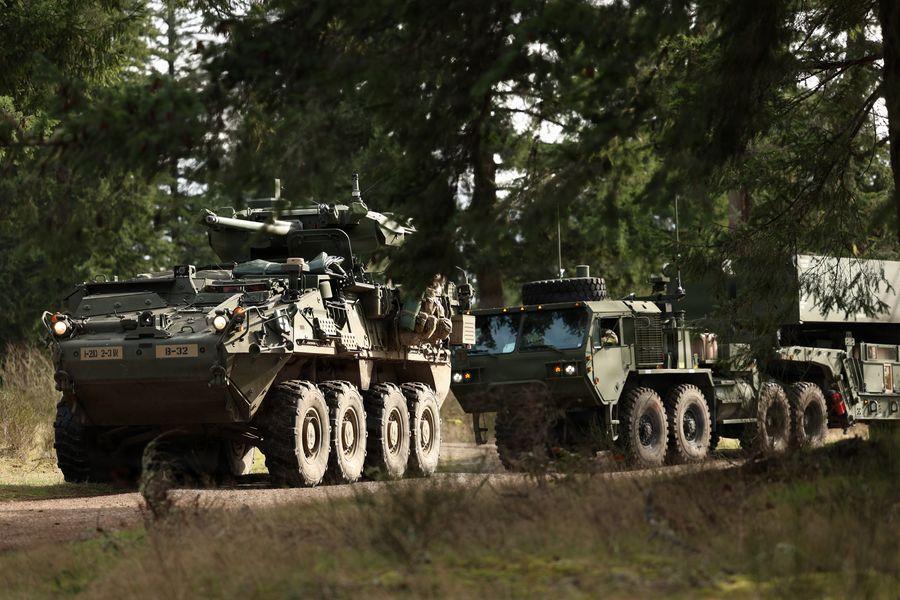
A Stryker assigned to 2nd Battalion, 3rd Infantry Regiment, 7th Infantry Division (Multi-Domain Command – Pacific) escorts a Dark Eagle Long-Range Hypersonic Weapon from 5th Battalion, 3rd Field Artillery Regiment (Long Range Fires Battalion), as part of Exercise Bamboo Eagle 26-1 at Joint Base Lewis-McChord, Wash., Feb. 18, 2026.
Defense Acquisition and Construction Must Move Together
Published Nov. 18, 2026 • Read time: 6m
Join the Conversation
0The Department of Defense is now capable of buying equipment faster than it can build the supporting facilities. In 2023, DoD set a goal to field thousands of autonomous systems within 18 to 24 months. Few construction schedules are capable of matching that today. Closing the gap between acquisition and construction is a planning problem as much as it is a funding one.
The gap between acquisition and construction has existed for some time. Army units have received new equipment before the accompanying plans for facilities, training, and personnel have been finalized. Planning gaps continue to persist. Construction itself has been slow, with legacy projects taking roughly three to three and a half years from the start of the design through to occupancy. Construction lags predate the Department's current push to buy faster.
Progressive design-build (PDB) under title 10 section 2808a can shorten that timeline, but only within limits. DoD's process is to select a builder before finalizing the design and price. It then refines the design in the open before agreeing on a guaranteed maximum price (GMP). Regulations and law constrains how certain funds are able to move under this authority. The Army's playbook for the design method confirms that the authority does not carry incremental funding, so money must be secured before work begins.
Fielding Outpaces Facilities
Fielding now moves quickly across DoD; construction has an opportunity to keep pace with it. When a piece of new equipment reaches a unit, the facilities, training, and personnel plans should be ready to receive it. Only then can the military generate readiness and create deterrence. However, that fielding can run ahead of those plans. Closing the sequence is well within DoD's reach.
Construction delays affect every service. Some of the main causes include poor initial planning, design errors, and changing requirements. The services can plan for each of those causes early. If the services plan construction projects earlier in the acquisition window, it is possible that they can tighten the schedule closer to when the equipment is fielded.
Planning facilities early also helps units sustain their equipment over their service life. A finished facility, paired with trained people, can help a unit keep its systems ready. The same 2026 review links planning gaps to a unit’s ability to sustain equipment. If the services can plan sustainment alongside fielding, it is more likely that the services can turns those systems into a credible deterrent.
Speed Needs a Plan
Speed in construction works best when DoD plans for it from the start. Leaders should set facility schedules at the same time they set equipment schedules. Planning acquisition and construction together can give each program a better chance of having a usable building when the systems arrive.
Progressive design-build under title 10 section 2808a gives military construction a practical tool to better align schedules. The method lets DoD select a builder early and refine the design before finalizing the GMP. Early selection better enables the team to spot problems while changes remain inexpensive because fixing something in design costs much less than during construction. Each problem that the team can address early has the ability to shorten the span of time across the acquisition and construction process.
To be sure, the method needs a solid foundation of rules and partnership agreements before the work begins. The Army's playbook sets decision points and an off-ramp, allowing each team to know when to continue the work and when it needs to stop. Clear rules and a partnering foundation give the builder and the customer a stable base from which to work.
Bring Construction Up to Speed
Construction needs to keep pace with the way that DoD now buys its equipment. When new systems arrive in months, the buildings that house them should move on a timeline with similar urgency. DoD can reach that pace with tools it already holds; PDB described below gives it a practical way to start.
Progressive design-build lets construction knowledge shape a project from the first day. The builder joins the team before the design is final, allowing its experience to inform the construction methods that will be applied. Again, the Army's playbook calls for construction representatives to join the project team early. Bringing the full team onboard early lets the team understand the cost, construction sequence, and design together while the design remains flexible.
What the Department Should Do Next
The Department of Defense can start with the projects that are already in motion. Each project team needs to name the date that its building will be ready and explain how that date fits the fielding plan for the equipment. Shared understanding, including delivery dates, keep leaders informed of what the force is expected to have and when. Publishing them also gives industry partners clear targets and common knowledge. Partners can make better recommendations as they see timelines and budgets slip.
Congress can help by asking for the same information in every service's budget request. When lawmakers are able to see construction dates listed next to equipment fielding timelines, they can spot gaps early and better direct funds where they are needed. Routine reporting of that kind gives DoD and Congress a shared picture to work from. It also makes progress visible from year to year.
The Defense Department should treat construction as a standard part of every fielding decision. Optimally, a new system should arrive with a building, trained people, and a plan to keep it working. Making that expectation routine gives the joint force the capability it needs when it needs it. Deterrence depends on that capability being ready when the equipment arrives.
Matt Russell and Michael Carvelli are co-founders and managing partners of Attain Leadership Solutions, a consulting firm that helps organizations reduce project delivery friction. Their work draws on their experience leading complex organizations and planning operations in demanding environments. Russell is an experienced Army strategist and infantry officer. Carvelli is an experienced Army engineer officer, operational planner, and organizational leader.
The views expressed are their own and do not represent those of the U.S. Army, the Department of Defense, or any part of the U.S. government.

Operation Epic Fury and the Illusion of Victory
By Stephen D. Cook • RealClearDefense
Previewing The Shenzen Summit: A Critical View
By Stephen Blank • RealClearDefense
How to Win Without Military Victory
By Kevin Eyer • RealClearDefense
We Keep Funding ‘Shared Infrastructure.’ Nobody Has Defined It.
By Frederick Gale • RealClearDefense
Congress Must Reauthorize Section 702 of the Foreign Intelligence Surveillance Act
By Bryce G. Poole • RealClearDefense

Five Takeaways From Navy Nominee’s Rocky Hearing
By Seligman & Weisgerber, WSJ
U.S. Air Force Taps Anduril for Containerized Launcher
By Global Defense News
Time To Say Goodbye to the NMESIS and NSM
By Marine Corps Compass Points
HII and U.S. Navy Break Ground on Shipyard Complex
By George Allison, UKDJ
Rare U.S. Air Force Spy Plane Spotted Over the Black Sea
By D. Malyasov, Defence Blog