
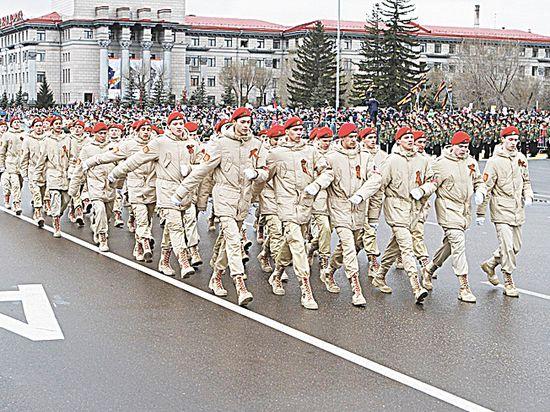
Putin's Military-Patriotic Youth
Published April 18, 2019 • Read time: 5m
In 2014, the dramatic deterioration of political relations between Russia and the West resulted in the Kremlin’s growing emphasis on military-patriotic upbringing of Russian youth. However, in spite of certain seemingly noble goals (e.g., elimination of youth criminality, the integration of less fortunate children and young people into Russian society, and the nurturing of patriotism and affection for the Fatherland), this program simultaneously appears to reflect a desire of Russian siloviki (security services) to increase the number of potential recruits for military and paramilitary units (see Part One in EDM, April 10).
On March 2, 2019, the head of the Russian General Staff, Army General Valery Gerasimov, delivered a speech laying out Russia’s current vision of future conflicts. One of the key elements emphasized by Gerasimov was the precept that the Russian Armed Forces will still require large numbers of soldiers capable of defending the country (RIA Novosti, March 2). Gerasimov’s remarks ended up having somewhat unexpected implications for Russian youth-patriotic organizations, whose role (already overarching) might be elevated to a new level. Namely, Russian Major General Yevgeny Burdinsky, the deputy head of the General Staff’s Chief Organization and Mobilization Directorate, declared that, “given the necessity of accumulating military-capable human resources, as well as current economic capabilities of the Russian state… [it is] impossible to fully reject the idea of mandatory military conscription” (Interfax, March 6). Therefore, in order to popularize military service, it will be essential to accumulate human capital through regional centers of military-patriotic upbringing. Specifically, a key role will be ascribed to such organizations as the Union of Russian Officers, the military club “Paratrooper” (“Desantnik”), Combat Brotherhood (Boyevoye Bratstvo) as well as Cossack communities. At this juncture, the youth-oriented military-patriotic organization Yunarmia will serve as a platform for unifying some 5,000 various pre-existing organizations for pre-draft preparation (doprizivnaya podgotovka) (Novaya Gazeta, March 15).
Budinsky’s announcement is a logical continuation of the overall trend of the growing nexus between Russian military-patriotic youth organizations and the regular Armed Forces. In early March 2019, in Krasnoyarsk, the local Yunarmia branch signed an agreement with the Krasnoyarsk Machine-Building Plant (Krasmash), which envisages creating an additional localized Yunarmiya branch on the basis of this plant. The plant is currently involved in producing the RS-28 Sarmat ballistic missile, one of six new Russian strategic weapons unveiled by President Vladimir Putin on March 1, 2018. Reportedly, Krasmash has pledged to provide all necessary economic resources to defray the expenditures associated with building up this new Yunarmia branch. Presumably, the initiative will soon be joined by such economic giants as Nornikel, Rusal, Rosneft and Gazprom (Moskovsky Komsomolets, March 10). In the meantime, Yunarmia has already concluded sponsorship agreements with Russian banks VTB, Russian Agricultural Bank, Gazprombank (GPB), and PJSC Sberbank (Meduza.io, October 5, 2017).
Russian Missiles Land in Poland As Europe Held Military Drills Nearby
The Summit as Mirror
Moscow Expresses Warnings on Kaliningrad Defense Against NATO
Strengthening Deterrence Against Russia’s Conventional Attack of Latvia, Lithuania, and Estonia
The organizational structure of Yunarmia progressively resembles the structure of the Russian Armed Forces. On April 1, Admiral Vladimir Korolyev proposed to unite all military-patriotic and youth groups/organizations with a maritime profile (with a combined membership of approximately 20,000 children and adolescents) under the Yunarmia umbrella. According to the admiral, this will allow for the creation of a well-coordinated system of military-patriotic upbringing. In his statement, Korolyev noted, “If we do not turn our attention to our children, someone else will do it for us soon” (Tvzvezda.ru, April 1). By 2020, Russian authorities plan to create 100 new centers for military-patriotic upbringing, where young people will learn skills commensurate with the existing branches of the Russian Armed Forces (paratroopers, military pilots, tank crew and others). Such training will be carried out at facilities belonging to the Ministry of Defense (MoD), the Central Army Sports Club, as well as the Volunteer Society for Cooperation with the Army, Aviation and Navy (DOSAAF) (Snob.ru, January 12).
At the same time, a promise once made by Russian Defense Minister Sergei Shoigu to familiarize members of Yunarmia with the most up-to-date pieces of Russian weaponry and munitions (Icds.ee, June 8, 2018) is now becoming a reality. Yunarmia members are becoming increasingly involved (for now, as spectators and limited-scale participants) in various military exercises carried out by the Russian Armed Forces. For instance, during one of those exercises, codenamed “Patriots of Transbaikalia” (at the Tsugol training ground), Yunarmia members were drilled in various maneuvers (such as traversing a river and other water obstacles or simulating offensive and defensive military operations). Moreover, these children witnessed the work of T-72B3 battle tanks, BMP-2 infantry fighting vehicles, 2S3 Akatsiya self-propelled guns, BM-27 Uragan and Tornado-G self-propelled multiple rocket launcher systems, as well as Iskander mobile short-range ballistic missile systems (Vk.com, April 2).
Most recently, reports have revealed that one of the main sponsors of Yunarmia may be related to Yevgeny Prigozhin, the sanctioned oligarch close to President Putin who is also behind the notorious Private Military Company (PMC) Wagner Group. Wagner mercenaries have been implicated in various hostilities and alleged war crimes in Ukraine and Syria (Svoboda.org, May 30, 2018; UNIAN, May 19, 2018). In early April 2019, Reuters uncovered that “a secret military base related to the Russian MoD” located near the Molkino polygon (the main training ground for the Wagner Group) was masked under the façade of a youth camp (RBC, April 4). If this information proves accurate, this means that youth military-patriotic organizations could in fact (in addition to other purposes, of course) serve as a pool for Russian PMCs (officially still illegal in Russia), which could have dramatic and unpredictable consequences.
Given difficult economic conditions and, in many cases, the lack of clear local prospects, large numbers of Russian youth will likely be tempted to join such military-patriotic organizations going forward.
Alla Hurska is an Associate Expert at the International Centre for Policy Studies (Kyiv) and a research assistant at the University of Alberta. She specializes in Ukrainian history, politics and culture.
This article appeared originally at The Jamestown Foundation's Eurasia Daily Monitor.
*To read Part One, please click here.
Iron Raven: Remembering Colonel Joseph B. Conmy, Jr.
By Louis Marano • RealClearDefense
Stand Proud of the Force
By Jay Rogers • RealClearDefense
How a Dying Agency Turned Fentanyl Into a Weapon of Mass Destruction
By Barry Angeline • RealClearDefense
The Pressure Is the Message: What Xi and Putin Faced in Shenzhen
By Emzari Gelashvili • RealClearDefense
China’s Revised Mobilization Law and the Expanding Reach of National Defense
By Muhammad Shoaib • RealClearDefense

Marine Corps Hero Under Federal Investigation
By Laporta, Burnham & Watson, CBS
A Postmortem of Maneuver Warfare in the U.S. Marine Corps
By Donald Vandergriff
U.S. Putting Weapons in Space: A Strategic Blunder?
By Ajey Lele • RealClearDefense
U.S. Senate Seeks to Exchange Shipbuilding Funds for More Munitions
By Naval News
F-35C Completes First Launch and Recovery Trials on a Ford-Class Carrier
By Navy T.