
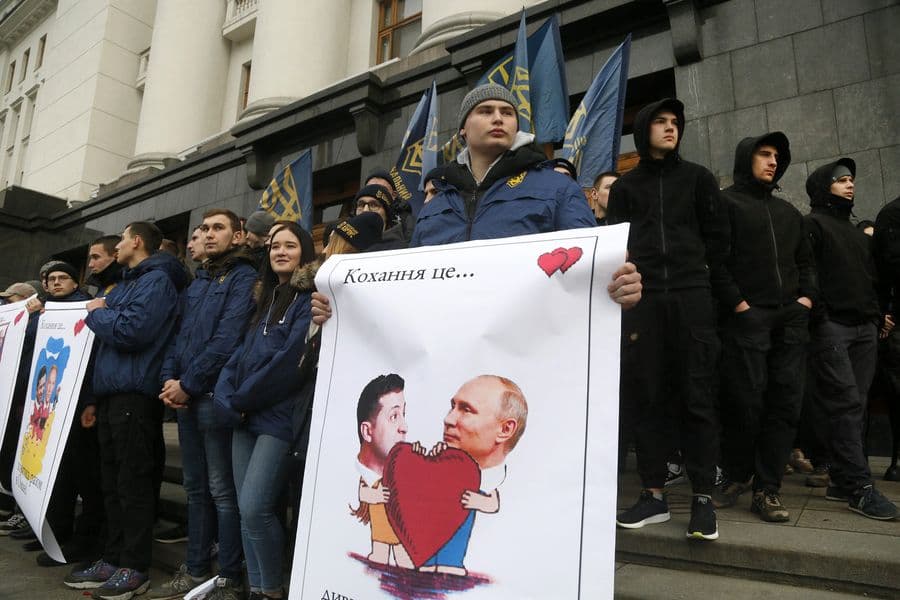
New Threats to Ukraine
Last updated 04:48 PM EDT • Read time: 5m
Despite pandemics, economic stagnation, and multiple domestic and foreign crises, Russia continues its war against Ukraine and even fabricates new threats. Since it has become clear that the Minsk process, the process based on agreements there in 2015 is not going anywhere, Russia is raising the ante. Because it cannot induce or compel Ukraine politically to sign its own death warrant and convert itself into a confederacy where Russian agents from the Donbass would have veto power over Kyiv's government, Moscow has alighted upon a new tactic. As it has done in Georgia, it is now issuing hundreds of thousands of Russian passports to residents of the Donbass in preparation for the formal incorporation of the territory into the Russian state.
Nobody should labor under the illusion that this annexation would satisfy Russian appetites. As Vitaly Portnikov observes, “In fact, the Kremlin’s main goal is to regain control over all of Ukraine in one form or another: either as a satellite country, or as an allied state, or as a new “oblast” (region) of the Russian Federation.” Putin's statements and those of prominent Russian leaders make clear that from their standpoint, no Ukrainian state has the right to an existence independent of Russia. Indeed, from their point of view, there is no historical or any other justification for an independent Ukrainian state at all. Indeed, Putin said this to President Bush in 2008 and subsequently offered to partition Ukraine with Poland. Indeed, for him, the whole idea is a Polish or other anti-Russian foreign invention. Putin has also publicly stated that the Soviet Union was Russia so that other nationalities had no right to an independent existence.
Meanwhile, the fighting continues with Russian probes and Ukrainian fatalities occurring every day. At the same time, the burden of maintaining Crimea, e.g., its freshwater sources, and power, as well as sustaining Russia's stagnant economy amidst rising domestic disaffection grows every day. Moreover, NATO is more and more probing the Black Sea and has upgraded its relationship with Ukraine, offering it enhanced strategic partnership and U.S. aid is again coming. Therefore, it is no surprise that Ukrainian sources report that the Crimea situation is developing towards the capture of Ukraine territories that give access to water from the Dnieper River. Russia has increased the military contingent in and around Crimea to about a reported 80,000 troops and concentrated its engineering units in the north of the Crimea. They built a water supply canal to Dzhankoi and a water pumping station there. It is therefore entirely possible that an operation will soon be launched to capture freshwater from Ukraine in order to service Crimea and make Ukraine rather than Russia pay for it. Russia actually conducted Command Post Exercises (CPX) to capture Tavriisk (a small town where the canal starts from the Dnieper). There have also been inexplicable movements of gas towers on the Black Sea with the intention to ram Ukrainian border guards when approaching. Ukrainian sources also speculate that this projected Russian advance may occur after Russia conducts its annual Kavkaz (Caucasus) 2020 exercises as those exercises would leave troops in the vicinity of the Crime and in a fully armed and high readiness condition. Moreover, it often has been a Russian trademark to launch operations off of exercises.
Russian military policy across the board has manifested increased aggressiveness through bomber probes off Alaska, and European countries, military involvement in Libya, continuing nuclear threats, and procurements, and the resort to passportization in Ukraine described above. Military threats to use force have, as Russian analysts acknowledge, the primary modus operandi of Putin's regime because there is literally nothing he can offer his people at home as the Covid-19 virus ravages Russia and the economy continues, as it always will under his stewardship, to underperform. Passportization indicates Moscow's desire to extend this war and make clear its intention to destroy Ukraine as a state. For our part, not only must we continue to support Ukraine and sanction Russia. We and our allies must redouble our readiness and alertness to the possibility of new Russian acts of overt military force wherever they may occur. Indeed, Russia has few, if any, recourses to any other form of operation other than lighting matches in flammable areas. The likely result of such recklessness is obvious. Since we and our allies are the global firefighters, like it or not, we must draw the appropriate consequences and be ready to extinguish the fire next time.
Stephen J. Blank, Ph.D., is Senior Fellow at FPRI’s Eurasia Program. He has published over 900 articles and monographs on Soviet/Russian, U.S., Asian, and European military and foreign policies, testified frequently before Congress on Russia, China, and Central Asia, consulted for the Central Intelligence Agency, major think tanks and foundations, chaired major international conferences in the U.S. and in Florence; Prague; and London, and has been a commentator on foreign affairs in the media in the U.S. and abroad. He has also advised major corporations on investing in Russia and is a consultant for the Gerson Lehrmann Group. He has published or edited 15 books, most recently Russo-Chinese Energy Relations: Politics in Command (London: Global Markets Briefing, 2006). He has also published Natural Allies? Regional Security in Asia and Prospects for Indo-American Strategic Cooperation (Carlisle, PA: Strategic Studies Institute, U.S. Army War College, 2005). He is currently completing a book entitled Light From the East: Russia’s Quest for Great Power Status in Asia to be published in 2014 by Ashgate. Dr. Blank is also the author of The Sorcerer as Apprentice: Stalin’s Commissariat of Nationalities (Greenwood, 1994); and the co-editor of The Soviet Military and the Future (Greenwood, 1992).

A Passage to the Middle East: India as a Mediator and Security Partner
By Irina Tsukerman • RealClearDefense
South China Sea is Key to Invigorate Positive U.S.–Malaysia Relations
By Brent D. Sadler • RealClearDefense
The Necropolitics of the Wasteland
By Yunus Emre Tumen • RealClearDefense
AI, Robotics, and Marines
By Gary Anderson • RealClearDefense
The Emerging SQUAD
By Muhammad Shoaib • RealClearDefense
AI, Robotics, and Marines
By Gary Anderson • RealClearDefense
AUKUS Partners Test Autonomous Maritime Systems
By Jangoulun Singsit, Naval Tech
AUKUS: USS Colorado Announced as First Submarine for SRF – West
By USNI News
Navy, Marine Corps Simulate Ship Strikes From Air and Land
By Alex Wilson, S&S
Air National Guard To Stand Up a New Special Tactics Squadron
By Patty Nieberg, T&P