
Victory at What Price in Ukraine?
Last updated 11:43 PM EDT • Read time: 7m
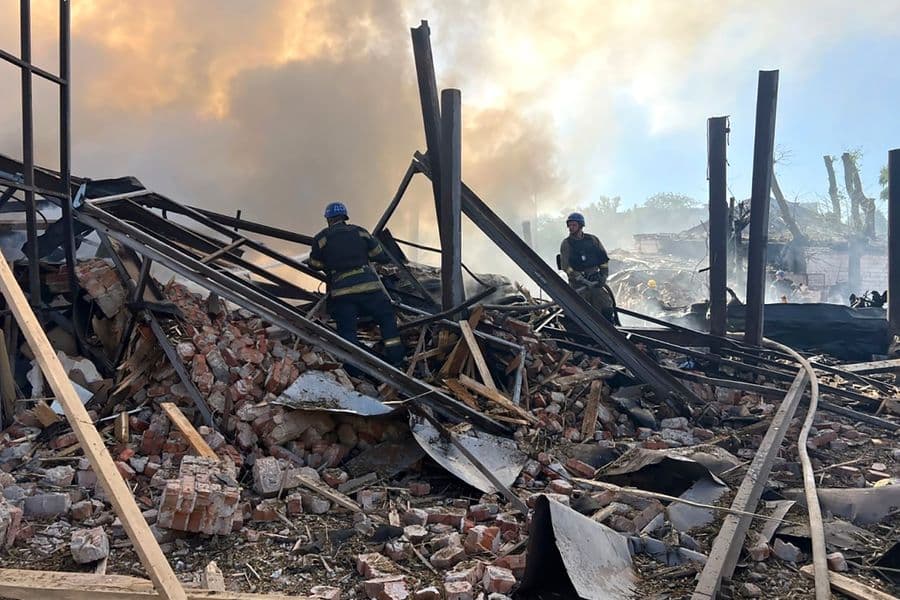
How many Ukrainian lives is full-out victory over Putin and recovery of the Donbas and southern Ukraine worth? 100,000? 500,000? A million? It´s a more relevant question than most realize. Despite the flurry of Ukraine War coverage in Western media, a February 2023 Responsible Science Journal article on the war with insight into the true human cost until now went almost completely without notice. That article asked an obvious question that almost everyone else seemingly intentionally avoids “how many Ukrainians have died as a result of this war?” and the likely answer was 150,000 excess deaths – deaths above the normal expected rate -- only by February of this year. One might expect this question in every article about the war – how many people are dying? To improve human security in Ukraine and prevent future conflicts, we need to ask new questions, scrutinize war in new ways, and reflect on what it means to work for peace.
Virtually all day-to-day coverage of deaths and injuries in Ukraine focus on direct acts of violence: shelling, bombing, drone strikes, etc. Most Western reports cite Ukrainian claims for Russian casualties, suggesting catastrophic Russian losses while Ukraine loses small but distressing numbers of civilians and soldiers. But this accounting distorts the real costs of war, showing a rosy and false picture to keep up war morale.
In the last year and a half, Ukrainians lost much access to food, electricity, medicine, medical care, and heat, and saw reduced access to medical care. By February Ukraine probably suffered 150,000 excess deaths, perhaps with a further 70,000 deaths in Europe more broadly due to high power prices in the cold. With tens of thousands of Ukrainians since dead, this adds up to maybe four to five times the Russian losses, based on estimated Russian excess deaths. Hundreds of thousands of healthy young people have been injured and/or traumatized in an already-poor health care system. Millions are live as refugees in Europe, with only 1/3rd of the refugees wanting to return to Ukraine despite impoverishment and vulnerability to sex exploitation. Ukraine´s birthrate has plummeted. Realistically hundreds of thousands of Ukrainians have already died and next winter may well again be very hard, perhaps even harder. War is crucifying Ukraine, and Ukraine may also be losing.
The question of loss of and injury to human life is deeply relevant to the political decision of how to approach the conflict. No war is ever fought to the last life – as wars become more costly, leaders – influenced by their publics – revisit the alternatives to war. Since spring of 2022, the Ukrainian and Western goal has been full recovery of occupied land, including Crimea, but this goal must be measured against the human cost. It is wrong to destroy a village in order to save it, as we have learned. How many hundreds of thousands would be too many? As we are already seeing Western media in various quarters start to do -- even NATO´s head -- great suffering and little gain leads to reflection. Ignoring war´s direct toll – not to mention the tens of millions of new food insecure people worldwide – dulls our instinct to seek other ways forward.
And it could get far worse. It is irresponsible how assurances from media and politicians promise that Putin won´t use nuclear weapons. The U.S. used the threat of nuclear war against China to freeze the conflict in the Korean War. China knew we may not be bluffing: general MacArthur –lionized in U.S. textbooks – said he´d have dropped “30 or so atomic bombs… strung across the neck of Manchuria.” In a war that claimed only 140,000 or so U.S. dead and wounded, a top general wanted to kill millions of Chinese people with nuclear bombs. While U.S. media give the impression Russian nuclear blackmail is without precedent, the U.S. notably even refused to rule out using nuclear weapons *offensively* against Saddam Hussein´s Iraq, just 20 years ago, should he use chemical weapons against us. Russia´s threats are criminal and U.S. nuclear blackmail does not excuse them. But it does show they could be earnest.
A variety of historians, journalists and foreign policy specialists, and politicians left-wing and right-wing have pushed for taking a realistic look at the range of possibilities in this conflict. With an eye on the human cost for Ukrainians built into continuing the fight, global publics might be more readily persuaded to view cease-fire as the least-bad option. Of course, if there is no possibility for ceasefire or for diplomatic action, naming the death toll is only defeatist and depressing. And it could be Ukraine will achieve a dramatic breakthrough and recapture at least Zaporizhzhia and Kherson, saving millions from a brutal to even quasi-genocidal rule. But if the war continues until winter with no major shift, tens or hundreds of thousands of lives could hang in the balance. Regardless, there is benefit for all sides in freezing the conflict. As the attempted coup this summer showed, the war is highly risky for Putin, who contends with economic anxiety and a public and elites who can effectively no longer travel or take initiative in private enterprise: as energy and commodity prices go, so go their jobs and fates. The war is nowhere near as bad for Russians as for Ukrainians, but it is a disaster.
While a thaw in Russia-Ukraine relations could not be expected after freezing the conflict, there would still be substantial diplomatic work to do. Re-opening the world to the Russian economy could be linked to Russia´s releasing its numerous captive Ukrainians. Regionally, countries need to work together to fairly resolve the humanitarian crisis in Nagorno-Karabakh, where the historic Russian-inclined bent of Armenian politics is leading to starvation for over a hundred thousand people. And above all, enormous civil society work is needed to support Ukraine. After World War II, the U.S. helped end a pattern of generationally recurring violence in Western Europe, not only with the Marshall Plan but also with new institutions of exchange and friendship that continue today, with hundreds of thousands of exchange students going both ways and deep civil society engagement. It was a significant error to not cultivate that same level of friendship in Eastern Europe after 1990. Now there will be a new chance in Ukraine. It was also a catastrophic mistake to build the European economy on Russian energy exports, which funded half of the Russian state budget and military. An urgent climate response is also a strong policy response to petro-dictatorship.
And in practice, a durable solution for the Ukraine-Russia border could bring in international parties that are not party to the conflict – unarmed peacekeepers from India, Israel, Brazil, Saudi Arabia, or other unaligned countries in the conflict between Russia and the West. Complex historical conflicts usually have multi-lateral solutions, not straightforward, one-time bi-lateral treaty endings. With a criminal, bad-faith actor like Putin, outside guarantors are even more needed. In former Yugoslavia, outside international peacekeepers have made a huge difference. Perhaps as urgently as in Ukraine, such peacekeeping could maintain borders in Georgia, Armenia and Azerbaijan, and in the event of future conflicts, elsewhere in the former USSR. It is a failure of Western imagination to not investigate bringing in disinterested actors to mediate our conflicts, just as we so readily for others.
In the end, we do not know what possibilities there are for freezing the conflict and improving the situation. But right now, Western audiences do not have accurate information about the staggering human cost of the war to Ukraine and Europe, or even accurate information about Ukraine´s prospects on the battlefield, given the discrepancy between wildly optimistic reporting and the hard crash of the counteroffensive. Understanding how terrible the situation is could be a first step toward weighing and discerning between different ways forward.
David Lapp-Jost (M.Ed.) is a Friedensarbeiter (Peace Worker) with the German Mennonite Peace Committee, which since World War II has worked for peace in Europe. David´s MA research on refugee education and six years of teaching Iraqi and Syrian refugees inform his perspective on the consequences of proxy war.
Eight Months of Epic Fury and Still No Internal Alternative
By Stephen D. Cook • RealClearDefense
The Readiness Cliff: Pacific Lessons Drawn from the Middle East
By Brian McSorley • RealClearDefense
The Pentagon’s Real Modernization Problem Is Time, Not Technology
By Bruce Allen Lubbering • RealClearDefense
The World His Mother Opened
By Carlo J.V. Caro • RealClearDefense
Wake Island Lessons for Expeditionary Advanced Base Operations
By Brian J. Dunn • RealClearDefense
Wake Island Lessons for Expeditionary Advanced Base Operations
By Brian J. Dunn • RealClearDefense
U.S. Navy Expands Unmanned Mine Hunting
By Global Defense News
MRF-SEA Will Maintain Continuous Presence in the Philippines
By Mahadzir, USNI News
Space Force Weighs Proliferated Cislunar Satellite Constellation
By C. Albon, A&SF
America-Class Amphibs Enable New Ship-to-Shore Attack Strategies
By Warrior M.