
Why Sending Ukraine ATACMs Will Help It Win in the Long Term
Last updated 11:48 AM EDT • Read time: 5m
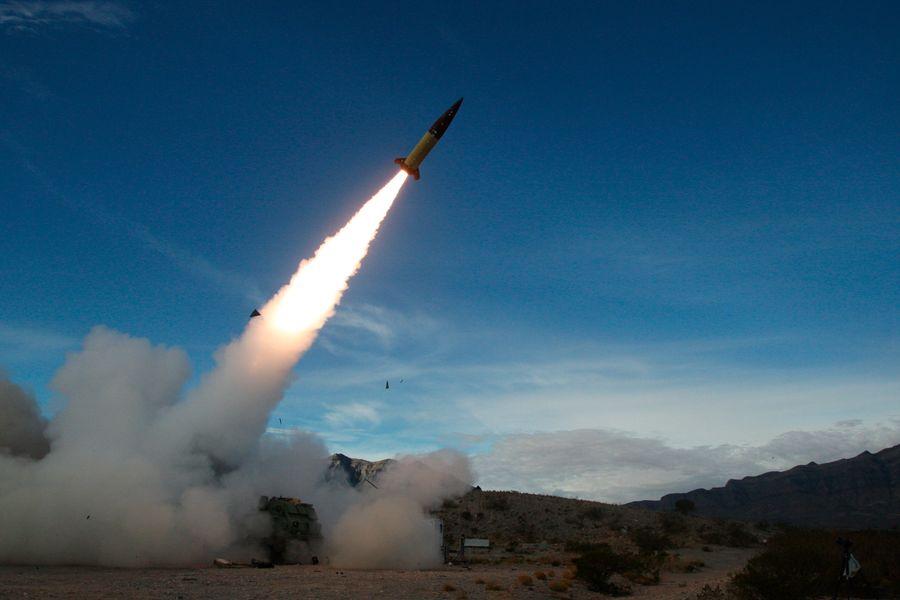
Earlier this week, U.S. officials confirmed that the Biden administration has recently sent Ukraine a small number of U.S. Army Tactical Missile Systems (ATACMs).
This is a good first step in enabling Ukraine to win the war in the long run. However, to ensure these shipments do not unduly weaken U.S. military readiness or deprive other partner states like Taiwan of desperately needed weapons, the President must invoke Title III of the Defense Production Act to expand defense industrial production.
While not a silver bullet, providing Ukraine with ATACMs would allow the Ukrainian military to strike targets deep behind enemy lines and further stress Russia’s already strained defense industrial base.
The war in Ukraine has now dragged on for nearly two years without much change in territory in the past year because of Russian fortifications in occupied regions in eastern Ukraine. Fortifications such as landmines, anti-tank mines, and air defense systems, have made it excruciatingly difficult for Ukrainian forces to make meaningful progress in its current counter offensive.
President Biden’s strategy throughout the war has been to supply the Ukrainian military with just enough military supplies to avoid escalating the war, fearing that Putin would deploy tactical nuclear weapons. However, in the long run this strategy, compounded with consistent delivery delays, only makes Russian victory more likely.
ATACMs, which have an effective range of up to 190 miles, will allow the Ukrainian military to strike targets well behind enemy lines. This will enable Ukraine to bypass Russian defenses and destroy strategic targets like supply depots, airfields, and command posts that Ukraine’s air force and army would be unable to reach otherwise.
Ukraine already begun implementing this strategy last month with British and French-supplied cruise missiles, which have an effective range of about 150 miles. Using these missiles has proven effective by enabling Ukraine to successfully strike Russian naval targets in Sevastopol.
However, Britain and France will be unable to supply Ukraine with cruise missiles in the long term without compromising their own military readiness. Indeed, according to one analyst at the University of Oslo, Ukraine will likely run out of these missiles by January at the latest.
The United States has an arsenal of 1,486 ATACMs and produces enough that it can replenish its supply in the near term.
Russia’s military industrial base relies on outdated Soviet-era infrastructure and because of western sanctions, it does not have access to western-made high-end “dual use” components to replenish its more advanced weaponry. Because of this, Russia must rely on lower quality components from China and less advanced weapons making a drawn-out war of attrition in its best interest. Any major escalation would stress and, if sustained, potentially overwhelm the Russian defense industrial base.
This would operationally have the same effect on Russia that Reagan’s Strategic Defensive Initiative (SDI) had on the Soviet Union.
According to European and U.S. officials, while China has sold components to Russia in the hopes of preventing Russia’s total defeat, China is unlikely to increase its involvement. Beijing has set boundaries to prevent further escalating the war and risking its access to European markets.
Because Russia cannot rely on China for more help in its defense production needs, Ukraine’s counter offensive that began in May presents an opportunity to exploit Russia’s crumbling defense industrial base. So far, while the U.S. government has supplied Ukraine with other advanced weaponry, like M1 Abrams tanks and javelin missiles, its shipments have consistently been at least two to three months behind Ukrainian weapon requests.
These slow deliveries have greatly hampered Ukraine’s ability to launch previously planned counter offensive operations. Last winter, the Ukrainian military was in a strong position to launch a counter offensive but was unable to because the West failed to fulfill its supply requests.
The U.S. government’s recent ATACM shipment to Ukraine is a key step toward giving the Ukrainian military a technological advantage that the Russian military may not be able to keep up with long term.
If Ukraine is to win total victory, it needs technologically advanced weapon systems like ATTACMs that will allow it to penetrate Russia’s fortifications in eastern Ukraine and weaken the Russian defense industrial base.
To ensure that Ukraine gets critical weapon systems in a timely manner in the future, the President must approve plans for specific deliveries and set detailed, realistic timetables. The Biden administration’s expedited ATACMs shipment is a good start.
Unlike other weapon systems, ATTACMs are easily replenished, with Lockheed Martin producing over 500 each year, far beyond what Ukraine needs. However, most of what Lockheed Martin produces is bound for foreign militaries.
To ensure that the U.S. military can replace its supply and maintain foreign military sales, the President should invoke Article III of the Defense Production Act to expand defense production. Because the United States will likely need to continue increasing its military supply to deter threats like a rising China, the President should also require that defense contractors plan for a surge in production.
If the West can sufficiently arm Ukraine to succeed in its counter offensive, it will shorten the war, saving lives and money in the long run and deter other aggressive rising powers like China.
Jonathan Harman is a student at Brigham Young University and a former intern at the Heritage Foundation's Center for National Defense.

Counterterrorism and the Growing Convergence in Homeland Security and Homeland Defense
By Austin Doctor • RealClearDefense
The Future of Space Power Depends on Integration
By Damian DiPippa • RealClearDefense
America Should Unleash Cyber Privateers
By Jacob Schelp • RealClearDefense
America Invented the Battery, but China Controls the Factory
By William Crane • RealClearDefense
A Defense Win for Americans and Israelis in Arkansas
By Bradley Bowman • RealClearDefense

F-16s Build on Iran Combat Lessons to Prepare for China Threat
By Rebecca Grant • Lexington Institute
Key Space Force Satellites Can’t Talk to Each Other
By T. Hitchens, Breaking Defense
Blue Angels Pilot Scott Laux Removed for Failing To Uphold Standards
By Johnson, PNJ
The Future of the Ground Reconnaissance Enterprise
By Joe Albano, The Connecting File
The Future of the ARG/MEU
By William Yale, Proceedings