
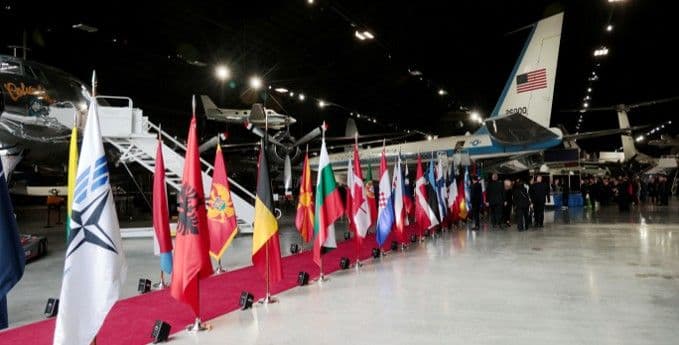
Integrating Security of Supply Into NATO's Defense Planning
Last updated 07:10 AM EDT • Read time: 4m
NATO has embarked on an unprecedented journey to strengthen its deterrence and defense posture in response to Russia’s war in Ukraine, growing Sino-Russian cooperation, and a barrage of hybrid threats. Yet one crucial concept — “security of supply to ensure the contingency of plans” — has not penetrated Allied discourse as deeply as it should. In plain terms, this phrase means that NATO’s contingency plans are only as credible as the supply chains they rely upon. It is time for the Alliance to adopt this language formally and embed its logic into the heart of its defense planning process.
Supply Chain Resilience: The Backbone of Deterrence
Modern warfare is not just about troop numbers or advanced weapons; it is about sustaining them. Ammunition, fuel, spare parts, communications equipment, and medical supplies are lifelines. If an adversary can choke off access to these goods — through cyber attacks, sabotage, economic coercion, or control over critical materials, then even the most meticulously crafted plans become paper tigers. NATO leaders recognized this in the 2024 Washington Summit Declaration, pledging to integrate civil planning with military planning and boost resilience across critical infrastructure and supply chains.
This recognition is not new. Cold War-era civil emergency planning built stockpiles and protected supply routes, anticipating large-scale conflicts. After the Soviet collapse, however, many governments pursued efficiency over resilience. Just-in-time logistics replaced stockpiles, and globalized supply chains grew brittle. In the wake of COVID-19 and ongoing wars, NATO now understands that brittle systems cannot sustain wartime operations.
Making “Security of Supply” Explicit
Despite this growing awareness, NATO still tiptoes around explicit language that ties supply resilience directly to contingency plans. The 2024 Industrial Capacity Expansion Pledge and the 2025 updated Defence Production Action Plan commit Allies to fostering the “responsiveness, strength, resilience, and security of supply chains”. But the link between supply security and the viability of contingency plans remains implicit.
Adopting the phrase “security of supply to ensure the contingency of plans” would clarify that the Alliance’s contingency planning cannot be divorced from logistics. It would also reinforce the expectation that every operational plan includes an explicit risk assessment of supply vulnerabilities—a feedback loop that simultaneously supports planners and warns them when supply chain disruptions threaten plan viability.
Risk Assessment: A Continuous Feedback Loop
This brings us to the second part of the argument: integrating risk assessment into the planning process. Supply chains are dynamic. Geopolitical shifts, natural disasters, and market fluctuations can quickly threaten critical inputs, from rare earth minerals to semiconductors. NATO planners need an iterative risk assessment function that constantly monitors these factors and adjusts plans accordingly. If new sanctions disrupt raw material flows, or a major supplier is compromised, planners must know immediately whether operational timelines and force packages remain feasible. Conversely, risk assessments can also spotlight opportunities to harden supply lines or diversify suppliers before a crisis hits.
Without this feedback loop, planners risk assuming that goods will magically appear on schedule—a dangerous illusion that adversaries could exploit. With it, NATO can pre-empt disruptions, direct investments, and update stockpiles in lockstep with evolving threats.
Towards a New Strategic Framework
The 2022 Strategic Concept acknowledged resilience and supply security but now looks dated. It did not foresee the scale of mobilization required to support Ukraine or the concerted effort to friend-shore critical supply chains. The upcoming Washington and subsequent summits should create a new strategic framework that elevates security of supply to a core element of deterrence. This framework must:
- Define supply chain resilience goals – Mandate regular risk assessments and formalize mechanisms for diversification and stockpiling.
- Institutionalize civil-military integration – Align logistics planning across ministries, militaries, and industry.
- Expand partnerships – Cooperate with EU allies and Indo-Pacific partners on supply security, leveraging joint production and procurement.
- Prepare for sustainability – Encourage green and resilient infrastructure, ensuring supply chains are not only secure but sustainable.
Conclusion
NATO’s credibility as a security guarantor will increasingly depend on supply chain resilience. Embedding “security of supply to ensure the contingency of plans” into NATO’s lexicon and planning doctrine would align language with reality. But semantics alone are not enough; we must pair this principle with an iterative risk assessment process that supports plans and warns of looming dangers. Only then can NATO’s planners move from hope to assurance—and ensure that the Alliance’s contingency plans are more than aspirational.
Freddy Jönsson Hanberg is a member of the Royal Swedish Academy of War Sciences, Chairman of The Defence Foundation, Director of the Security of Supply Centre of Excellence, and a strategic advisor.
From Siberia to Fairford: How Operation Spider’s Web Has Changed the Rules of Airpower
By Frank A. Rose • RealClearDefense
Faster Simulations, Better Defense Decisions
By Rut Lineswala • RealClearDefense
Will HASC Have an Oversight Subcommittee in the Next Congress?
By Christopher J. Bright • RealClearDefense
The U.S. is Overpaying for Missiles
By Alex Lee • RealClearDefense
The U.S. Nuclear Deterrent Umbrella
By Peter Huessy • RealClearDefense
From Siberia to Fairford: How Operation Spider’s Web Has Changed the Rules of Airpower
By Frank A. Rose • RealClearDefenseFaster Simulations, Better Defense Decisions
By Rut Lineswala • RealClearDefense
Bombers Could Have a Major Air-to-Air Combat Role
By Joseph Trevithick, The WarZone
Pentagon, Lockheed Agree to 10-Year Deal for 850 F-35 Jets
By M. Scanlon, Military T.
The Marine Corps Has a Boot Problem
By Travis Pike, Sandboxx News