
America First in a Nuclear World
Published Aug. 17, 2023 • Read time: 15m
Struggles between hostile nuclear powers end with nuclear war unless regime change that eliminates the hostility happens first. The U.S. needs a national security strategy that aims at regime change for its opponents.
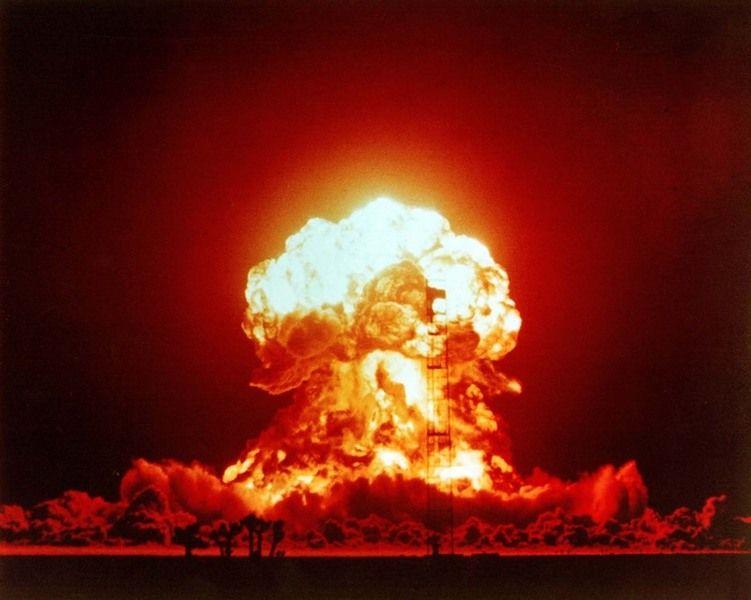
An America First national security strategy that aims above all to keep America safe, prosperous, and free at home must begin by facing a fundamental truth about our nuclear world: there is no such thing as a Cold war between hostile nuclear powers. While it may appear that the U.S. is in Cold wars with Russia, China, North Korea, and (soon) Iran underpinned by nuclear deterrence, this is an illusion. Nuclear deterrence is inherently and inescapably unstable — it can fail during a crisis if events spin out of control, and it can fail during non-crisis times if an early warning system failure triggers a retaliatory strike by mistake. Over a long enough horizon, then, a game of deterrence roulette inevitably ends with a nuclear exchange — as the U.S./Soviet struggle nearly did more than once — unless regime change in one party or the other that eliminates the hostility happens first. So, what we think of as a deterrence based Cold war is in reality a Regime Change or Nuclear Exchange (RCONE) war.
The U.S. needs a national security strategy to prevail in the RCONE wars it is fighting rather than the Cold wars it isn’t. The principal objective of this strategy must be to utilize all instruments of national power to bring about regime change in the opponent(s) in a manner that minimizes the cumulative long run probability of a nuclear exchange. That is, the U.S. needs to replace its current Cold war strategy of Integrated Deterrence/Containment with an RCONE war strategy of Integrated Rollback.
Cold Wars or RCONE Wars?
The dominant strand of U.S. strategic thought begins with the proposition that nuclear deterrence is nearly stable due to the logic of Mutual Assured Destruction (MAD). While policy-makers and researchers that operate within this strand do acknowledge in the abstract that deterrence can fail, the probability of failure is assumed to be so negligible in practice that it can be effectively ignored. Deterrence instability is then treated as an issue that can be managed rather than as the fundamental fact of any struggle between hostile nuclear powers.
To illustrate, consider the debate over how to deal with North Korea’s nuclear threat. Susan Rice, a former UN Ambassador and President Obama’s National Security Advisor from 2013 to 2017, wrote in the New York Times that “History shows that we can, if we must, tolerate nuclear weapons in North Korea — the same way we tolerated the far greater threat of thousands of Soviet nuclear weapons during the Cold War”. Along similar lines, Scott Sagan, certainly among the world’s leading scholars on nuclear policy, argued in Foreign Affairs that the U.S. “can now learn to live with a nuclear North Korea” by using the same deterrence approach “that prevented nuclear catastrophe during the Cold War”. In short, as Rice concludes, “rational, steady American leadership can avoid a crisis and counter a growing North Korean threat”. And if rational, steady American leadership in a regime of deterrence did effectively eliminate the threat of a nuclear exchange with the Soviet Union and can effectively eliminate the threat of a nuclear exchange with emerging hostile nuclear powers such as North Korea, then nuclear deterrence is indeed nearly stable.
Suppose that deterrence is nearly stable. The best strategy to deal with a hostile nuclear power is then to contain it rather than to seek to eliminate the nuclear threat that regime poses by changing its regime. The logic is straightforward: since deterrence already eliminates the nuclear threat, any strategy that aims at regime change can only increase the risk of nuclear war. As Sagan observes in the case of North Korea (but the logic applies to any hostile nuclear power), “there is no reason why Kennan’s strategy of containment and deterrence cannot continue to work on North Korea, as it did on the Soviet Union. The United States must wait with patience and vigilance until the Kim regime collapses under the weight of its own economic and political weakness”.
On the other hand, if deterrence is inherently and inescapably unstable rather than nearly stable, then deterrence does not effectively eliminate the risk of nuclear war with a hostile nuclear power. It follows that the time the U.S. spends waiting (even with patience and vigilance) for the opponent’s regime to collapse is time during which the U.S. is exposed to a significant risk of a nuclear attack. In this case, a strategy of playing deterrence roulette while patiently waiting for containment to work its magic is enormously costly in expected terms. Consequently, seeking to change the game via regime change is not necessarily foolish.
The question of deterrence stability is therefore central to both understanding the nature of the struggle between hostile nuclear powers and for deducing the right strategy for such struggles. So, how stable is deterrence?
Two of the principal sources of deterrence instability are nuclear crises and early warning system failures.
A nuclear crisis — a sharp moment of conflict between hostile nuclear powers — can result in a war that the political leadership would not explicitly choose due to a combination of imperfect control over all parties involved and the momentum of events. The Cuban Missile Crisis is the most famous (but far from the only) such crisis. Avinash Dixit, David McAdams, and Susan Sheath re-examined this dynamics of this crises in a new paper and estimate that there was a 60% chance of a U.S./Soviet war arising from this one event alone.
Turning to early warning system failures, nuclear powers build early warning systems because it is generally impossible for each country in a nuclear deterrence relationship to be certain that each possesses a secure second strike capability. This means that an opponent could (with some positive probability) have an incentive to launch a disabling first strike if that opponent knew for certain that the target would not retaliate until that strike landed. So, countries adopt a launch on warning posture (which means building an early warning system) to eliminate that certainty, thereby reducing the probability that the opponent launches a first strike to begin with.
Unfortunately, early warning systems are inevitably subject to failure risk. In the event of a false signal that the opponent has launched (or is about to launch) a first strike, the supposed target country may launch its retaliatory (or revenge) strike by mistake (which looks like a first strike from the opponent’s perspective). The Petrov incident provides a clear illustration of this danger. Plausible estimates using different methods put the risk of a U.S./Soviet nuclear exchange arising from an early warning system failure at about 1% per year.
The combination of crisis risk and early warning system failure risk together therefore imply that the average risk of a U.S./Soviet Union nuclear exchange during the Cold War was in the neighborhood of 1% to 2% per year, or 25% to 45% over a 30 year horizon. Given the consequences of a nuclear exchange, the U.S./Soviet “Cold War” was, in expected terms, by far the bloodiest war in all of human history. A struggle between hostile nuclear powers is a war, full stop.
Of course, the true long run average value of the annual probability of a nuclear exchange due to deterrence failure is highly uncertain. The crucial point is, though, that, based on evidence we have, it is clearly impossible to be very certain that this probability is essentially zero. A fundamental premise of any rational U.S. national security strategy must therefore be that deterrence necessarily entails a positive and significant risk of nuclear war for each finite period of time. It follows that, over a long enough horizon, a nuclear exchange between hostile nuclear powers becomes inevitable. That is, any struggle with a hostile nuclear power is an RCONE war, not a Cold war.
So, the U.S. needs a national security strategy to prevail in the RCONE wars that it is actually fighting rather than the Cold wars that those directing national security strategy now think they are fighting.
Prevailing in an RCONE War
An RCONE war ends with victory (regime change in the opponent before a nuclear exchange), defeat (regime change at home), or death (a nuclear exchange before regime change). Consequently, U.S. national security strategy must aim for victory. This aim implies the following objective: bring about regime change in the opponent(s) in a manner that minimizes the cumulative probability of a nuclear exchange while avoiding regime change at home. I refer to the strategy defined by this aim and objective as Integrated Rollback.
Integrated Rollback consists of five core principles that provide a coherent set of ideas about how to wage and prevail in an RCONE war.
I. An RCONE war is a cage match
In a Cold war, the U.S. wins if it doesn’t lose. In an RCONE war, the U.S. loses if it doesn’t win. So, the U.S. should adopt an offensive posture that aims for victory by inducing or bringing about regime change in the opponent before deterrence fails and before the opponent changes the U.S. regime.
For example, it is highly likely that Iran is on the North Korean path to acquiring the ability to launch a nuclear strike at the U.S. and Israel. Since nuclear deterrence is inescapably unstable, Iran getting nuclear weapons means that (in expected terms) millions of Americans and Israelis will die. The U.S. and Israel should therefore take even enormously costly actions to bring about the overthrow of the current Iranian regime and replace it by one that is less hostile to the West before that happens.
Supporting current Iranian movements that aim to overthrow the regime would be a good and obvious place to start. It is therefore simply astonishing that the Biden Administration is not already doing that. Indeed, far from pursuing the optimal strategy vis-a-vis the Iranian regime, the Biden Administration is providing that regime with billions of dollars of financial support. From an RCONE perspective, it is difficult to imagine a worse strategy for dealing with the Iranian threat than the one the Biden Administration has chosen.
II. A “Core Interest” for the U.S. is anything that materially affects regime change probabilities
The objective of Integrated Rollback is regime change. So, the metric that matters for the definition of a U.S. core interest vis-a-vis a hostile nuclear power is regime change probability, not the balance of power. Consequently, the U.S. has a core interest in any situation that affects the probability of regime change in: i) a hostile nuclear power; ii) the U.S. itself; or iii) a U.S. ally.
For example, consider whether or not the U.S. has a core interest in bringing about a Russian defeat in Ukraine while noting that: i) a Russian conquest of Ukraine will not materially affect the U.S./Russian balance of power; and ii) a Putin victory will undoubtedly strengthen his hostile regime.
Since a Russian victory would not affect the material balance of power, the Kennan strategy implies that “Ukraine is a core Russian interest but not an American one” (to quote from Jeffrey Goldberg’s interview with President Obama). The Kennan strategy therefore further implies that the U.S. should just accept that, as President Obama put it, “Ukraine…is going to be vulnerable to military domination by Russia no matter what we do”.
Integrated Rollback offers a different perspective. Since a stronger Russian regime reduces the probability of U.S. victory in the RCONE war that the U.S. and Russia are now fighting, a Russian victory in Ukraine would be a massive strategic defeat for the U.S. (not to mention a disaster for the rights of the Ukrainian people to life, liberty, and the pursuit of happiness). It follows that the U.S. does have core national security interest (as well as a moral interest) in bringing about a decisive Russian defeat in Ukraine (the same logic implies that the U.S. also has a core national security interest in preventing China from conquering Taiwan).
III. To prevail in an RCONE war, the U.S. must take risks
Once a hostile power acquires nuclear weapons, the U.S. is automatically and inescapably in an RCONE war with that power. It follows that any U.S. policy towards a hostile nuclear power short of outright surrender — including the Kennan deterrence/containment policy — carries with it a significant and unavoidable risk of nuclear war. Any strategy the U.S. takes towards a hostile nuclear power must therefore be evaluated by its overall probability of victory in the RCONE war the U.S. is locked into fighting with that opponent rather than by its immediate consequences in any given period.
In general, the Kennan strategy of waiting for the opponent to collapse is not the optimal strategy for an RCONE war. To see why, think of the cumulative probability of a nuclear exchange as a function of the immediate risk of war this period and the total risk of nuclear war over all future periods. The future risk of a nuclear exchange will of course decrease as the probability of regime change for the opponent increases (all else equal). It follows that: a) the U.S. will optimally undertake any action now that increases the opponent’s regime change probability; even if b) that action increases the immediate risk of nuclear war; so long as c) the overall cumulative probability of a nuclear exchange falls due to the decrease in the future probability of a nuclear war.
Applying this logic to U.S. policy towards the war in Ukraine shows that the debate over NATO/Russia escalation risk is completely nonsensical. The U.S. is already at risk of a nuclear war with Russia because Russia is a hostile nuclear power — supporting or not supporting Ukraine does not change that. Consequently, evaluating a policy option by asking whether or not that option increases the immediate risk of a nuclear war with Russia is completely the wrong approach. The right approach is to ask whether or not a policy option reduces the overall cumulative risk of a nuclear war with Russia over the entire course of the RCONE war that the U.S. and Russia are fighting.
From this perspective, the U.S. should be willing to run a non-trivial risk of war with Russia now in order to bring about a decisive Russian defeat in Ukraine so as to significantly reduce the risk of a nuclear exchange with Russia in the future (by increasing the Russian regime change probability). While the Biden Administration’s Ukraine policy is clearly far superior to the Obama Administration’s, the Biden Administration should go much further than it has to date to provide Ukraine with the tools it needs for victory.
IV. An RCONE War creates a zero sum relationship between the U.S. and a Hostile Nuclear Power
Any action the U.S. undertakes that will directly or indirectly improve the stability of a hostile nuclear power’s regime harms the U.S. by decreasing the probability that the U.S. wins the RCONE war with that opponent. In general, U.S. actions that improve the opponent’s economy and/or technological capabilities will improve the stability of an opponent’s regime. Such actions should therefore be prevented.
Since individuals, firms, academic institutions, etc., will not take their impact on the opponent into account while pursuing their own privately sensible goals, government must act to bring about a radical sundering of the economic/academic/technological (broadly defined) relationships between the U.S. and its RCONE opponents such as Russia and China. This sundering will look destructive, but increasing the chances of prevailing in an RCONE war is worth the economic costs that sundering entails.
The Biden Administration has gone some way towards decoupling from Russia and China, but it has not gone anywhere near far enough.
V. The opponents are fighting RCONE wars against the U.S. and its allies
While the U.S. is attempting to bring about regime change in its opponents, the opponents are of course attempting to promote regime change in the U.S. and its allies. The U.S. and its allies must therefore treat the massive ongoing efforts on the part of their opponents to infiltrate and subvert their regimes as the acts of war that they are.
In the U.S., the House Select Committee on the CCP is doing an excellent job of raising awareness of Chinese subversion efforts. Canada, Australia, and other target countries are also becoming more aware of the spy war that Russia/China/Iran/North Korea are waging against them. Awareness must be followed by action commensurate with the threat.
Conclusion
John Quincey Adams famously advised that America should not go “abroad in search of monsters to destroy”. And this may or may not be wise advice in general. It is, however, irrelevant in the context of the nuclear armed monsters that have been the subject of this essay. The inherent and inescapable instability of nuclear deterrence means that these monsters are in the house in that they pose a direct threat to the safety, prosperity, and freedom of Americans at home. It follows that the U.S. needs a national security strategy that aims to eliminate this threat. The Kennan strategy of Integrated Deterrence/Containment doesn’t do that, but Integrated Rollback does.
Integrated Rollback is the right national security strategy for America in a nuclear world.
Kevin R. James (@kevinrogerjames) is an economist in the Systemic Risk Centre at the London School of Economics.
After the Midterms, the Right Strategy Against Iran
By Lance Gordon • RealClearDefense
The Color Revolution Came Home
By Emzari Gelashvili • RealClearDefense
When Access Becomes the Fight
By Richard Byno • RealClearDefense
What the 2026 Midterm Results Mean for U.S. Strategic Competition with Rivals
By Dean Chen • RealClearDefense
Measurable by Design: Project Meridian
By Alex Willard • RealClearDefense
New USAF Force Design Bets on Technology
By Stephen Losey, Air & Space Forces
DoD Pushes $450M in Loans To Bolster U.S. Space Companies
By Hitchens, BrDefense
The U.S. Navy Needs a New Battlecruiser. Will It Get One?
By Sadler & Ouellette, NatInt
U.S. Army Rehearses Rapid HIMARS Rocket Launcher Deployment
By Global Defense N.
Coding Commander's Intent into Unmanned Systems
By Thomas Baumstark, Proceedings