
Germany's New Military Strategy Deserves a Strong U.S. Endorsement
Published May 20, 2026 • Read time: 5m
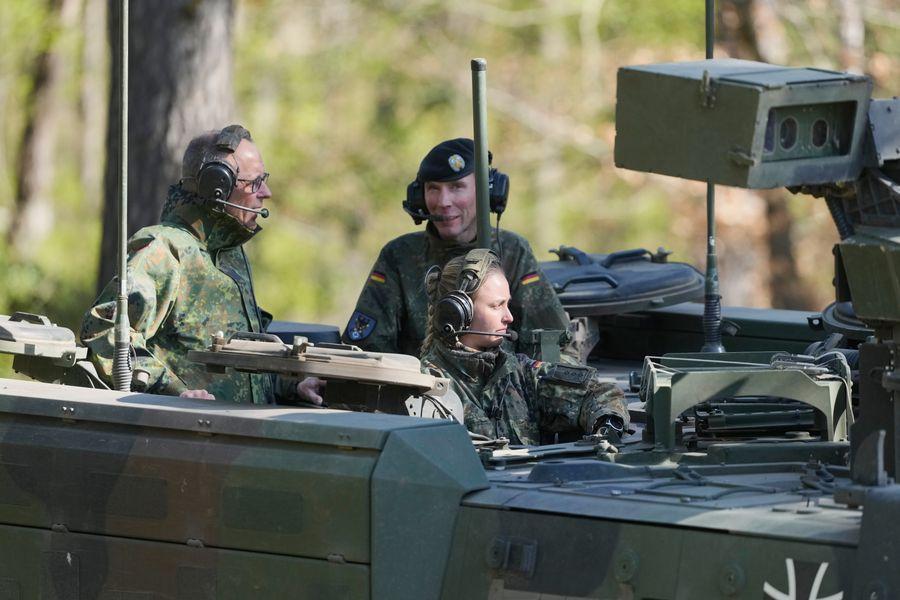
On April 22, Germany’s Bundeswehr released its first standalone military strategy, along with other planning blueprints covering related topics, such as personnel and capabilities. The document’s release occurred amid growing tensions with the U.S., as illustrated a few days later by President Trump’s announcement that Washington would withdraw 5,000 troops from the country within 6 to 12 months in response to Chancellor Friedrich Merz’s comment that Iran had humiliated Washington, and even threatened additional cuts.
Given Washington’s need to focus on higher priorities elsewhere, the Trump administration should encourage Germany to implement and build upon a strategy that will relieve Washington of Europe’s defense burden.
The document still emphasizes America's vital contributions to Europe’s security, elides some of the region’s key vulnerabilities, and remains to be implemented. Despite these limitations, Berlin’s plan shows promise.
Berlin’s strategy, titled “Responsibility for Europe,” commits to strengthening the region’s defense.
This commitment was recently demonstrated by its first permanent troop deployment in Eastern Europe and by its leadership role in the contingency planning process European leaders have initiated to defend NATO in the event of a U.S. withdrawal.
Germany could sustain its effort for some time, having shielded its defense budget from the debt-ceiling goals of its Constitution, allocated €500bn to that domain for 2025-2029, and ensured that those expenditures would not trigger (unpopular) austerity policies.
Moreover, Berlin has begun recalibrating its industrial capacity for military production.
Germany’s strategy prioritizes readiness through 2029, capability development through 2035, and world-leading technological proficiency by 2039, with investments in air defense networks, deep-strike capabilities, and other advanced assets.
It envisions fielding 460,000 troops by 2035, including a 200,000-strong reserve that will ensure homeland defense, connect active forces with the civilian population, and coordinate NATO logistics.
Germany also seeks to streamline the Bundeswehr’s bureaucratic apparatus. For instance, it will prioritize an “effects-based planning model” over specific targets and treat its planning blueprints as “living documents” to foster intellectual and managerial innovation.
Whereas Chancellor Merz and his coalition pledged to turn the Bundeswehr into “Europe’s strongest armed force,” other leading politicians in Germany are already advocating for even more.
Germany is following a coherent rationale. Whereas Russia’s invasion of Ukraine triggered its military revival, the new strategy portrays Moscow as Europe’s “greatest and most immediate threat.” The document’s classified version even discusses war scenarios.
Berlin’s ambitions also stem from growing uncertainty about the U.S. commitment to NATO.
The Trump administration has made clear in its own planning documents that, given Europe’s power potential, Washington expects its allies to “take primary responsibility for [their] conventional defense.”
Amid tensions over the war in Iran, U.S. officials have discussed adjusting their level of support (e.g., troop presence and weapons exports) for each NATO member based on that member's level of support for American policies.
Although Germany is stepping up to protect the transatlantic alliance, it recognizes the need to prepare for a potential (partial) U.S. disengagement and to gradually achieve “independence” from Washington.
Yet, like other European countries (except rare cases like Poland), Germany has a long history of overpromising and underdelivering in defense.
After decades of neglect, the Bundeswehr faces severe readiness gaps and significant deficiencies in “enabling” assets (e.g., munitions and command-and-control systems).
Its procurement, much of which has recently replenished capabilities sent to Ukraine, relies on deeply ineffective processes and remains vulnerable to disruptions in “global production capacity.”
Meanwhile, labor shortages and conservative corporate strategies constrain industrial-military output.
More broadly, support for Germany’s buildup could decline as its economy struggles.
Changing the country’s approach to the use of force could take decades, especially given its post-World War II pacifism.
For instance, only 17% of Germans would enlist to defend their country. Recent scandals involving some Bundeswehr members’ ties to neo-Nazis could further erode recruitment.
Moreover, some Germans retain a soft spot for Russia due to its victory over the Nazis, support for Germany’s reunification, and prior ties to East Germany.
For the immediate future, Berlin’s strategic dependency on Washington may endure. After all, its military strategy emphasizes that Washington is still crucial to NATO. Its industrial limitations will incentivize acquisitions from the U.S.
The Trump administration’s ambiguities compound this issue. Washington still has about 80,000 troops in Europe and wants to keep leadership over NATO’s key commands.
The administration’s recent threats to undertake punitive measures against NATO allies lack credibility. For instance, shifting troops across European states based on their respective levels of support for the U.S. war in Iran or meeting Washington’s preferred defense spending targets would be costly and cumbersome without diminishing America’s regional footprint.
President Trump has also expressed uneasiness about Berlin’s military resurgence.
Some European countries view Germany’s buildup as a potential threat to their national defense industries. Others feel uncomfortable with it because of memories of Berlin’s role during World War II. The rise of the far-right in the country only compounds those concerns.
As such, Berlin’s military rise could derail joint European defense programs and revive the region’s long-standing rivalries and strategic divergences.
The U.S. should leverage the publication of Germany’s military strategy to push European leaders to overcome their divisions and make the sacrifices necessary to achieve strategic autonomy. However, this prospect will stand a chance only if Washington chooses to abandon its hegemonic ambitions in the region.
Thomas P. Cavanna
Non-Resident Fellow, Defense Priorities and Collaborating Academic Visitor, Lehigh University

Iran’s Nuclear and Chemical Weapons Threat
By Ben Ollerenshaw • RealClearDefense
Europe’s Rearmament Paradox
By Daniel Darling • RealClearDefense
Pentagon’s Pursuit of Faster Acquisition
By Ben Harris • RealClearDefense
The Army’s AI Cyber Defenders Need a Proven Stand-Down Order
By Gleb Tsipursky • RealClearDefense
After the Silence
By Chase Skylar DeMayo • RealClearDefense
Hung Cao Facing Contentious Confirmation To Become Navy Secretary
By Konstantin Toropin • Associated Press
The First Surface Drone-v-Drone Fight
By CDR Salamander, CDR Salamander
Air Force Strengthens F-22 Raptor Combat Readiness in the Pacific
By Global DefenseAfter the Silence
By Chase Skylar DeMayo • RealClearDefense
Underwater Arms Race Puts U.S. Naval Supremacy at Risk
By Tom O'Connor, Newsweek