
The Enormous Costs of 'Science Based Stockpile Stewardship' for Nuclear Weapons
Last updated 07:23 AM EST • Read time: 22m
The most serious problem resulting from the so-called “Science Based Stockpile Stewardship” (SBSS) as a substitute for the testing of our nuclear weapons is the potential decline in the reliability of the U.S. nuclear weapons arsenal due to aging, fixing problems by making changes from the tested designs and life extension programs which have introduced even more significant changes from the tested versions. As a publication of the Lawrence Livermore National Laboratory stated “…the U.S. stockpile of nuclear weapons aged beyond its designed service life, and the national laboratories were tasked with conducting Life-Extension Programs (LEPs) to refurbish existing designs and reuse existing parts to the maximum extent possible. Because of the nature of LEPs, key production technologies were allowed to atrophy or disappear completely from the Nuclear Security Enterprise (NSE).”[1] Worse yet, as Dr. John C. Hopkins, the retired leader of the nuclear weapons program at the Los Alamos Nuclear Laboratory and nuclear weapons designer Dr. David Sharp wrote, “Those who dismiss the need for nuclear test data pertaining to weapons in their current state are gambling with the nation’s nuclear deterrent.”[2] Moreover, the reduction in reliability may be asymmetrical because of the less optimized design of Soviet-era nuclear weapons which gives Russia an advantage in a protracted no testing environment.[3]
The second most important problem is that adversaries, as President Trump has stated,[4] are covertly conducting low-yield nuclear tests, creating a potentially very serious disparity in nuclear weapons reliability and introducing new and improved designs while the United States is not.[5] The late Dr. C. Paul Robinson, in his Comprehensive Test Ban Treaty (CTBT) ratification testimony as the Director of the Sandia National Laboratory, stated that, “If the United States scrupulously restricts itself to zero yield while other nations may conduct experiments up to the threshold of international detectability, we will be at an intolerable disadvantage.”[6] It is noteworthy that the CTBT was rejected by a majority vote in the U.S. Senate.
The third most important problem is the enormous increase in nuclear weapons cost resulting from the absence of nuclear testing. According to Dr. George Miller, a former Director of the Lawrence Livermore National Laboratory, since the end of nuclear testing:
The U.S. has managed to execute a few modest life extension programs (LEPs), albeit over very long timescales. The country has spent a tremendous amount of money on improving the production capability of its nuclear enterprise with very little to show for it. Leadership, not money, has been the problem—principally the schism that was purposefully created between the laboratories, the production complex, and NNSA [National Nuclear Security Administration] headquarters. This strategy has largely been a failure, with one major opportunity remaining.[7]
Much of the cost increase is a result of the several fold increase in the length of time required for the life extension programs compared to the original time required to develop these weapons. The reverse should be true since the original warhead development programs were the product of much inferior technology and were making large performance increases rather than merely sustaining decades old capabilities. The cost increase has resulted in a large reduction in the number of nuclear weapons types in the U.S. active nuclear weapons stockpile.[8]
The stockpile stewardship programs are unique compared to the Cold War-era programs in that the United States was making great improvements in the military effectiveness of U.S. nuclear weapons which is much more difficult than life extension. For example, the Department of Energy’s National Nuclear Security Administration (DOE NNSA) stated that with regard to the W76 life extension program (the lower yield and most numerous of the two Trident warheads types) , “The W76-1 meets all missions and capabilities of the original W76-0 warhead without providing new military capabilities.”[9] (Emphasis added.) According to a publication of the Sandia National Laboratory, “Though the W76-1 is emphatically not a new weapon system, the scope of the LEP [life extension program] effort was very demanding.”[10] It is not politically correct to explain this assessment because this would not be the case if these programs were being conducted with nuclear testing.
The original W76 design, a product of the 1970s, was built with the technology of that era. The Sandia National Laboratory says that the LEP program brings W76 technology “into the 21st century.”[11] The problem is that the new technology has never been the subject of a nuclear test in the actual form of the weapons that are being life extended. The implication of this is that our main adversaries who are increasing their nuclear capabilities with nuclear testing will eventually have superior nuclear capabilities assuming this has not already happened.
The cost increase of the stockpile stewardship program is not a trivial matter in a nation that has a national debt of $38 trillion dollars which is increasing.[12] Moreover, as a direct result of the very high costs of nuclear warhead life extension without nuclear testing, there has been a large reduction in the number of weapons types in the U.S. nuclear arsenal.[13] The Obama Administration adopted the “3+2” strategy to reduce the U.S. nuclear “stockpile to three types of ballistic missile warheads and two air delivered systems, reducing the number of weapons in the deployed stockpile and simplifying maintenance requirements.”[14] The idea was to have eventually three interoperable ballistic missile warheads.[15] The Biden Administration reportedly planned on reducing the nuclear stockpile to four types.[16] In addition, the high cost of stockpile stewardship is also reducing the number of variants (“Mods”). This is reducing the military options available to the United States because it is reducing the number of warhead yields in the active stockpile since Mods frequently have different yields.[17]
These reductions are increasing the potential impact of an inadvertently stockpiled dud (i.e., little or almost no yield). This happened during the 1958-1961 testing moratorium.[18] By 2050, a stockpiled dud could result in the loss of an entire leg of the nuclear Triad.[19] Even in the best case scenario, it will reduce the number of military options available to the United States.
While many of the problems faced during the life extension programs resulted from the fact that the United States has allowed its nuclear weapons production complex to become seriously broken (i.e., in part nonfunctional), this was also a result of the same mentality that ended U.S. nuclear testing. As Dr. Miller stated, the costly efforts to restore the nuclear weapons complex have resulted in “very little to show for it.”[20] Moreover, the added cost resulting from the absence of nuclear testing makes it more difficult to fix problems (usually from old age) in the production complex. The W76, the lower yield strategic warhead for the Trident missile, a core element of the U.S. nuclear deterrent, began engineering development in May 1973 and the first production unit was completed in June 1978.[21] It was a major technical accomplishment. Reportedly, it more than doubled the yield of the previously developed and deployed Poseidon SLBM warhead (the W68).[22] By comparison, work on the life extended version (the W76-1) began in 2000 but the first production unit was delayed until November 2008 and the program exhibited a significant cost overrun.[23] This created problems for the U.S. Navy.[24]
The original development costs for the W76 was reportedly $128 million.[25] In current dollars this is $632 million.[26] The cost of the W76 life extension program to the first production unit reportedly was $912 million in then-year dollars.[27] This is about $1.477 billion in current dollars, or over twice the original warhead development cost. Moreover, this was the cheapest of the life extension programs probably because experienced designers with extensive nuclear testing experience were available to work on the program. This is no longer the case.
As noted above, the life extended W76 warhead provided no new military capabilities. The same is true for the subsequent life extension programs for other warhead types despite the fact that they have taken longer to accomplish and have been more expensive. The only partial exception were the W61-12 and the W61-13 which were given precision accuracy.
The W80, which started out as a warhead for the Tomahawk naval cruise missile and the AGM-86B long-range nuclear air-launched cruise missile, have been the subject of life extension programs. The original development time for the W80-0 and the W80-1, which were developed simultaneously with nuclear testing, was less than five years from the start of development engineering in June 1976 to the first production unit in January 1981.[28] The first of the W80 life extension programs life extended both of these warhead variants.[29] The second and the most significant life extension program, which is still underway, is creating the W80-4 for the new nuclear air-launched cruise missile, the Long Range Standoff Weapon.[30] For the last five years it has been funded at over $1 billion dollars a year and it is projected to continue at almost this level through the first production unit.[31] If the projected date for the first production unit is met, it will take 13 years.[32]
The third W80 life extension program which has been classified as an “Alt” (alteration) involves development of a variant of the W80-4 for the new nuclear SLCM-N cruise missile. It is early in its development funded at $263 million in FY2025.[33] During the nuclear testing era, the time it took to modify the first production version of the W80 warhead (the W80-1) into the W80-0 (an oddity in the usual numbering) was less than two years and in addition this program corrected a low-temperature problem with the W80 and the B61 upon which W80 is reportedly based.[34] By comparison, the development time for the W80-4 variant for the SLCM-N is reported to also be 13 years.[35] U.S. Navy Commander Ben Massengale, writing in the United States Naval Institute publication Proceedings, states, “The W80-4 Life Extension Program’s anticipated 13-year development cycle (2014–27) suggests that even the 2034 target [for the SLCM-N warhead availability] is optimistic.”[36]
There have also been multiple life extension programs and problem fixing efforts related to the B61 bomb. The program to develop the B61 began in October 1961 with the first production unit delivered in October 1966.[37] The life extended versions are taking much longer to develop.
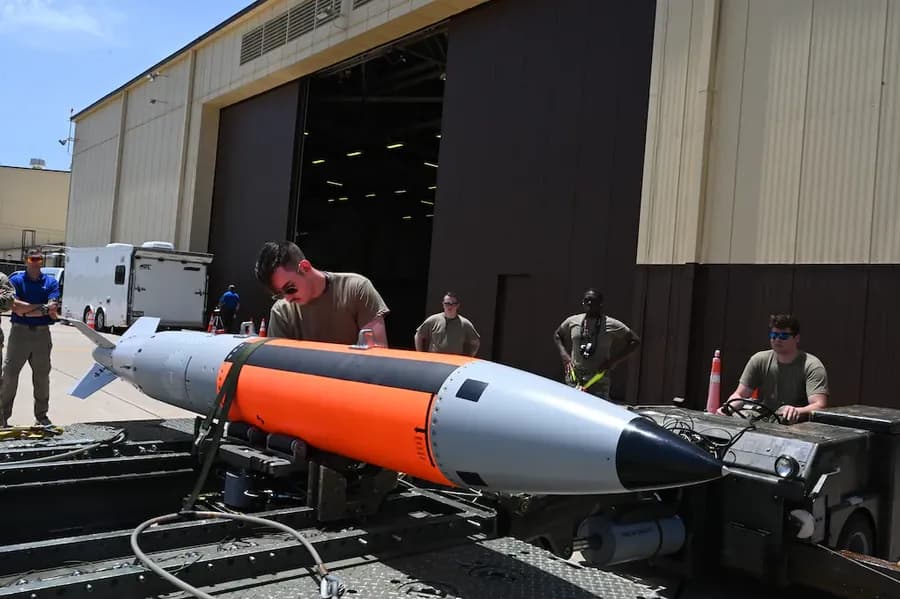
The B61-12 was initiated by the Obama Administration as a (inadequate) substitute for all the other nuclear bombs (B61 variants and the B83.). According to the Department of Energy, the W61-12 LEP “…consolidates multiple variants of the B61 gravity bomb.…”[38] This is not true. What is really happening is that multiple versions of the B61 are being eliminated without replacement. As a result, the United States has lost a lot of its yield options. The maximum yield of the B61-12 is reportedly much lower than the higher yield versions of the B61 and the B83.[39] Development engineering on the B61-12 began in February 2012 with the first production unit delivered in November 2021.[40] The bomb was clearly optimized for the non-strategic nuclear mission. This resulted in a much reduced capability against hard and deeply buried targets. The B61-13, a much higher yield version of the B61,[41] was rapidly developed by the Biden Administration apparently in an effort to persuade Congress to eliminate the B83 high-yield bomb which the Congress had blocked. The B61-13 “…features a yield oriented to the defeat of certain harder and large-area military targets.”[42] Yet, the B61-13 was actually inferior to the B83 against the hardest and deepest underground targets.[43] DOE NNSA says that the B61-12 life extension program will extend the service life of the weapon for at least 20 years.[44] Presumably, the same is true for the B61-13.
The W87 began as the warhead for the Peacekeeper ICBM, transitioned to the Minuteman III ICBM and now will be the warhead for the new Sentinel ICBM. Developmental engineering of the W87 began in February 1982 with the first production unit delivered in April 1986.[45] The development of the new W87-1 began in 2002 with the first projected production not until 2030, an 18 year development timeline although there was a gap in its development.[46]
According to the Lawrence Livermore National Laboratory, the W87 program is a “modification program” which will be the “…first newly manufactured nuclear warhead in three decades, which will replace the aging W78.”[47] The W78 started its life as a warhead for the Minuteman III ICBM. Originally, the W78 was to be life extended as a hedge against problems with the W87.[48] This changed apparently mainly due to cost. The W87-1 will involve substantial changes in the nuclear physics package without nuclear testing – using insensitive high explosive and a new pit.[49] It is being designed to be “…interoperable with the USAF Mk-21 and the U.S. Navy Mk-5 reentry vehicles.”[50] Reportedly, “…10 nuclear tests were required to certify the W-87 for stockpiling….”[51] However, the W87-1 will not be subject to a nuclear test.
The W88 is the high yield warhead for the Trident SLBM.[52] It is critically important because it is the only highly survivable U.S. nuclear warhead with substantial capabilities against very hard and very deeply buried targets. It is not the subject of a full life extension program but rather an “Alt.” DOE NNSA states that, “The W88 Alt 370 program replaces the arming, fuzing, and firing subsystem; adds a lightning arrestor connector; and refreshes the conventional high explosives within the weapon to enhance nuclear safety and support future Life Extension Program options.”[53] According to the Los Alamos National Laboratory, “Alterations are changes to a weapon’s systems, subsystems, or components. Not as extensive as a LEP, an alteration is a limited-scope change that affects the assembly, maintenance, and/or storage of a weapon. The alteration may address identified defects and component obsolescence without changing a weapon’s operational capabilities.”[54]
W88 development engineering began in March 1984 with the first production unit in September 1988.[55] The W88 Alt 370 entered development in 2012 with the first production unit taking place in July 2021.[56] The program was completed in December 2025.[57]
The W93 nuclear warhead development program is the only completely new type of nuclear weapon in the current program. It was not originally developed during the Cold War. However, the W93 is clearly not pushing nuclear weapons technology. According to the DOE NNSA, “All W93 key nuclear components will be based on currently deployed and/or previously tested nuclear designs, as well as extensive stockpile component and materials experience. However, the W93 will also incorporate modern technologies to improve safety, security, and flexibility to address future threats and will be designed for ease of manufacturing, maintenance, and certification.”[58] The W93 development began in 2020 and is still relatively early in the development cycle. Yet it has already taken more time to develop than the full development time for most of our nuclear testing-era legacy weapons.
According to the Congressional Research Service, “NNSA and the Navy have indicated that the W93 sea-based warhead will eventually replace the W76 and W88 warheads on life-extended Trident II missiles.”[59] In 2020, it was estimated that the W93 would be “fielded by 2040.”[60] More recently, a LANL publication stated that deployment would be “…likely starting in the mid-2030s.”[61] Either way, the development time would be several times as long as previous types of nuclear weapons which, unlike the W93, were major efforts to increase nuclear performance levels.
The Biden Administration’s rationale for eliminating the B83-1 bomb was that, “DoD will rely on other existing capabilities to hold at risk adversary hard and deeply buried targets.”[62] What it did not say was that none of the alternatives were nearly as effective.
The large increase in the duration of life extension programs and alterations in relationship to the original warhead development programs is a direct result of the inability to test these modified nuclear weapons. The following chart produced by DOD Nuclear Matters illustrated the enormous decline in productivity under stockpile stewardship.[63]
The very basis of the Science Based Stockpile Stewardship is the subordination of military and deterrence requirements to ideology. The desire to eliminate the B83 very high yield nuclear bomb was apparently based upon the fact it was the only U.S. weapon with a megaton range yield. The Obama Administration rationale for the elimination of the W83 was that:
Sustained support for the completion of the B61-12 will enable the retirement of the B83, the last megaton-class weapon in the U.S. arsenal, and will result in a reduction in the total number of nuclear gravity bombs in our stockpile by a factor of two, and a reduction in the amount of special nuclear material in the total number of gravity bombs by more than a factor of six. Other strategies to extend the life of the many current variants of the B61 and the B83 would likely be double the cost compared to continuing progress on the B61-12. The B61-12 is part of an integrated national strategy for the future of the stockpile. The “3+2” Strategy provides responsiveness to the inherent uncertainty of the future global security environment with a capability that is more safe, more secure, with fewer weapons and less destructive power. I cannot endorse an alternative strategy for the weapons complex that is less safe, less secure, and that requires more weapons with greater destructive power, all at higher cost to the taxpayer.[64]
Much of this rationale was bogus. The excessive costs of the life extension programs were largely the result of the prohibition on nuclear testing. The reduction of the amount of special nuclear material was largely irrelevant because the material already exists and did not have to be procured. While the accuracy upgrade of the B61-12 was useful, it had little to do with the number of nuclear gravity bombs that were required. The “3+2” strategy is increasing the potential impact of a dud. What was left out of this assessment was that U.S. capability against very hard and very deeply buried targets was being dramatically reduced by the elimination of the B61-11 earth penetrator weapon and the B83 gravity bomb. Even with the addition of the B61-13 to the program of record, U.S. capabilities against very hard and very deeply buried targets was going to decline compared to what it was before the Obama Administration or what would have been the case if the Biden Administration had continued the programs under the Trump Administration’s 2018 Nuclear Posture Review which preserved existing U.S. capabilities against very hard and very deeply buried targets.
The bottom line is that Science Based Stockpile Stewardship has been inordinately expensive and has created significant uncertainty concerning the technical effectiveness of the U.S. nuclear deterrent. The time to resume nuclear testing is sooner rather than later.
Mark B. Schneider is a Senior Analyst with the National Institute for Public Policy. Dr. Schneider previously served in DoD as Principal Director for Forces Policy, Principal Director for Strategic Defense, Space and Verification Policy, Director for Strategic Arms Control Policy and Representative of the Secretary of Defense to the Nuclear Arms Control Implementation Commission. He also served in the senior Foreign Service as a Member of the State Department Policy Planning Staff.
Notes:
[1] Lawrence Livermore National Laboratory, “W87-1 The Modification that Invigorated an Enterprise,” December 2022, https://str.llnl.gov/past-issues/december-2022/w87-1-modification-invigorated-enterprise.
[2] John C. Hopkins and David H. Sharp, “The Scientific Foundation for assessing the Nuclear Performance of Weapons in the US Stockpile Is Eroding,” Issues in Science and Technology, Vol. 35, No. 2 (Winter 2019), p. 25, https://issues.org/the-scientific-foundation/.
[3] Senator Dewey P. Bartlett, “The Consequences of a Comprehensive Test Ban Treaty” (Washington, D.C.: Government Printing Office, 1978), pp. 3-6, available at https://originalufdc.uflib.ufl.edu/AA00022237/00001.
[4] Donald J. Trump, Trump’s Truth, October 2, 2025, https://truthsocial.com/@realDonaldTrump/posts/115460423936412555.
[5] Mark B. Schneider, “President Trump Is Correct About Adversary Nuclear Testing,” National institute for Public Policy, Information Series No. 645, December 3, 2025, https://nipp.org/information_series/mark-b-schneider-president-trump-is-correct-about-adversary-nuclear-testing-no-645-december-3-2025/.
[6] “Statement of C. Paul Robinson, Director Sandia National Laboratories, United States Senate Committee on Armed Services October 7, 1999,” p. 9, https://nuke.fas.org/control/ctbt/conghearings/robinson.pdf.
[7] George Miller, “Stockpile Stewardship: What Were We Thinking? How Did It Work Out?,” in Brad Roberts, ed., Stockpile Stewardship in an Era of Renewed Competition (Livermore, CA: Center for Global Security Research, Lawrence Livermore National Laboratory, April 2022), p. 12, https://cgsr.llnl.gov/sites/cgsr/files/2024-
08/CGSR_Occasional_Stockpile-Stewardship-Era-Renewed-Competition.pdf.
[8] Mark B. Schneider, The Case for Resumed Nuclear Testing, (Fairfax Va.: National Institute for Public Policy, 2025), pp. xvii, 50-51, 66, 68, https://nipp.org/wp-content/uploads/2025/09/Vol.-5-No.-9.pdf.
[9] The Department of Energy, National Nuclear Security Administration, “The W-76 Life Extension Program Completed in 2019,” January 2022, https://www.energy.gov/nnsa/articles/w76-1-life-extension-program-lep.
[10] Bill Murphy, “W76-1 Life Extension Program milestone a Labs-wide accomplishment,” Sanida Lab News, December 4, 2009, p. 4, https://www.sandia.gov/app/uploads/sites/81/2021/07/labnews12-04-09.pdf.
[11] Ibid.
[12] United States Congress, Joint Economic Committee, “U.S. Debt Hits New Record High, tops $38.019 Trillion; Added $1 Trillion in Only 71 Days, Almost $383 Billion During the Government Shutdown Alone,” October 22, 2025, https://www.jec.senate.gov/public/index.cfm/republicans/2025/10/u-s-debt-hits-new-record-high-tops-38-019-trillion-added-1-trillion-in-only-71-days-almost-383-billion-during-the-government-shutdown-alone.
[13] Schneider, The Case for Resumed Nuclear Testing, op. cit., p. xiv. xvii, 61.
[14] “Testimony of Secretary Ernest Moniz U.S. Department of Energy Before the Committee on Energy and Natural Resources United States Senate March 3, 2016,” https://www.energy.gov/congressional/articles/house-committee-energy-and-commerce-september-15-2016-secretary-ernest-moniz.
[15] Los Alamos Study Group, “NNSA OUTLINES PRICE TAG OF ‘3+2’ VISION FOR FUTURE OF NUCLEAR STOCKPILE,” Nuclear Weapons and Materials Monitor, Volume 17, number 26, June 21, 2013, https://www.lasg.org/press/2013/NWMM_21Jun2013.html.
[16] Schneider, The Case for Resumed Nuclear Testing, op. cit., p. 57.
[17] Nuclear Weapons Achieve, “Complete List of All U.S. Nuclear Weapons,” March 30, 2023, https://nuclearweaponarchive.org/Usa/Weapons/Allbombs.html.
[18] George H. Miller, Paul S. Brown, Carol T. Alonso, Report to Congress on Stockpile Reliability, Weapons Remanufacture, and Role of Nuclear Testing (Livermore, CA: Lawrence Livermore National Laboratory, October 1987), p. 20, https://www.osti.gov/servlets/purl/6032983.
[19] Schneider, The Case for Resumed Nuclear Testing, op. cit., pp. xiv, xvii, 61.
[20] Miller, “Stockpile Stewardship: What Were We Thinking? How Did It Work Out?,” op, cit., p. 12.
[21] Nuclear Weapons Achieve, “The W76 Warhead,”, January 2007, https://nuclearweaponarchive.org/Usa/Weapons/W76.html.
[22] “Complete List of All U.S. Nuclear Weapons,” op. cit.
[23] Government Accountability Office, “Nuclear Weapons,” GAO-09-385, March 2009, pp. 3, 6, https://www.gao.gov/assets/gao-09-385.pdf.
[24] Ibid., p. 15.
[25] “The W76 Warhead,” op. cit.
[26] This calculation was based upon use of the Federal Reserve Bank of Minneapolis inflation calculator available at
https://www.minneapolisfed.org/about-us/monetary-policy/inflation-calculator.
[27] Nuclear Watch, “Each B61 nuclear warhead will cost ten times W76 warhead to refurbish,” October 10, 2013,
https://nukewatch.org/2013/10/10/each-b61-nuclear-warhead-will-cost-ten-times-w76-warhead-to-refurbish/.
[28] Nuclear Weapons Achieve, “The W80 Warhead,” August 29, 2007, https://nuclearweaponarchive.org/Usa/Weapons/W80.html
[29] Lawrence Livermore National Laboratory, “Fusion of lab efforts on W80 work.” April 20, 2001, https://www.llnl.gov/article/27671/fusion-lab-efforts-w80-work.
[30] The Department of Energy, National Nuclear Security Administration, “NNSA certifies first W80-4 warhead canned subassembly at Y-12 ahead of schedule,” September 25, 2025, https://www.energy.gov/nnsa/articles/nnsa-certifies-first-w80-4-warhead-canned-subassembly-y-12-ahead-schedule.
[31] Congressional Research Service, “The U.S. Nuclear Security Enterprise: Background and Possible Issues for Congress,” August 15, 2025, p. 25 file:///C:/Users/anner/Downloads/R48194.12.pdf.
[32] The Department of Energy, National Nuclear Security Administration, “W80-4 Life Extension Program,” November 2023, https://www.energy.gov/sites/default/files/2023-11/W80-4_1123.pdf.
[33] “The U.S. Nuclear Security Enterprise: Background and Possible Issues for Congress,” op,. cit., p. 25.
[34] “The W80 Warhead,” op. cit.
[35] Commander Ben Massengale, “The Case for Nuclear Weapons on Aircraft Carriers,” Proceedings, Vol. 151/11/1,473, November 2025, https://www.usni.org/magazines/proceedings/2025/november/case-nuclear-weapons-aircraft-carriers.
[36] Ibid,
[37] Nuclear Weapons Achieve, “The B61 (Mk-61) Bomb,” January 9, 2007, https://nuclearweaponarchive.org/Usa/Weapons/B61.html.
[38] “Testimony Statement of The Honorable Jill Hruby Under Secretary for Nuclear Security And Administrator of the National Nuclear Security Administration U.S. Department of Energy Before the House Armed Services Subcommittee on Strategic Forces,” May 17, 2022,
https://docs.house.gov/meetings/AS/AS29/20220517/115057/HHRG-117-AS29-Wstate-HrubyJ-20220517.pdf.
[39] “Complete List of All U.S. Nuclear Weapons,” op. cit.: The Department of Energy, National Nuclear Security Administration, “B61-12 Life Extension Program,” no date, https://www.energy.gov/sites/prod/files/2018/12/f58/B61-12%20LEP%20factsheet.pdf.
[40] Air Force Technology.com, “B61-12 Nuclear Bomb, USA,” November 28, 2025, https://www.airforce-technology.com/projects/b61-12-nuclear-bomb/.: The Department of Energy, National Nuclear Security Administration, “NNSA Release: NNSA Completes First Production Unit of B61-12 Life Extension Program,” December 2, 2021, https://www.y12.doe.gov/news/press-releases/nnsa-release-nnsa-completes-first-production-unit-b61-12-life-extension-program.
[41] Shannon Bugos, “U.S. to Develop Unanticipated New Nuclear Bomb,” Arms Control Today, December 2023, https://www.armscontrol.org/act/2023-12/news/us-develop-unanticipated-new-nuclear-bomb.
[42] The Department of Energy, National Nuclear Security Administration, “NNSA completes assembly of the first B61-13 nuclear gravity bomb ahead of schedule,” May 19, 2025, https://www.energy.gov/nnsa/articles/nnsa-completes-assembly-first-b61-13-nuclear-gravity-bomb-ahead-schedule.
[43] Mark B. Schneider, “The October 2023 Strategic Commission Report and U.S. Nuclear Weapons Requirements,” Information Series No. 568, December 1, 2023, https://nipp.org/information_series/mark-b-schneider-the-october-2023-strategic-commission-report-and-u-s-nuclear-weapons-requirements-no-568-december-1-2023/.
[44] “B61-12 Life Extension Program,” op. cit.
[45] Nuclear Weapons Achieve, “The W87 Warhead,” September 1, 2001, https://nuclearweaponarchive.org/Usa/Weapons/W87.html.
[46] Department of Energy, National Nuclear Security Administration, “The W81-1 Modification Program,” November 2023, https://www.energy.gov/sites/default/files/2023-11/W87-1_1123.pdf.
[47] “W87-1 The Modification that Invigorated an Enterprise,” op. cit.
[48] “THE STOCKPILE STEWARDSHIP PROGRAM Hearing of the Committee on Foreign Relations U.S. Senate July 15, 2010, George H. Miller, Director Lawrence Livermore National Laboratory,” https://www.foreign.senate.gov/imo/media/doc/Miller.pdf.
[49] The Department of Energy, National Nuclear Security Administration, “W78 Replacement Program (W87-1): Cost Estimates and Use of Insensitive High Explosives, Report to Congress,” December 2018, https://nukewatch.org/wp-content/uploads/2019/02/W78-Replacement-Program-Cost-Estimates-IHE-1.pdf.: U.S. Government Accountability Office, “NUCLEAR WEAPONS NNSA Should Further Develop Cost, Schedule, and Risk Information for the W87-1 Warhead Program,” September 2020, pp 5-6, https://www.gao.gov/assets/gao-20-703.pdf.
[50] Ibid.
[51] “The W87 Warhead,” op. cit.
[52] “Complete List of All U.S. Nuclear Weapons,” op. cit.
[53] The Department of Energy, National Nuclear Security Administration, “W88 Alteration 370,” June 2020, https://www.energy.gov/sites/prod/files/2020/06/f76/W88-Alt%20370-20200622.pdf.
[54] Los Alamos National Laboratory, “What's on board now?” July 26, 2021, https://www.lanl.gov/media/publications/national-security-science/0721-navy-warheads.
[55] Nuclear Weapons Achieve, “The W88 Warhead, October 1, 1997, https://nuclearweaponarchive.org/Usa/Weapons/W88.html.
[56] Brianna Maestas, “Pantex completes nuclear submarine warhead modernization,” Amarillo Tribune, December 16, 2025, https://amarillotribune.org/2025/12/16/pantex-completes-nuclear-submarine-warhead-modernization/.
[57] Department of Energy, National Nuclear Security Administration, “NNSA completes Last Production Unit of W88 Nuclear Warhead Upgrade,” December 16, 2025, https://www.energy.gov/nnsa/articles/nnsa-completes-last-production-unit-w88-nuclear-warhead-upgrade.
[58] The Department of Energy, National Nuclear Security Administration, “W93/MK 7 Acquisition Program,” November 2023, https://www.energy.gov/sites/default/files/2023-11/W93_1123.pdf.
[59] Congressional Research Service, “ U.S. Strategic Nuclear Forces: Background, Developments, and Issues,” December 10, 2020, p. 30, https://embed.documentcloud.org/documents/20422867-us-strategic-nuclear-forces-background-developments-and-issues-updated-dec-10-2020.
[60] Aaron Mehta, “Inside America’s newly revealed nuclear ballistic missile warhead of the future,” Defense News.com, February 24, 2020, available at https://www.defensenews.com/smr/nucleararsenal/2020/02/24/inside-americas-newly-revealed-nuclear-ballisticmissile-warhead-of-the-future/.
[61] Whitney Spivey, Ed., “Los Alamos engineers help design a new warhead for submarine-launched ballistic missiles,” Los Alamos National Laboratory, June 5, 2025, https://www.lanl.gov/media/publications/national-security-science/full-ahead-for-the-w93.
[62] “Statement of Dr. John Plumb Assistant Secretary of Defense for Space Policy before the House Armed Services Committee Strategic Forces Subcommittee (HASC-SF) on Fiscal Year 2023 Nuclear Forces May 17, 2022,” p. 7, https://democrats-armedservices.house.gov/_cache/files/3/c/3c89cba1-e46b-47ac-b468-d6a82728e23a/9D3EAC30B6857A965EDA379C73B82C17ACC362EBEDE083669A228B09E7A77A64.20220517-str-witness-statement-plumb.pdf.
[63] Office of the Secretary of Defense, THE NUCLEAR MATTERS HANDBOOK 2020 [Revised], 2020, https://www.acq.osd.mil/ncbdp/nm/NMHB2020rev/chapters/chapter4.html.
[64] “Statement of Dr. Donald L. Cook Deputy Administrator for Defense Programs National Nuclear Security Administration U.S. Department of Energy On the The B61 Life Extension Program and Future Stockpile Strategy Before the Subcommittee on Strategic Forces House Committee on Armed Services,” October 29, 2013, https://www.govinfo.gov/content/pkg/CHRG-113hhrg86075/html/CHRG-113hhrg86075.htm.

The Services Do Not Need a Four-Star Autonomous Warfare Command
By Steven Wills • RealClearDefense
Honor Them While There Is Still Time
By Jeffrey Rosales • RealClearDefense
From Siberia to Fairford: How Operation Spider’s Web Has Changed the Rules of Airpower
By Frank A. Rose • RealClearDefense
Faster Simulations, Better Defense Decisions
By Rut Lineswala • RealClearDefense
Will HASC Have an Oversight Subcommittee in the Next Congress?
By Christopher J. Bright • RealClearDefense
Hegseth Barred Trans Troops. Military Boards Are Rejecting Those Orders.
By NYT
Closing the Sea: Lessons from Ancient Mediterranean Blockades
By DeCasien, CIMSECFrom Siberia to Fairford: How Operation Spider’s Web Has Changed the Rules of Airpower
By Frank A. Rose • RealClearDefenseFaster Simulations, Better Defense Decisions
By Rut Lineswala • RealClearDefense
Bombers Could Have a Major Air-to-Air Combat Role
By Joseph Trevithick, The WarZone