
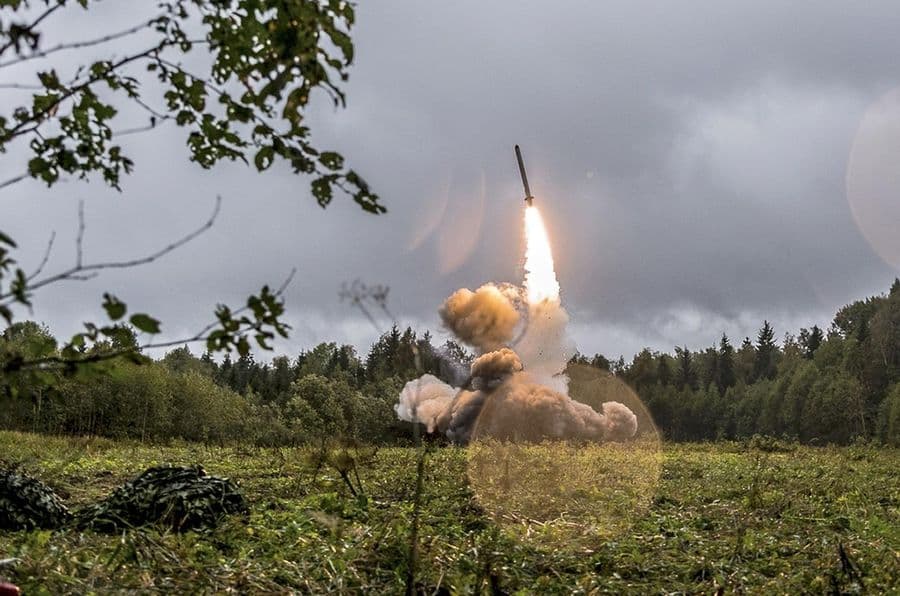
The Return of Battlefield Nuclear Weapons
Last updated 07:52 AM EST • Read time: 6m
A new Nuclear Posture Review is scheduled for release in early 2022, and it will likely diminish the role of nuclear weapons. The administration plans to adopt "integrated deterrence," a concept that claims to integrate non-military aspects of American power into deterrence strategy. However, such change may cause a deterrence failure and possible loss of a war against Russia.
Evidence of the growing relevance of what are interchangeably called non-strategic, tactical, or battlefield nuclear weapons became apparent in 2014 when Russia violated the Intermediate Nuclear Forces Treaty (INF). Given its economic and strategic limitations, Russia has pursued battlefield nuclear weapons as an asymmetric advantage against the United States. It has developed short- and medium-range nuclear missiles that can rapidly strike North Atlantic Treaty Organization (NATO) member-states—primarily with low-yield (0.1 to 10 kiloton) warheads.
Russian Approach
Although there is some debate over Russia’s approach to nuclear weapons use, it appears Russia may have an “escalate to deescalate” strategy that relies on the use of what we call battlefield nuclear weapons to win a possible war against a superior conventional NATO force maneuvering to defend a member of the alliance.
What makes such an approach highly attractive to Russia is that NATO’s dual-capable aircraft (DCA)—fighters armed with B61 nuclear bombs—are not a combat-ready force that can quickly and effectively counter Russian nuclear use on a European battlefield. Lest we forget, the Russians maintain an estimated 3,000-6,000 intra-theater nuclear weapons that vary from low to high yield and short to intermediate range. A 2017 Defense Intelligence Agency report analyzed Russia’s tactical nuclear warfare commitment revealing delivery systems that include air-to-surface missiles; short-range ballistic missiles; gravity bombs; depth charges for tactical- and medium-range bombers and naval aviation; as well as anti-ship, anti-submarine, and anti-aircraft missiles and torpedoes for surface ships and submarines.
What Russia does not maintain is a conventional force sufficient to defeat a fully mobilized NATO force. In short, Russia may seek a fait accompli using one or a small number of low-yield nuclear weapons in a limited capacity on the battlefield, for which NATO has no equivalent response.
For American forces, it is undoubtedly more difficult to deter Russia from using battlefield nuclear weapons when the United States does not have effective counters. There are approximately 150 B61 nuclear gravity bombs in NATO, but the dual-capable aircraft tasked with delivering the weapons are maintained at a low operational readiness rate and lack adequate support to reach likely targets. The United States also developed the W76-2 low-yield warhead for submarine-launched ballistic missiles, but their use risks leading to miscalculation by the Russians.
Signaling amid nuclear conflict is difficult. Nuance is rarely understood as intended. This means both deterrence, escalation, and de-escalation are more readily achieved when both sides can see and understand parity of capabilities. While it is easy to suggest that “all nuclear weapons are strategic” and there is “no such thing as a winnable nuclear war,” we cannot dismiss the reality that the use of nuclear weapons on the battlefield is a real possibility.
Two points are important to keep in mind.
First, Russia neither believes all nuclear weapons are strategic nor does it believe all nuclear war is inherently a losing proposition. President Putin understands that the United States lacks a similar capability to his own and is reluctant to respond to Russian use of low-yield battlefield nuclear weapons with strategic nuclear weapons. This creates a seam where Russia can operate.
Second, the use of one or a small number of battlefield nuclear weapons does not turn large areas into a nuclear wasteland. The destructive effects of nuclear weapons depend on the yield, height of burst, and location of the detonation.
Nuclear Weapons Effects
For example, a hypothetical 10-kiloton Russian nuclear weapon detonated at approximately 600 feet above a flat plain, like in northeastern Poland, produces no local fall-out. If detonated in a rural area ahead of advancing NATO troops, the blast wave will topple farmhouses within a one-thousand-yard radius. Thermal radiation could catch dry fields or trees on fire. Farmers and their livestock within a one-thousand-yard radius are also likely to suffer harm from prompt ionizing radiation within six hours.
However, American troops outside this radius would be unharmed and could move through the detonation zone within 63 hours without any harmful radiological effects. Should a commander urgently need to mobilize troops post-detonation, they would have access to land 3,000 feet away from ground zero within one hour.
Contrary to the perception many Americans hold about nuclear weapons, the United States, Russia, and China can tailor effects to achieve widespread destruction or limited destruction. The ability to achieve discreet effects is what makes Russia’s large and varied arsenal of battlefield nuclear weapons so dangerous and usable.
The American failure to field equivalent capabilities does not signal benign United States intent to the Russians. It signals weakness to an authoritarian, Vladimir Putin, who values strength above almost all else.
American policymakers must understand that Russia and China see the utility of battlefield nuclear weapons. The widening gap between their capabilities and our own must be closed. Too few Americans understand that we are not entering a new Cold War like that between the United States and the Soviet Union. The present is much more dangerous.
At a time of such danger and uncertainty, we must close the battlefield nuclear weapons gap by developing and fielding short- and medium-range nuclear weapons that prevent our adversaries from forcing the United States into a position where capitulation or nuclear Armageddon are our only two options. Now is the time to reject old tropes about nuclear weapons and take a cold hard look at how best to deter America’s nuclear-armed adversaries.
Robyn Hutchins is a Ph.D. candidate in the Nuclear Engineering Department at Kansas State University and a former intern at the Kansas City National Security Complex and Idaho National Lab. Dr. Adam Lowther is Director of Multidomain Operations and Professor at the Army Management Staff College. He has spent more than two decades working nuclear issues with the Navy, Air Force, and Army.
The views expressed in this article are those of the authors and do not necessarily reflect the official policy or position of Department of the Army, DoD, or US Government.
From Siberia to Fairford: How Operation Spider’s Web Has Changed the Rules of Airpower
By Frank A. Rose • RealClearDefense
Faster Simulations, Better Defense Decisions
By Rut Lineswala • RealClearDefense
Will HASC Have an Oversight Subcommittee in the Next Congress?
By Christopher J. Bright • RealClearDefense
The U.S. is Overpaying for Missiles
By Alex Lee • RealClearDefense
The U.S. Nuclear Deterrent Umbrella
By Peter Huessy • RealClearDefense
From Siberia to Fairford: How Operation Spider’s Web Has Changed the Rules of Airpower
By Frank A. Rose • RealClearDefenseFaster Simulations, Better Defense Decisions
By Rut Lineswala • RealClearDefense
Bombers Could Have a Major Air-to-Air Combat Role
By Joseph Trevithick, The WarZone
Pentagon, Lockheed Agree to 10-Year Deal for 850 F-35 Jets
By M. Scanlon, Military T.
The Marine Corps Has a Boot Problem
By Travis Pike, Sandboxx News