
Decision To Upgrade F-35 Engine Program a Win for Air Force, Navy, and Allies
Last updated 01:00 AM EDT • Read time: 5m
After the world witnessed three days of large-scale combat exercises around Taiwan from China, an area I’ve seen personally during my Navy days, I can say this as a former naval aviator: It was a pleasure to see Air Force Secretary Frank Kendall recently announce that the U.S. Air Force will upgrade the F-35’s current engine rather than switch to an entirely new design — a major win for the Air Force, Navy and our 17 allies and partners.
With growing geopolitical threats around the globe, our military leaders and representatives in Congress must make intelligent decisions about how we allocate funding to ensure our national security and global stability.
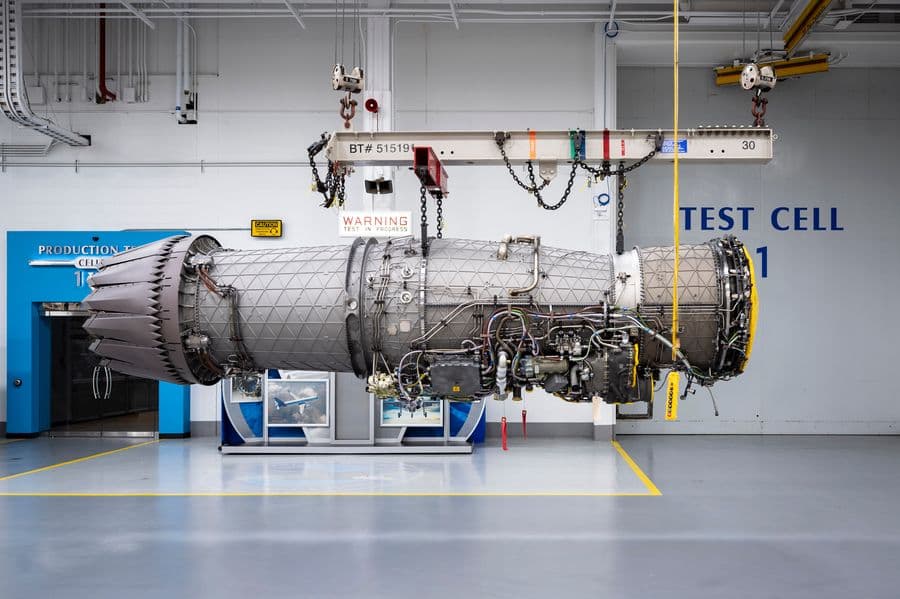
The Engine Core Upgrade (ECU) which he approved will modernize the current F135 engine to boost thrust and improve the cooling system in order to keep it superior to jet fighters from rival powers. One big reason for those improvements is allowing for more and heavier weapons to stay ahead of emerging threats in the sky.
Earlier this month on an Apple podcast entitled “Defense & Aerospace Report,” Sash Tusa of the independent equity research firm Agency Partners hit the nail on the head about a natural need for engine upgrades in aging aircraft like F-35s: “I have never known a military aircraft that has either lost weight or had reduced drag over a couple of decades of service. You must upgrade the engines otherwise you end up with fat and lazy aircraft 20 years down the line.” So true. Thus, doing nothing was clearly not an option.
Moreover, it’s a far more efficient and effective strategy to upgrade the engines you have and not start from scratch on the same airframe.
Having flown EA-6B Prowler electronic attack jets off of aircraft carriers for several years where the margin of error for takeoff and landing is zero, I can assure you that I would have much preferred the Prowler’s Pratt & Whitney engine be upgraded rather than completely replaced with a new engine, which is exactly what was recently being considered for the F-35.
Why? Because an incremental engine upgrade is the tried-and-true method of improving performance, especially for single-engine combat aircraft such as the F-35. In fact, the U.S. Department of Defense has never allowed a single-engine fighter to be re-engined because of the inherent risks to pilot safety. Instead, it has depended on derivative block upgrades based on proven twin-engine experience in other aircraft. For example, the F135 engine is based on the proven F119 engine – two of which power the F-22 Raptor flown exclusively by the U.S. Air Force.
When you have a proven aircraft and engine combination as we currently have in the F-35, it simply makes sense to upgrade a proven engine rather than replace it altogether.
The concern, of course, is that after Secretary Kendall’s good decision, the ball is now in Congress’ court which has the power to potentially overrule it by amending the current budget proposal and in effect wasting additional taxpayer dollars. Congress should back Secretary Kendall and not compel the Air Force to spend approximately $6 billion dollars more on a completely new propulsion system called the Adaptive Engine Transition Program (AETP).
Furthermore, as previously noted by this author, the U.S. Navy and Marine Corps should not have to bear the costs of an F-35 engine replacement that only the Air Force desires. The AETP option is only designed for the Air Force F-35A used on conventional runways — not the Marine Corps F-35B for vertical, short takeoff and landing; and not the Navy F-35C used in catapult launches and arrested landings.
Nor should our allies have to bear the cost of an entirely new engine as I argued in an opinion piece entitled “An F-35 Engine Swap Might not Fly Down Under.” For example, the impact on the Royal Australian Air Force would be two entirely different supply and maintenance chains for pre-2027 and post-2027 F-35 aircraft while not necessarily delivering performance improvements. It would be a costly headache for them. A similar argument could most likely be made for most if not all of the 17 allies and partners who fly F-35s or are procuring them.
As some defense experts have correctly noted, if General Electric Aviation were to win the contract to manufacture the AETP, GE’s share of our industrial base would expand exponentially, paving the path towards a monopoly for GE. Like all monopolies, costs then soar and quality declines.
Air Force Secretary Kendall has made the right decision in the F135 Engine Core Upgrade and Congress should accept this recommendation as being in the best interest of the U.S. military as well as those of our allies and partners.
Scott Gureck, a retired U.S. Navy captain, most recently served as an Executive Vice President at the U.S. Naval Institute in Annapolis, Md and president, Naval Academy Class of 1986. Military assignments include spokesman for Commander, U.S. Pacific Fleet in Pearl Harbor, U.S. Seventh Fleet in Japan, and USS Independence (CV 62) during the China-Taiwan crisis of 1996. The opinions expressed here are his own.

A Passage to the Middle East: India as a Mediator and Security Partner
By Irina Tsukerman • RealClearDefense
South China Sea is Key to Invigorate Positive U.S.–Malaysia Relations
By Brent D. Sadler • RealClearDefense
The Necropolitics of the Wasteland
By Yunus Emre Tumen • RealClearDefense
AI, Robotics, and Marines
By Gary Anderson • RealClearDefense
The Emerging SQUAD
By Muhammad Shoaib • RealClearDefense
AI, Robotics, and Marines
By Gary Anderson • RealClearDefense
AUKUS Partners Test Autonomous Maritime Systems
By Jangoulun Singsit, Naval Tech
AUKUS: USS Colorado Announced as First Submarine for SRF – West
By USNI News
Navy, Marine Corps Simulate Ship Strikes From Air and Land
By Alex Wilson, S&S
Air National Guard To Stand Up a New Special Tactics Squadron
By Patty Nieberg, T&P