
Answering the Army's Three Questions
Last updated 01:00 AM EDT • Read time: 8m
In a July 18 blog post, Hoover Institution fellow Kori Schake called out the U.S. Army for failing to make its funding case to the president, Congress, and the American people. “For the Army leadership to get ahead of the train and craft an outcome different from cuts of another 100,000 soldiers,” Schake warned, “it will need to be much more forthcoming and much more analytically persuasive than [Chief of Staff Ray] Odierno has been.”
Schake’s focus was on the size of the active component of the Army and why the number 490,000 is important and relevant to the needs of the nation. Among the more problematic aspects of Schake’s argument was her citation of a state adjutant general’s assertion that the National Guard is more cost effective than the regular Army.
The latter should not engage in an intramural fight with the National Guard Association. The Guard is more politically savvy than the active force. The ludicrous assertion that the Guard can provide a trained and ready soldier for one-third the cost of a regular soldier omits relevant facts. For example, regular Army advisers and supporting units enable Guard training. Also, institutions within the regular Army provide the schools and training facilities required to field units capable of combined arms training.
The Total Army – regular, Guard, and reserve – should be the product of realistic assessments of an uncertain world and the full range of potential requirements for trained and disciplined manpower led by equally well-trained, educated and disciplined commanders and staffs. The issue is balance and affordability relative to requirements. This sustained effort is supported by the depth provided by the reserve and National Guard. But the need for regular Army has not diminished.
Schake’s article raised three important questions for the Army. Here is my best attempt to answer them.
Why so similar to the 1990s? With more advanced technology and a more competent National Guard than in the 1990s, Schake asked reasonably why the United States would need roughly the same size active Army.
The 1990s are over, and no period of relative peace is near. Assuming that the Army won’t be needed in large numbers because we don’t want it to be is dangerous and an ahistorical way of thinking about warfare.
Technology may be more advanced today, but as we experienced in Iraq and Afghanistan, it is no replacement for trained and capable soldiers in cohesive units. Most often, technology enhances capabilities, it does not replace them.
In the 1990s, we used two potential wars as a basis for calculating force structure. We are no longer planning for two conventional conflicts, but in a way that makes force planning more difficult. Now we must make judgments about needed capabilities based on profound uncertainty.
The dark art of force design, planning and anticipating where the next war will happen is not precise. Indeed, the object is really to be not too badly wrong and have enough resilience in the active force to buy time for reserves to activate and to allow doctrine, tactics and techniques to adapt to the demands of the ongoing fight; 490,000 soldiers represents the best, affordable guess in looking at a world that is uncertain, where the challenges to U.S. vital national interests are multiple, complex, and dynamic.
Not being too badly wrong demands that the general-purpose forces in the active component of the Army be balanced forces: armored, infantry and motorized brigades, led by division headquarters in combined arms teams. Thankfully, wars are spasmodic and thus a 490,000 soldier standing Army affords the nation the ability to respond to a range of crises from hurricane relief to firefighting, because when the nation calls, the Army must respond.
Why not more in the reserve component? The Army National Guard and U.S. Army Reserve are composed of exceptionally brave men and women. That is a given. We need an active force of 490,000 because policy decisions are never made in time to meet the alert, mobilization, training and deployment time needed to bring the reserve forces into readiness for deployment. Only a force in being at a high state of readiness can meet this requirement.
The balance needed in the Total Army is about correct. The Total Army gives the nation the depth required to conduct one war, but also the depth required to respond to the range of demands of governors, disasters requiring a federal response and other unforeseen events.
Moreover, the reserve components are not self-sustaining, self-assessing or self-deploying — they need the active component. Does more structure in the reserve “save” money? I submit this is a circular argument because the nation will pay essentially the same (perhaps more) now or later. National interests are protected by the responsive, cohesive units formed by the unique training of the regular Army. That costs money. More force structure in the Guard and reserve means ready in an undetermined number of months, but not right now.
Should Army and Marine Corps roles and missions be further disaggregated? Schake wrote that in contrast to the Marine Corps, “there does not appear to be a similar refocus by the Army on its traditional strength,” namely the ability to enter a mature theater of war and engage in extended combat.
Gen. James F. Amos, the USMC commandant, stated, “America funds a Marine Corps in order to have an immediate crisis response force — what I call a hedge force.” A Marine return to amphibious operations does not mean the ability to conduct Inchon-like operations (putting 20,000 Marines ashore in days). Having 182,000 Marines ensures the nation will have three to four battalions of Marines in three to four Marine Expeditionary Units (MEUs). The MEU is a great force to show the flag, conduct non-combatant evacuation operations, and raids in support of regional combatant commander requirements.
Crisis response is not the sole mission of any force, as national leaders need a range of potential responses. The fact is that a 490,000-strong active component is the reason there are “mature theaters of war.” The forces required to open sea and air ports, run pipelines, deliver mail — in short, build the theater of war from infancy to maturity — exist in a 490,000 active Army and the reserve forces. The Marines do not open a theater and hand it over in a mature state to the Army. The role of the latter vis-à-vis the Marines is clear: Both serve the nation in complementary and supporting roles. The Army fights, sustains and wins battles over the duration of a campaign.
Furthermore, the U.S. Army is the only substantial land force in the Western world. Our European allies are reducing the size of their ground forces to the point where they could become irrelevant. A powerful regular army supported by deep reserves enables U.S. diplomacy and is the true deterrent to adventurism by forces inimical to the U.S. and our interests.
The U.S. Army checks potential opponents through demonstrated capability to wage and sustain war and through consistent, routine engagement with allies and potential partners. The Army enables diplomacy because other powers do not want to cross the line that threatens U.S. interests because our Army can wage sustained campaigns on enemy soil.
The Marines do not perform this task. Their capabilities reinforce, but do not replace, the Army.
Special Operations Forces also do not perform this task. They enhance deterrence through the demonstrated capability to strike with no warning in the conduct of limited-duration, high-risk operations.
And the Navy and Air Force do not perform this task. Air and sea forces are transitory. The former can deliver devastating bombardment and crush facilities and infrastructure. The latter can embargo ports, deliver fire from an invulnerable distance. Both, however, cannot remain for indefinite times as ships and planes must return to their bases at some point. When the Army is committed, it stays.
If the Army becomes too small, U.S. diplomacy loses powerful backing.
Schake’s point about the “message” the Army is sending is germane. If that message is not clear, it is doing the Army no good. Our Army’s case requires a public, visible post-war strategic review, similar to the effort that produced the Army’s counterinsurgency doctrine. The Army must frame the problem and develop a broad consensus on how to address it.
Military historian Roger Spiller wrote, “In the end, I think we should be honest and admit, strategy or no strategy, readiness as traditionally defined since WWII will decline. To my mind, that puts more pressure, not less, on the policymakers and strategists.” Size, and how “ready” forces are, matters. Policy makers must understand what an “X” sized force means when they face a crisis.
The Army is the force in being the nation needs to face the uncertain future.
Retired Army colonel Kevin Benson served in the U.S. Army for 30 years, following his graduation from West Point in 1977. He participated in the planning for both the start and conclusion of the war in Iraq, and now teaches at Fort Leavenworth’s University of Foreign Military and Cultural Studies.
The U.S. is Overpaying for Missiles
By Alex Lee • RealClearDefense
The U.S. Nuclear Deterrent Umbrella
By Peter Huessy • RealClearDefense
The Islamic Republic Can Lose the War and Still Win
By Nima Gholam Ali Pour • RealClearDefense
Talent Ecosystems: Building a Scalable National Security STEM Workforce
By Payuna Uday • RealClearDefense
The Underground Cloud
By Ben Poulin • RealClearDefense
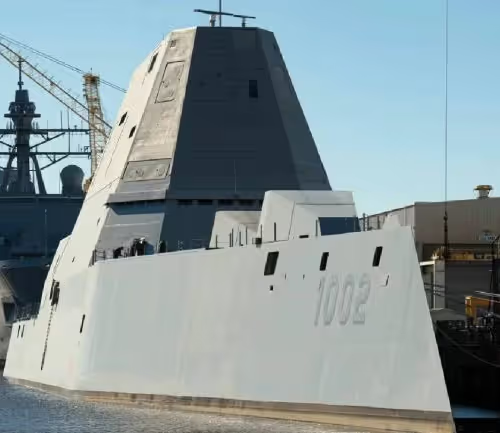
U.S. Navy to Begin Testing for USS Lyndon B Johnson (DDG 1002)
By Naval-Technology
Marine Corps Moves To Expand Maven Smart System Account Access
By DefScoop
Navy F/A-18 Spotted With New AIM-174B And AIM-260 Long-Range Missiles
By TWZ
Pentagon’s 6th Generation Stealth Fighter Will Control Drone Swarms
By Warrior M.
Air Force Needs 1,509 Combat-Ready Jets by 2035
By Michael Marrow, Breaking Defense