
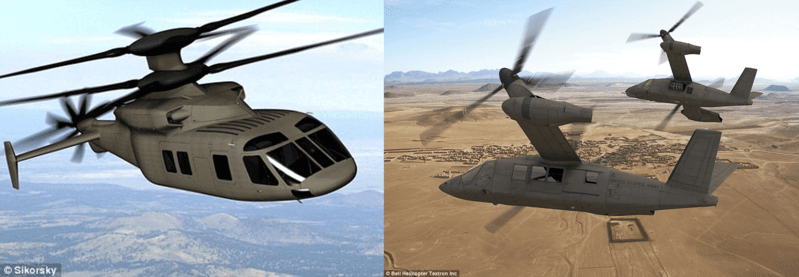
Army Must Re-Evaluate FLRAA Choice
Last updated 01:00 AM EST • Read time: 6m
On best value and integrating with allies, the Defiant is a clear winner for the future aviation platform. So why did Army pick a tiltrotor?
The Government Accountability Office (GAO) has less than 60 days to review the data and assess if the Army didn’t evaluate proposals consistently or in accordance with their own stated evaluation criteria – showing what one long-time analyst called “unequal treatment and rampant subjectivity” – in selecting an offering for its Future Long-Range Assault Aircraft (FLRAA) program.
Bottom line up front: GAO should sustain the Sikorsky-Boeing team’s protest and recommend a reevaluation of the competition because the Army did not adhere to its own “best value” criteria.
Background
In early December the Army announced its selection of Bell Helicopter’s tiltrotor technology, akin to the V-22 Osprey, over a compound rotor offering from a Sikorsky- Boeing team called the Defiant. Although Lockheed Martin does not often protest government award decisions, Sikorsky, a Lockheed Martin company, filed a protest of that decision in late December and requested GAO’s review of the Army’s decision.
A major reason for the protest, as an analyst notes, is Bell’s “significant [higher] price ” did not seem to have any bearing on the competitive selection. The protest alleges that not all criteria were evaluated equally, with preference given to the range and speed of the tilt rotor at the expense of equally important requirements that favor the Defiant compound configuration, such as high-altitude hot performance, critical in mountainous environments.
Evaluating performance beyond that which was included in the Army’s evaluation criteria is irrelevant at best and biased at worst: if the Army justified its selection of Bell using unstated requirements, it could be grounds to uphold the protest. Further, the Army would be paying a steep price for capability that it did not ask for and cannot afford.
On “Best Value” the Tiltrotor Falls Woefully Short
If both competitors met all FLRAA requirements, the tiltrotor’s significantly higher production and sustainment costs make the Defiant the best value when total life cycle cost and performance are considered.
Of serious fiscal concern is the disparity in Life Cycle Costs (LCC) between the two FLRAA competitors, especially at a time when Operation and Sustainment (O&S) demands are expected to consume 80% of the Army budget, meaning “funding available for modernization is significantly constrained.”
With such large O&S expenditures limiting modernization efforts, selecting the best value platform becomes all the more critical. Shockingly, the Army did not provide a FLRAA life cycle cost sustainment estimate that includes additional costs for training and military construction. This violates Army Regulation 70-1, Army Acquisition Policy, that requires a documented estimate of life cycle costs and affordability, considered minimum essential documentation for Army acquisition program execution.
To this point, cost and value have not been fully considered in the FLRAA competition. If an LCC estimate was provided, it would be significantly higher for Bell’s design due to its tiltrotor configuration, additional training requirements and complexity.
Consider that Bell’s configuration is 28 feet wide – 45% more than the Defiant.
This means the tiltrotor configuration will require additional ramp and hangar space. Because the Bell’s aircraft flies both as a helicopter and airplane, the Army’s training curriculum will also be required to train pilots for both fixed wing airplanes and rotary wing helicopters, increasing training time and consequently cost. The tiltrotor configuration is also more complex than a helicopter, increasing maintenance time, and decreasing the common components and repair parts, a requirement listed in the RFP.
With no operational history beyond flying a prototype in pristine conditions, one has to wonder how the Army evaluated, if at all, O&S costs for the new tiltrotor platform. On the other hand, Sikorsky and Boeing continue to provide 90% of the Army’s rotorcraft fleet and have been tested in real world conditions, yielding known O&S costs.
The Defiant’s compound helicopter design can easily be absorbed into the Army’s existing training program. It’s designed to have the same footprint as the UH-60 Black Hawk – which FLRAA will ultimately modernize – requiring minimal additional infrastructure. And while both aircraft are complex, the Defiant is very likely to have more common components and repair parts than the tiltrotor. With O&S costs consuming the budget, the significantly lower LCC of the Defiant makes a strong case as the best value.
Interoperability Will Suffer if Army Goes for the Tiltrotor
Another cost and operational consideration is interoperability with our international partners. While this critique falls outside the domain of GAO, it is well within the domain of other equities in U.S. national defense – especially for the new Congress.
On allied interoperability, again Defiant has the advantage. For the Army to meet its power projection objectives, international partners are critical; they’ll need to be interoperable with the Army’s FLRAA aircraft.
Currently, there are fewer than 500 tiltrotor aircraft operating across the US defense enterprise, and Japan is the only allied country operating the same design, presumably because of the high life-cycle costs and complexity of the aircraft. Compare that with the 2,100 Black Hawk helicopters in service with the Army, and the 1,200 Black Hawks operated by 30 international partners and allied nations around the world.
With the same footprint as the Black Hawk, the Defiant wouldn’t require additional hangar or ramp space. The compound helicopter configuration is also more familiar to support and maintenance crews. The logical assumption, given these similarities, is that allies will be more likely to want the Defiant when they choose to upgrade their own capabilities. No major changes would be required to facilities, maintenance, and support equipment, either US or allied. By contrast, the much less widely promulgated tiltrotor will require significant hangar and ramp accommodations as well as a more complex design for maintainers.
Conclusion
When it comes to meeting FLRAA requirements, LCC, and international interoperability, the best value decision is clear. Bell’s offering costs significantly more to procure, operate, and sustain. The Defiant meets all required criteria and has far lower procurement, sustainment and, interoperability costs. The Defiant delivers capability at the best value providing revolutionary performance now, while preserving the Army’s revolutions in technology and capability in the future.
Scott Trail is a retired Marine CH-46E helicopter pilot, V-22 developmental test pilot, and a member of the Society of Experimental Test Pilots.
Is It Déjà vu All Over Again: The 2012 Report on Global Zero
By Peter Huessy • RealClearDefense
As Private Investment Pours Into Defense, the Clock Is Ticking
By Elaine McCusker • RealClearDefense
The First Test of Peace Lies in Ukraine's Borderlands
By Dennis T. Cosgrove • RealClearDefense
The VFW’s Gambling Addiction Victimizes Veterans
By Jack Yoest • RealClearDefense
Superintelligence Exposes a Gap in the Law of Delegated Authority
By Sue Ghosh Stricklett • RealClearDefense
When Your Navy is too Small, the Bill Comes Due Bigly
By CDR Salamander
Quo Vadis MCU?
By Marine Corps Compass Points
When the Network Goes Dark, Who Controls the Battlefield?
By Jonathan K. Corrado • RealClearDefense
Air Force Should Buy 250 Blended-Wing Tankers, as 2027 Demo Looms
By A&SF Mag.
Long Deployments to Be Navy Standard For Next Couple Years
By Mongilio, USNI News