
Diagnosis and Cure: A Path Forward for the Navy
Published May 13, 2024 • Read time: 9m
A number of commentators have weighed in on the parlous state of the United States Navy; its deficient fleet size as well as the limitations of a shipbuilding industry that has been allowed to decay. For its part, the Navy is attempting to modernize the fleet within the constraints of current budgets by decommissioning numbers of ships that have reached or are their service life limits. Such modernization appears to include new technologies such as an array of unmanned systems, but also includes massive new Ford Class aircraft carriers and F-35 fighter jets as well as Virginia Class submarines and Arleigh Burke Class destroyers. There is controversy over what direction Navy modernization should take, with a growing number of people advocating a move toward smaller, more numerous ships. The source of the Navy’s difficulties as well as criteria for judging the suitability of a new fleet design should be understood if an effective program of recovery is to be developed.
There is a saying among naval strategists that sea power, when it is hitting on all cylinders, is invisible. What that means is that when one nation and its navy possess dominant maritime superiority, commerce flows peacefully and unobstructed. Warships make port calls to show the flag and conduct exercises with the local navy. Sailors go on liberty and spend money. The seas of the world, with isolated instances of piracy, are peaceful and calm. This is in direct contrast to the situation at sea when more than one navy is vying for command of the sea or at least attempting to disrupt that of the superior navy. Then the sea floor becomes littered with new shipwrecks and the debris of sunken ships washes up on the shore. Thousands of sailors and mariners are sent to Davy Jones’ locker. In addition to overall national policies and strategies, the difference between these two conditions of the ocean is a function of the dominant superiority of one navy over any others; its nation possesses command of the sea.
The United States has possessed virtually unchallenged command of the sea since it, along with allied navies, defeated the navies of the Axis powers. That command, maintained principally by the U.S. Navy, has lasted for the past eight decades, exceeded in modern times only by the hundred-year reign of Great Britain in the wake of the Napoleonic Wars. Command of the sea is a handmaiden of the wider condition of global leadership, the ability of a great power to establish or at least influence a world order congenial to its interests. A key element of such influence is to define and enforce a policy with respect to the status of the ocean. In the case of Great Britain for most of its reign of command of the sea and for the entirety of the U.S. tenure, the status of the ocean has been a mare liberum, a sea open to the legitimate use by the vessels of any nation, with navigation unimpeded by territorial claims. Especially in the U.S. case, its navy routinely conducts freedom of navigation operations in sea areas subject to territorial claims by coastal states in excess of the limits imposed by the 1982 United Nations Convention on the Law of the Sea. Freedom of the seas has spawned a global economy featuring the movement of massive amounts of resources like crude oil and ores, manufactured goods carrieed by huge container ships, and a network of undersea communications cables that carry the bulk of internet traffic around the world.
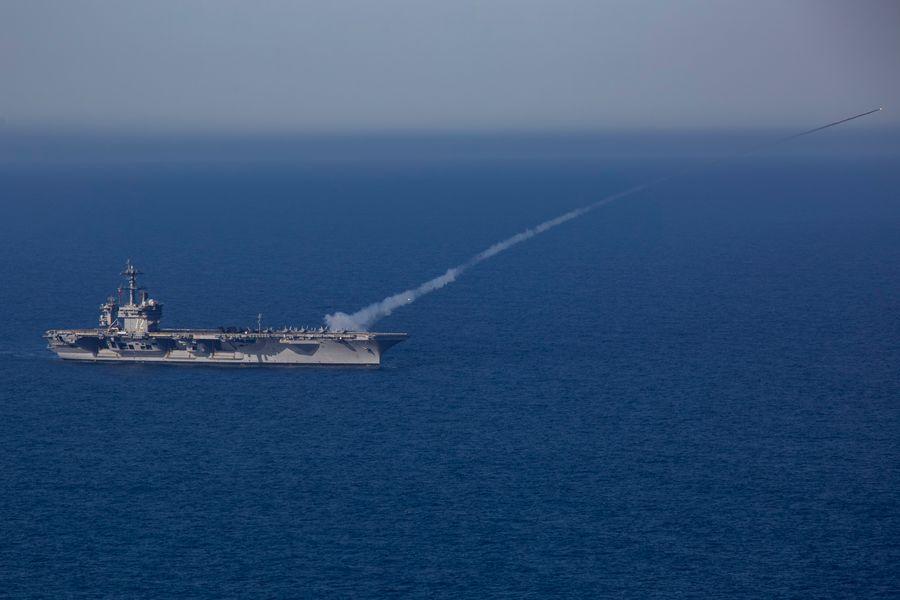
Peaceful, friendly seas have been an explicit policy of the United States, and in this, has been so successful that the underpinning for the policy has become virtually invisible. This might seem paradoxical given the massive size of American aircraft carriers and their almost routine presence in crises that seem to routinely pop up around the periphery of Eurasia, but in fact their presence in those littoral waters and their focus on projecting power over the shore is based on the now tacit assumption of American command of the sea; nobody interferes with their operations at sea. The assumption of American command of the sea has faded into the background and allowed the American public to become “sea blind,” to essentially ignore the oceans as a political space, seeing them instead, if they think of them at all, as a venue for vacations or a source of hurricanes. Thus, over time, the resource intensive Navy has been allowed to shrink and in various ways deteriorate, as Administrations sought to harvest budgetary peace dividends after the end of the Cold War.
In 1974 an article by then-Rear Admiral Stansfield Turner caused the Navy to turn its back on the concept of command of the sea.[i] Although the classic naval theorists had emphasized the importance of seizing and maintaining command of the sea, Turner asserted that the idea of “sea control” was more appropriate for the Navy’s situation at the time. Sea control, as he defined it and as it was henceforth formalized in Navy doctrine, is simply the ability to use a defined area of the sea for one’s purposes for a defined length of time. This new focus made sense for a Service whose focus was toward the shore; local sea control would be necessary to support operations over the shore. In the regionalized joint command structure, the U.S. had established after World War II, this was a more compatible concept than global command of the sea. Even now, when a burgeoning Chinese navy shows signs of wanting to extend its operations globally, the U.S. Navy resists reinstating command of the sea as a doctrinal pivot. The latest version of its keystone doctrinal publication mentions the term only in its forward and then mis-defines it as the policy of a free and open sea, which, rightly understood, is simply a benefit of having command of the sea.[ii] The Navy apparently does not want to rock the jointness boat by adopting a concept that inherently crosses joint command boundaries and perhaps appears too hegemonic.
Regardless of public indifference and Navy reluctance to embrace it, command of the sea is a real and increasingly compelling geopolitical issue, and it is that lack of awareness and acceptance by both the American public and the U.S. Navy that has led to the problematic state of U.S. sea power today. Attempting to address the Navy’s problems without understanding command of the sea constitutes a shot in the dark and could lead to a massive misdirection of effort and resources.
Command of the sea, rightly understood, is a power relationship among potentially contending navies in which those not holding command, but desiring it, either cannot or will not directly contest command with the navy holding it. Navies are expensive, especially the capital ships that have traditionally been the determinants of command, so subjecting them to risk is not a decision to be taken lightly. Even navies that are as strong or stronger than the incumbent might elect not to challenge, which reveals the fundamental role of deterrence in command. Even now, with a navy that has almost fifty percent more hulls than the USN, China has not elected to kinetically challenge U.S. Navy freedom of navigation operations in waters China claims as territory.
Command of the sea consists of two elements that are operative in both war and peace: maintenance and exercise. Peacetime concerns us here. Maintenance consists of having a sufficient margin of superiority to deter any challenge and ideally to dissuade any competitive naval building. A 1989 study of the past five centuries revealed that if a nation holding command possessed fifty percent of the total major warships possessed by all competitors, peace prevailed. When naval power became more evenly spread out, global war eventually broke out. While no causative relationship was determined, the correlation is worth noting.[iii] The U.S. actually barely maintains the fifty percent advantage, but only on the basis of overall tonnage. The question now is whether tonnage, hull counts, or some other capability is the new determinant of command of the sea – something the Navy cannot look into unless it adopts the concept of command of the sea. The other element of command of the sea is exercise. A major benefit of a nation holding command is the ability to establish or at least influence the development of a global order congruent with its security interests. To obtain that benefit the nation must extend its influence globally, which in former times meant deploying its navy with some regularity to all relevant parts of the globe and even now naval presence has relevance. That navy can be dispersed because it holds command, and the presence of its warships has meaning and influence because of both their local power and the overall power of their parent navy and nation.
Over the course of America’s lengthy reign of command of the sea, the elements of maintenance and exercise have coalesced into one fleet that performs both functions. But as that fleet has shrunk, and a serious competitor has arisen, the fusing of those functions begins to present serious strategic risks. If we regard interventions such as occurred in Korea, Vietnam, and Desert Storm as instances of exercising command (along with routine peaceful deployments) then a fundamental principle states that overall maintenance of command of the sea should not be risked during instances of exercising it. In other words, the risk/reward balance becomes critical when command of the sea is potentially under challenge. Because the U.S. Navy has used its fleet of aircraft carriers and escorts as the basis for both maintenance and exercise of command, it is now not in a good position to balance strategic risk if, for instance, it elects to face down China in a Taiwan invasion.
The magnitude, priority, and urgency of national investment in revitalizing the U.S. Navy and the character of fleet design should be based on an understanding of command of the sea, and how its disappearance from both national and Service awareness has led to the present troubles.
Captain Robert C. Rubel (U.S. Navy, ret.), was a Navy pilot who flew light-attack and strike-fighter aircraft. He retired after 30 years of active duty and then served for 13 years on the faculty of the Naval War College, including eight years as dean of the Center for Naval Warfare Studies.
Notes:
[i] Turner, Stansfield (1974) "Missions of the U.S. Navy," Naval War College Review: Vol. 27: No. 2, Article 2.
https://digital-commons.usnwc.edu/nwc-review/vol27/iss2/2
[ii] Navy Warfare Development Center, Naval Doctine Publication 1 Naval Warfare, April 2020, Foreward.
[iii] George Modelski and William Thompson, Seapower in Global Politics 1494-1993, (Seattle, WA: University of Washington Press, 1988), pp.16-17.

Iran’s Nuclear and Chemical Weapons Threat
By Ben Ollerenshaw • RealClearDefense
Europe’s Rearmament Paradox
By Daniel Darling • RealClearDefense
Pentagon’s Pursuit of Faster Acquisition
By Ben Harris • RealClearDefense
The Army’s AI Cyber Defenders Need a Proven Stand-Down Order
By Gleb Tsipursky • RealClearDefense
After the Silence
By Chase Skylar DeMayo • RealClearDefense
The First Surface Drone-v-Drone Fight
By CDR Salamander, CDR Salamander
Air Force Strengthens F-22 Raptor Combat Readiness in the Pacific
By Global DefenseAfter the Silence
By Chase Skylar DeMayo • RealClearDefense
Underwater Arms Race Puts U.S. Naval Supremacy at Risk
By Tom O'Connor, Newsweek
New Facilities To Pump Out Upgraded F/A-18E/F Super Hornets
By Trevithick, WarZone