
Finding the Truth and Standing for It
Last updated 06:40 PM EDT • Read time: 16m
I have worked closely with many admirals and spent a career living with the fruits of their labor. Unfortunately, I have grown to question the results of their work, if not the sincerity. With time and experience, it has become increasingly plain to me that there is something fundamentally wrong when the actual material condition of the fleet, its readiness to fight, and its morale are at such odds with a leadership that continues to pronounce this as the most lethal Navy ever. How have we arrived at a point at which many at sea wonder why leadership seems to have so little idea about what is going on at the pointed end of the Navy stick?
I have discussed this with a number of admirals, and they take umbrage with this perspective. In their collective view, while admitting that the Navy does face dire challenges, they contend that it is mostly out of their hands. Their masters, these admirals say, are elected officials, and admirals have little choice but to obey the orders of those appointed over them. So, if the administration says that diversity, equity, and inclusion (DEI) is the order of the day, the admirals must comply. If their masters say to rob maintenance funds to build a problematic new hull, it is out of the admirals’ hands. If a senator on the Senate Armed Services Committee says build this, not that, and in my state, if you expect me to fund anything, then that is what must be done. If the training of Sailors in sexual misconduct prevention is more important than training them how to effectively operate their equipment, it is also out of the admirals’ hands. They say that if the Chief of Naval Operations (CNO) balks at any command, no matter how antithetical that order might be to the conduct of prompt and sustained combat operations at sea, then the Secretary of Defense will instantly find a new, more obedient CNO to do the administration's bidding. In short, resistance is not only contrary to the idea of civilian control of the military, but also futile.
Evidently, the CNO is, to a certain extent, a hapless victim: A pump, not a filter.
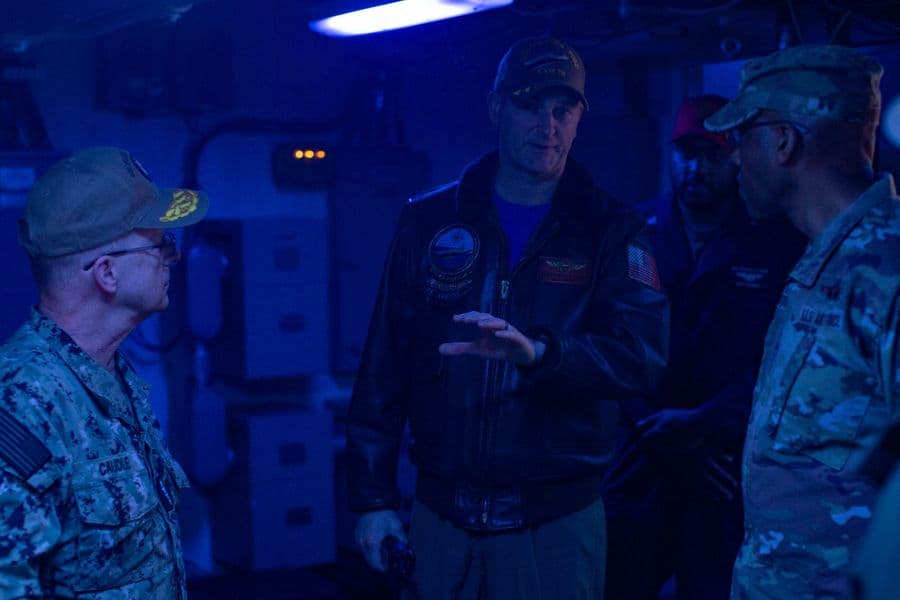
Further, there is little evidence that most admirals know much about either what life in the fleet is like or the impact of their decisions. They live in a splendid, earnest, political isolation – an echo chamber where they only hear and reinforce that which they prefer to believe. A place where the fact that ships are falling to pieces, and crews cannot do anything about it is little more than a faint rumor that lies in stark opposition to that which they choose to believe.
The Lives of Admirals
One admiral told me that “Admirals in the Pentagon are learning to become trench fighters in the inter-service and governmental wars." Long hours, enormous pressure, and great responsibility are their lot. Even the fresh-caught one-star has to make critical decisions and then carry them to fruition. It is a fantastic meat-grinder of a place, with few pleasures, and without any demonstrable metric of success, other than getting and spending as many dollars from Congress as possible: A sticky mess in which the Navy is forced to constantly revise its plan, based upon the shifting sands of partisan flavor and pork. Everyone, it is argued, is doing the best that they can.
During this struggle, an admiral makes choices (unless under an edict from above, which completely ties his hands, whether the admiral agrees with it or not). If he can choose, he might ask his staff of captains and commanders for their thoughts. A vigorous debate might be joined. In the end, though, after the admiral decides, all are expected to fully support that decision. If anyone continues to express even the slightest opposition, they will be looked at askance. The dissenters become impediments to a train that the admiral has ordered to leave the station.
Consider the case of the Littoral Combat Ship (LCS). During the decision process leading to construction, there were many captains who had spent decades at sea who expressed significant doubt regarding the ship, its cost, its potential, and its mission. Voices were raised in ways seldom heard, both in the halls of the Pentagon and in the fleet. It became a sort of cacophony. Everyone who knew warships knew the LCS to be a terrible decision, and many spoke out. However, once the decision was made to fund the ship, it quickly became evident that any captain, anywhere, who expressed even the slightest doubt was doomed to be publicly excoriated. Those who continued to carp were marked by surface force leadership as officers who "just don't get it" – essentially an effective career death knell. The train is leaving the station. In the Navy, when that happens, you are either onboard or you are under the wheels.
Admirals are Above the Law
When one is in command of a ship, squadron, or submarine, performance may be measured by hard metrics. The question of whether your aircraft fly or whether they put ordnance on target is inescapably binary. Read the papers: Those commanding officers who fail to meet the given standard, whatever that standard might be on any given day, are fired. An admiral, on the other hand, is a protected species. For an admiral to be broken on the wheel of "loss of confidence" requires them to get caught by the public doing something downright awful. Otherwise, admirals are essentially above the law.
This invulnerability has a consequence: It breeds bulletproof self-confidence. Three factors compound the certainty that grows in an admiral that he alone knows. First, the suppression of dissent. Second, once they leave major command, they have little, if any, day-to-day interaction with the operational crews of the fleet. With each passing year, they become better trench fighters – better Washingtonians – while at the same time becoming increasingly remote from the ships, squadrons, and submarines that they are supposedly representing. Third, an admiral inevitably surrounds himself with a penumbra of "yes-men." The job is difficult enough, and officers who "just don't get it" are impediments. Of course, everyone says that they don't want yes-men, but they do.
As for those captains and commanders who attach themselves to an upwardly bound admiral, they are every bit as much of the problem. The key to selection to flag rank is the advocacy of the right admiral at the right time. There are many fully qualified captains and only a few can be chosen to ascend. Those without flag support simply do not make it to the flag ranks, no matter how extraordinarily talented they might be. If you wish to join the Flag Wardroom, your advocates need to know that you get it – and that means that you believe in and support whatever they believe.
By the time you achieve three stars, you may consider yourself to be unquestionably and inevitably correct. Who knows better than you? This is your area of expertise, after all! Worse, with each additional star, you become more and more insulated from ground truth. No one tells you bad news, and your only visits to ships, squadrons, and submarines are under the most highly orchestrated and controlled conditions. While there, you certainly are not having unregulated conversations with the Sailors. No one would allow that to happen.
Historically, only CNO Admiral Jeremy "Mike" Boorda took the frequent opportunity to speak directly to Sailors. Of course, when he did this, everyone, top-to-bottom in the Flag Wardroom absolutely hated the nuisance it caused. What could Sailors possibly know?
The net result is that if you are a senior officer, you quite naturally become completely insulated from any truth that does not comport with either your own considered opinion or the thoughts and wishes of your seniors, upon whom you also depend for further advancement. Add to that the fact that an admiral does not openly disagree with another admiral. That is taboo. So, even if Admiral X may consider Vice Admiral Y to be wrong, X will never make his concern public. It is just not done. So, as is the case with his penumbra of yes-men, an admiral is not subject to critique from peers – or really anyone, for that matter.
Who is Going to Tell the Emperor He Has No Clothes?
The machine is entirely too big for even the most senior admiral to have a complete picture of what may or may not be happening in the fleet. Bad things happen out there, every day, and unless they are a major, identifiable crisis, at which a finger can be exactly pointed, these things are diffused as they go up the chain-of-command. Ultimately, little real changes take place. Too many hands, too many rice bowls, too many oxen to gore, too many imperatives in conflict with one another, too many long-term changes scheduled at great cost and trouble to truly solve the emerging big, endemic problem, let alone fully grasp it.
Admirals live in stovepipes. They have one job with one specific set of responsibilities and authorities, and these seldom overlap those of another admiral until much higher in the food chain. The admiral in charge of the strike group has no say regarding how that group is manned, trained, or equipped. The admiral in charge of preparing ships, submarines, and aircraft squadrons for deployment has no say in what ships, submarines, and aircraft are being delivered. The admiral responsible for providing the Navy's aircraft has no say as to how these aircraft will overlap with surface ship air defense. It only fits together, if it does fit together at all, almost by accident.
Consider the so-called Balisle Report of 2010. In February 2010, the Navy tasked retired Vice Admiral Phillip M. Balisle to assess surface force readiness. His report found that the Navy's attempts to create efficiencies had instead harmed the fleet, resulting in cuts to staffing, training and maintenance. Further, the report warned that unless the Navy took immediate steps to correct the trajectory of the surface fleet, it would continue to see surface ships failing and unready to fight.
The Balisle Report proved far too honest. Here was a man who took a deep dive and discovered that the surface force was on its knees. This was far more truth than could easily be necked down by the surface force, let alone the Navy writ large. Though the Navy had no intention of releasing the report to the public, it was ultimately leaked to the press, and it was only after this that an official release took place. The naked, ugly truth was told.
The result? Too many agencies were responsible. Too many dollars locked away by other interests. Go to any fleet concentration area today and walk down the piers. The surface fleet is worse today than it was in 2010.
There Is a Solution
There is a way to cut through the stovepipes, and the yes-men telling the emperors that they look fantastic. However, it must be understood that it is, as the Ayatollah once said, "like drinking bitter poison" for the Navy's leadership. One thing the Flag Wardroom hates is uncontrolled agencies or people getting the ear of senior officers. That can only lead to trouble, and by what right should an outsider be given the ear of the CNO, especially if what that person is saying may contradict what I am selling?
Still, if you are the Chief of Naval Operations you should want to hear the truth. It may not be the only truth, it may not jibe with other imperatives, it may not be a truth that anything can be done about, but it is an important one and one that represents the critical reality: Can the Navy fight and win a war at sea?
Some experienced naval personnel know what is going on in the Navy, and they are unshielded from reality in the way that an admiral is not. These are the fleet's major command captains. There is a problem with captains in major command, though. If you are one of these, and you wish to become an admiral, you know better than to say that things are going in the wrong direction. You don't want to impugn those upon whom you depend for promotion, so you need to sing the song that everything is going great! So, while we may want to constitute a "Council of Captains," we also will want to select them carefully. This means we cannot include those officers who are to be selected to flag rank, because they have already been incorporated into the machine. What is wanted are those captains who might be more competent engineers, aviators, and mariners, but who are at the same time more interested in the fleet than ascent. We want captains unafraid to say that the baby is ugly if the baby is ugly.
These captains should be selected by their fellows based upon their intellect, expertise, integrity, and ability to find and express the truth. So, in any given year, once an officer has exhausted each of his "looks" for flag selection, those remaining from his or her year group should elect a small number of their peers to represent their community in the council. This selection should be merit-based, and entirely officers from the surface, aviation, and submarine communities. Men and women who have had skin in the game. Once elected, these officers should only serve for a limited period, perhaps three years. And then, without recourse, they should be retired. Further, this Council of Captains should operate without a specified portfolio, without limitation, and with the authority of the CNO. Their only charge is to seek and find the truth, wherever that leads.
What is the effect of transgender policy? What about the Big Green Fleet? Can an Aegis destroyer replace an Aegis cruiser? What should the Navy be flying, now, and five years from now? How many and what kind of drones? Why can't we do mine warfare? Should submarines ever interact with strike groups? Every month, these officers should brief the CNO, and any other officers chosen by the CNO, depending on the topic matter selected by the council. While the CNO may suggest a topic, the council will act unilaterally. Then, if upon hearing the council, the CNO decides these officers are wrong, or uniformed, or "just don't get it," no harm done.
But the CNO will hear the truth.
The Navy Knows How to Play This Game
During the Clinton Administration, I was a Lieutenant Commander serving in the Navy Staff. One day, I was called to accompany my admiral to a meeting with one of his civilian masters, in this case, the Assistant Secretary of the Navy for Research, Development, and Acquisition. In the room was this appointed civilian, and eight admirals, all of whom reported to this person. The secretary in question quickly proceeded to "wire brush" these eight one and two-star admirals, and at length. They were not only not doing what she had told them to do, but they were plainly being willfully intransigent. To my shock, they all remained silent throughout. There was no pushback at all. When the meeting was over, and we were walking back to our office, I could not help but ask my admiral about this. From my perspective, the secretary had been wrong. Why not argue? My admiral looked at me and said something that has affected me profoundly since: In three years, she'll be gone, and we'll still be here.
In short, the Navy's leadership knows how to play the game, and claiming that civilian political appointees are the masters of all is disingenuous. The Navy is nobody's punching bag, and it never has been. In the words of President Franklin Delano Roosevelt, "To change anything in the Navy is like punching a feather bed. You punch it with your right, and you punch it with your left until you are finally exhausted, and then you find the damn bed just as it was before you started punching."
If the Navy does not like the marching orders, experience shows that it has a historic and famous capacity to slow-roll any administration. Between 1964 and the end of the Cold War, the Navy knowingly and purposely mislead the entire government into believing that the Soviet Navy was ten feet tall, when all the time the Navy’s leadership knew that the Soviet Fleet was not even remotely interested in going beyond (for example) using their fleet to protect ballistic missile submarines, hidden in home-water bastions. This decades-long deception was undertaken to ensure that the Navy got the right share of the budget. In other words, the Navy knows how to play the game.
As for that vaunted civilian oversight, it is true to say that there have been highly influential Secretaries of the Navy, for example John Lehman during the Reagan Era. Mostly though, CNOs always have found their way around those ephemeral and political visitors to the halls of naval power.
We'll still be here in three years, and they will not.
The Country Needs a Real CNO
In the early 1980s, CNO Admiral Thomas B. Hayward personally oversaw the development of the Navy's Soviet war strategy. This is no longer the case. In the post Goldwater-Nichols era, the CNO mans, trains, and equips. War is not in his wheelhouse, except as a member of the Joint Chiefs of Staff, and that seems peripheral at best, given recent CNOs who lacked the historic warfighting credentials of CNOs in the past.
Construct a Council of Captains to cut through the noise of Washington. At the same time, find CNOs tough enough to push back against – or at least subvert that which hurts the Navy's ability to fight and win the nation's wars at sea. That has been what the Navy's leadership has done for most of its history, and it is elemental to the job. Get out of your man, train, and equip stovepipe, and look at how what you do interfaces with what goes on where the rubber will meet the road – war.
Vice Admiral Balisle is doing another study for the Navy. Balisle is constitutionally unable to tell anything other than the truth. When the report comes out, there is little doubt that we will all know the temperature of the surface fleet. Once again, like an oh-so-rare comet illuminating the night sky, someone at the top will be forced to hear the truth.
But will the new report make a difference?
Captain Furay (a pen name for a real, retired Navy Captain) deployed in every tour and to operational areas in the Middle East, Western and Eastern Asia, Europe, and South America while serving in, and commanding, Aegis ships. In addition to serving as Air Warfare Commander for multiple carrier strike groups, he completed tours in both the Navy Staff and Joint Staff and attained a master’s from Harvard’s Kennedy School.

ICE Is Not a Four-Letter Word
By Meda Parameswara Reddy • RealClearDefense
The U.S. Can Draw Down in the Middle East Without Going Blind
By Cudi Zerey • RealClearDefense
America Needs a Joseph Directive
By Jeff Ballabon • RealClearDefense
Partnering Decides Whether Flexible Military Construction Can Work
By Matt Russell • RealClearDefense
Eight Months of Epic Fury and Still No Internal Alternative
By Stephen D. Cook • RealClearDefense

GE Aerospace to Supply Engines for Two US Navy Flight III Destroyers
By Defense Post
U.S. Air Force Asks Industry for New Cruise Missile for Ukraine
By Michael Peck, DNews
First Flight II San Antonio-class Amphib Completes Builder’s Trials
By Mongilio, USNI N.
LGM-35 Sentinel ICBM on Track for 2030
By Kris Osborn, Warrior Maven
On American Destroyers, Avoid a Self-Inflicted Wound in Spain
By Defense News