
Navy's New Mandate: Refurbish, Renovate, Repair, Upgrade, Fix
Last updated 05:24 AM EDT • Read time: 8m
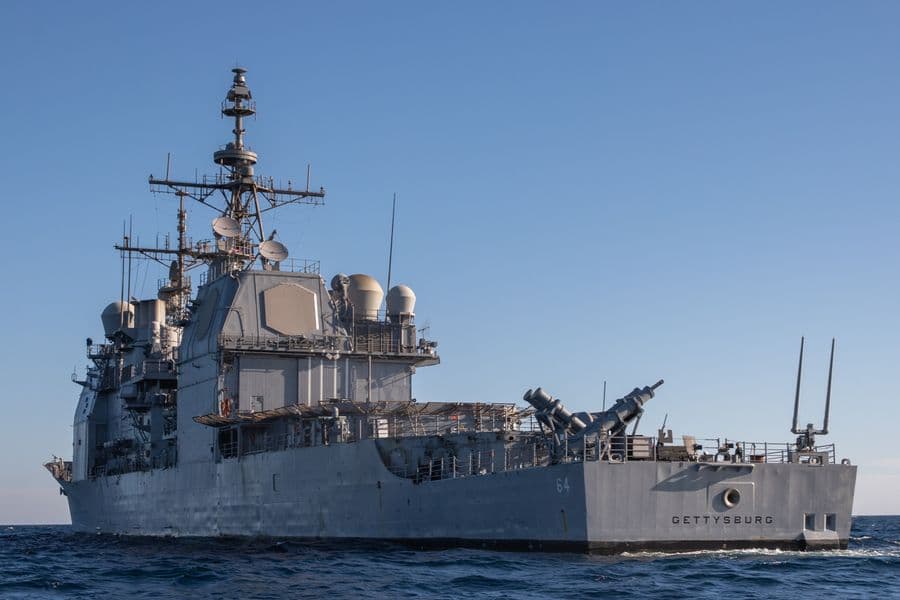
The decommissioning of cruisers and destroyers built in the 20th century, coupled with reduced shipyard build capacity, is shrinking the Navy’s number of deployed ships. The service needs an innovative approach to increasing its active ship count.
VLS-41 Launch Tube Shortfall
During the 2020s, the United States Navy expected to retire its Ticonderoga-class (CG-47) AEGIS cruisers (21 ships). Since each vessel loads its Standard and Tomahawk missiles in 122 VLS-41 launch tubes, the Navy was confronting the loss of 2,562 deployed missiles.
In the early 2000s, the Navy planned to build 32 Zumwalt-class ships, each carrying eighty missiles, deploying a class total of 2,560 missiles. This offset the Ticonderoga retirement impact, keeping the deployed VLS-41 launch tube count almost unchanged (8,512 vs 8,514). In the early 2010s, the Navy slashed its Zumwalt-class build plan to three ships (240 missiles total). In place of the cutdown Zumwalt plan, the Navy partially compensated by building, over 15 years (from first order to final commissioning), twelve Arleigh Burke, Flight II Restart destroyers, each deploying 96 VLS-41 launch tubes for a total of 1,152 launch tubes. Thus, by 2025, the Zumwalt-class plan cuts, the impending Ticonderoga-class retirements (2027 planned completion), and the offsetting Arleigh Burke, Flight II Restart destroyer build left the Navy with a slight reduction in deployed VLS-41 launch tubes (8,514 vs 8,442).
In 2024, the Navy commissioned its first Arleigh Burke, Flight III destroyer, with plans to commission an additional one in early 2025. The Navy has also laid down keels for five more ships (totaling 672 launch tubes), leaving the planned Ticonderoga retirement deficit at 486.
To partially correct a late 2020s decline in VLS-41 launch tube count, the Navy extended, until 2030, three Ticonderoga-class ships, thus preserving the fleet’s VLS-41 launch tube count above 8,000.
Currently, the Navy has 18 additional Arleigh Burke, Flight III destroyers that are either named, on order, or in the initial phases of construction, with their keels yet to be laid down. Additionally, the Navy plans to build 20 Constellation-class (FFG-62) frigates, each deploying thirty-two launch tubes for a total of 640. One frigate is currently under construction, with a planned delivery in 2029, and six are on order. When commissioned (starting in 2028), these ships will address the last of the Ticonderoga-class retirements and the upcoming retirements of 35-year-old Arleigh Burke destroyers (21 Flight I and 24 Flight II) and their 4,320 VLS-41 launch tubes. Even with a yet-to-be-realized two destroyers and two frigates per year commissioning rate, an imprecise estimate of additions to the fleet from 2025 to 2040 (Arleigh Burke destroyers: 30 ships, 2,976 VLS-41 launch tubes; Constellation frigates: 20 ships, 640 VLS-41 launch tubes) results in nearly 2,000 fewer VLS-41 launch tubes in 2040 when compared to 2025 levels.
The Shipbuilding Concern
Hobbled by shortages of trained shipyard workers, can the American naval shipbuilding establishment deliver on schedule? This is a worrying situation. So much so that President Trump is establishing a shipbuilding group in the White House so he can readily monitor and influence what is happening.
Additionally, the Navy’s surface ships will face new threats from emerging technologies such as hypersonic missiles and drones. These weapons are already making an impact in the Russia-Ukraine war and are now influencing the design of a potential new warship projected for the 2030s, the ‘Future Surface Combatant.’
The Decline of Navy Project Management
In the latter half of the 20th century, the Navy successfully introduced new technologies across its many missions: naval aviation (the F-4, F-14, and the F/A-18); submarines (numerous types of nuclear-powered SSBNs, SSGNs, and SSNs); missile systems (numerous types of SLBMs, cruise missiles, and anti-aircraft missiles); nuclear-powered aircraft carriers (the Enterprise and the Nimitz-class) and surface warships (the Ticonderoga and Arleigh Burke-classes).
In the 21st century, the Navy’s program management slipped. It has struggled with the numerous technical problems blocking the initial deployment of the Gerald Ford (CVN-78), the Zumwalt-class destroyers’ lack of a mission and delayed commissioning, the Littoral Class Ships’ early decommissioning and Freedom sub-class combining-gear problems; the inadequate hypersonic missile deployment strategy; the Columbia-class SSBNs cost overruns and schedule delays; the first ship of the Constellation-class (FFG-62) and its lengthy ten-year design to commissioning; and the slow F/A-18 to F-35C transition.
Trimming the Navy Department’s Bureaucracy
The Navy’s problems are more than technical difficulties associated with specific projects. The Navy Department’s large civilian staff (220,000 people) is prone to problems caused by a malfunctioning bureaucracy, which includes overstaffing, reluctance to embrace alternative approaches to challenges, and a slow response to problems. The Navy needs a layoff to reduce internal organizational spending, improve organizational functionality, and eliminate the shortage of shipbuilder personnel possessing critical skills.
The layoff should give the employees three alternatives: First, a buyout option, offering an immediate separation payment and benefits package based on their length of service. Second, a retraining option: the Navy Department continues pay and benefits for two years while the employee receives classroom instruction and on-the-job training in a critical shipyard skill. After completing the retraining program, the employee would separate from the Navy Department and work for the shipbuilder. Third, the Navy Department would separate the requisite number of remaining employees if the first two options did not achieve targeted staffing levels.
Increasing the Number of Deployed Launch Tubes
By 2040, because the projected Ticonderoga and Arleigh Burke-class retirements will likely cause a loss of nearly 2,000 deployed VLS-41 launch tubes, the Navy needs an alternative.
American allies, Japan and South Korea, have considerable experience building AEGIS-equipped destroyers. European nations, Great Britain, France, Italy, and Spain, build destroyers and frigates, and the Italian shipbuilder Fincantieri operates a shipyard on Lake Michigan.
Although elderly by Navy standards (35 years post commissioning or greater), the Ticonderoga-class ships were operational until their decommissioning. President Trump's shipbuilding team should consider approaching foreign nations and their shipbuilders to determine if they would repair the non-functional and degraded components on the 21 Ticonderoga-class cruisers.
After their repair, the refurbished cruisers should have their SPY-1 radar and fire control systems (Arleigh Burke Flight I level technology) upgraded to an Arleigh Burke Flight III AEGIS SPY-6 equivalent.
With all 21 Ticonderoga-class ships refurbished and upgraded, the Navy would have an additional 2,562 deployable VLS-41 launch tubes.
The Technical Challenge of the Ticonderoga-class Recovery
The Ticonderoga-class recovery project faces two significant challenges: the SPY-6 radar, the fire control system, and their high-power demands. Second, as always, cost.
While the SPY-1-based AEGIS systems needed 9,000 kilowatts of electric power delivered at 450 volts, the SPY-6 installations require more electric power (12,000 kilowatts) at a much higher voltage (4,160 volts). This 9-plus-fold increase in voltage will drive a significant wiring upgrade and the replacement of existing gas turbine-driven generators with larger units.
The Cost of the Ticonderoga-class Recovery
An Arleigh Burke Flight III destroyer (in a lot of ten) costs $1.45 billion. Repairing a group of Ticonderoga-class cruisers should cost less but would still be expensive. Assuming $500 million for the repairs and another $500 million for Arleigh Burke Flight III SPY-6 upgrades, the repair and upgrade would cost one billion dollars per ship or $21 billion for the Ticonderoga-class recovery project. The annualized cost would equal $3 billion if the effort took seven years.
To equal the deployment of 2,562 VLS-41 launch tubes carried on 21 Ticonderoga-class cruisers, if the Navy could find available capacity in American shipyards, it would need to order and build 26 Arleigh Burke Flight III destroyers (96 VLS-41 tubes per ship) for $ 37.7 billion ($1.45 billion per ship). Assuming $21 billion for the Ticonderoga-class recovery project, the Navy would pay an extra $16.7 billion for brand-new versus equivalent-to-new ships.
Repairing ships in foreign yards will bring howls of protest, particularly from affected unions. Inevitably, the dispute will become a legal and political issue. To prevail, the budget hawks and the defense advocates will have to make convincing arguments in court, in Congress, and to the public that a more capable fleet trumps the wants of special interest groups.
The Air Force and Army Practice
Since the peak of the Reagan-era buildup in 1987, the active Navy ship count has declined from 594 to 297 in 2024. While the Navy advocates talk of naval expansion, the limited shipbuilding capacity makes such a prospect unlikely.
Unlike the Navy, the Air Force and Army refurbishes and upgrades its older equipment. The Air Force purchased unwanted DC-10 airliners and successfully converted them into KC-10 tankers, which have served for many years. The Air Force has given its giant C-5B, built in the Reagan era, new engines, installed glass cockpits, and deployed the upgraded aircraft as the C-5M. Finally, the Air Force is upgrading 60 B-52s, built in the 1960s, with new engines and glass cockpits and intends to deploy them for decades. Likewise, when it makes the latest version of its M-1 tank, the Army starts the building process with an M-1 drawn from its reserve inventory.
The Challenge
President Trump has told a joint session of Congress and the American public that the Navy’s shipbuilding effort fails to meet the nation's needs.
The Navy needs to emulate its sister services and refurbish its older ships as a matter of course.
The United States cannot continue to ignore the resources available in foreign countries and miss an opportunity to solve, at least partially, its shipbuilding shortfall.
Robert (Bob) Purssell is a Massachusetts Institute of Technology graduate, Bob worked in the defense and semiconductor industry first as an engineer and subsequently as an engineering manager. Currently retired, he writes novels and gives talks on military and historical events.

The Services Do Not Need a Four-Star Autonomous Warfare Command
By Steven Wills • RealClearDefense
Honor Them While There Is Still Time
By Jeffrey Rosales • RealClearDefense
From Siberia to Fairford: How Operation Spider’s Web Has Changed the Rules of Airpower
By Frank A. Rose • RealClearDefense
Faster Simulations, Better Defense Decisions
By Rut Lineswala • RealClearDefense
Will HASC Have an Oversight Subcommittee in the Next Congress?
By Christopher J. Bright • RealClearDefense
Hegseth Barred Trans Troops. Military Boards Are Rejecting Those Orders.
By NYT
Closing the Sea: Lessons from Ancient Mediterranean Blockades
By DeCasien, CIMSECFrom Siberia to Fairford: How Operation Spider’s Web Has Changed the Rules of Airpower
By Frank A. Rose • RealClearDefenseFaster Simulations, Better Defense Decisions
By Rut Lineswala • RealClearDefense
Bombers Could Have a Major Air-to-Air Combat Role
By Joseph Trevithick, The WarZone