
The Navy's Failure Is SecDef Hegseth's
Last updated 06:29 AM EDT • Read time: 4m
The Navy is failing at one of its most important jobs: keeping the Strait of Hormuz open. Ensuring that the commercial shipping lanes remain open and safe was the very rationale for creating an American Navy. Over the years, we added additional core missions – deterrence and power projection. But protecting the sea lanes was the reason Congress passed the Naval Act of 1794 and authorized the construction of six frigates including the USS Constitution.
That failure, however, is on the Secretary of Defense, Pete Hegseth. The Administration’s inability to secure any allied support may ultimately devolve to the President. But the combatant commanders report to the SecDef, and he has full authority for missions and forces.
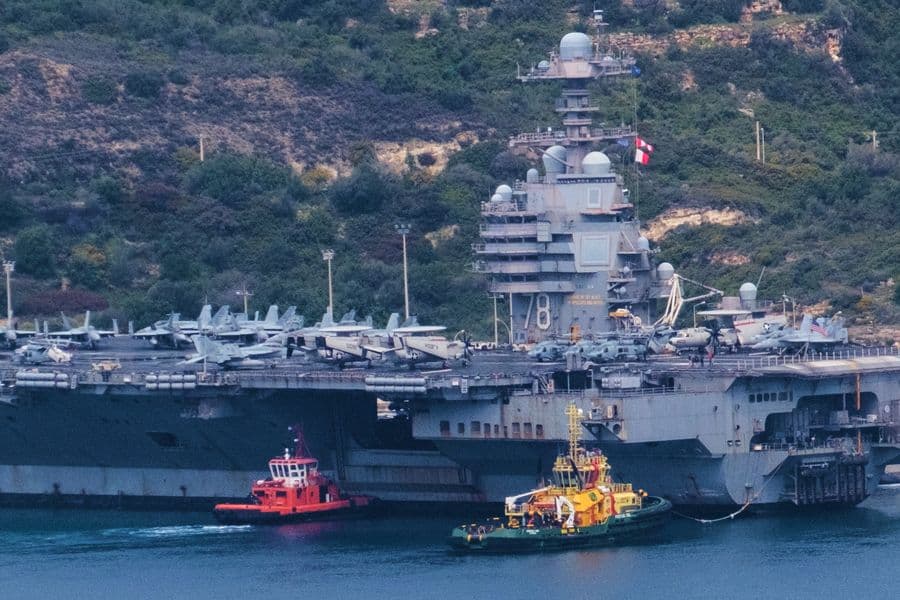
Let’s be clear: Iran has effectively shut down the Strait of Hormuz, through which 20% of oil, 20% of LNG, and one-third of the world’s fertilizer trade pass each year. And at best, Iran will continue to control the Strait for at least the next three to four weeks; and possibly longer. One of America’s most effective tools for degrading Iran’s military capability – the nuclear aircraft carrier USS Gerald Ford – is out of commission for the next several weeks as it undergoes essential repairs in Souda, Crete following a 30-hour fire that started in the ship’s laundry room.
The American war effort has unquestionably been a success on several levels: Iran’s ability to launch ballistic and cruise missiles has been seriously degraded; its leadership decapitated; its nuclear development program seriously degraded; and its navy sunk. One particularly telling measure is that American jets are using their nose canons to strafe targets – a clear indication that Iran’s air-defenses are no more.
But Iran is still able to control the Strait for two reasons: first, the geography makes it difficult to protect commercial traffic. As a retired senior naval strategist explained, “It is a narrow navigable channel and plenty of places to hide missile launchers along the Iranian shore or to launch small boats equipped with mines. The confidence of shippers and insurance companies is as important as kinetic defenses. And second, to protect tankers over time, a lot of ships would be needed and that's why we would need allied forces.”
The Navy has conducted “dozens, if not hundreds” of war games for Hormuz. Many involved allies. And as another senior naval strategist said, “In every wargame I have seen or was a participant since 1979, the Strait got closed.” Now, without any allied involvement, we are scrambling to fill the void. The USS Tripoli, an amphibious warship carrying 2,200 Marines and at least 19 F-35 fighter jets is on its way to the Iran war zone from its home port of Sasebo, Japan. And two – possibly three – small littoral combat ships equipped with minesweeping packages are enroute from Malaysia. But the 4,000-mile journey for all these ships means their presence in-theater is not happening tomorrow.
President Trump’s (shifting) statements on the war’s objectives and prognosis notwithstanding, the question of America’s ability to ensure the Strait remains open and safe for commercial ships remains uncertain. And that uncertainty not only threatens oil supplies and financial markets, but colors thinking about (and funding for) the Navy.
Mr. Trump has proposed funding a new class of battleship, cancelled one frigate class, and proposed another. There are no plans to build more minesweepers, and in fact the Administration just decommissioned four Avenger-class minesweepers and ordered their demolition. To get USS Ford back into the game, the Navy has diverted 1,000 mattresses from the still-under-construction USS John F. Kennedy and sent to Crete, along with 2,000 sweatsuits and other clothing items for Ford’s sailors who are unable to get clean clothes while the ship’s laundry is out of service.
In short, the Navy’s woes would seem almost comical if they weren’t also strategic. Ultimately, the buck stops with President Trump. But his principal military advisor, self-proclaimed Secretary of War Hegseth, needs to be held accountable. Did he tell the President that America had almost no minesweepers? Did he admit that without allies, most of the war-game scenarios for keeping the Strat of Hormuz open were not promising? Did he ever share naval experts’ assessments that Mr. Trump’s golden fleet of battleships was not what the nation needed to achieve deterrence, force projection, or to keep the commercial sea lanes open?
The Navy must be held accountable for carrying out its missions. But so must their civilian overseers.
Steve Cohen is an attorney at Pollock Cohen and a former member of the Board of Directors of the United States Naval Institute.

The Services Do Not Need a Four-Star Autonomous Warfare Command
By Steven Wills • RealClearDefense
Honor Them While There Is Still Time
By Jeffrey Rosales • RealClearDefense
From Siberia to Fairford: How Operation Spider’s Web Has Changed the Rules of Airpower
By Frank A. Rose • RealClearDefense
Faster Simulations, Better Defense Decisions
By Rut Lineswala • RealClearDefense
Will HASC Have an Oversight Subcommittee in the Next Congress?
By Christopher J. Bright • RealClearDefense

Hegseth Barred Trans Troops. Military Boards Are Rejecting Those Orders.
By NYT
Closing the Sea: Lessons from Ancient Mediterranean Blockades
By DeCasien, CIMSECFrom Siberia to Fairford: How Operation Spider’s Web Has Changed the Rules of Airpower
By Frank A. Rose • RealClearDefenseFaster Simulations, Better Defense Decisions
By Rut Lineswala • RealClearDefense
Bombers Could Have a Major Air-to-Air Combat Role
By Joseph Trevithick, The WarZone