
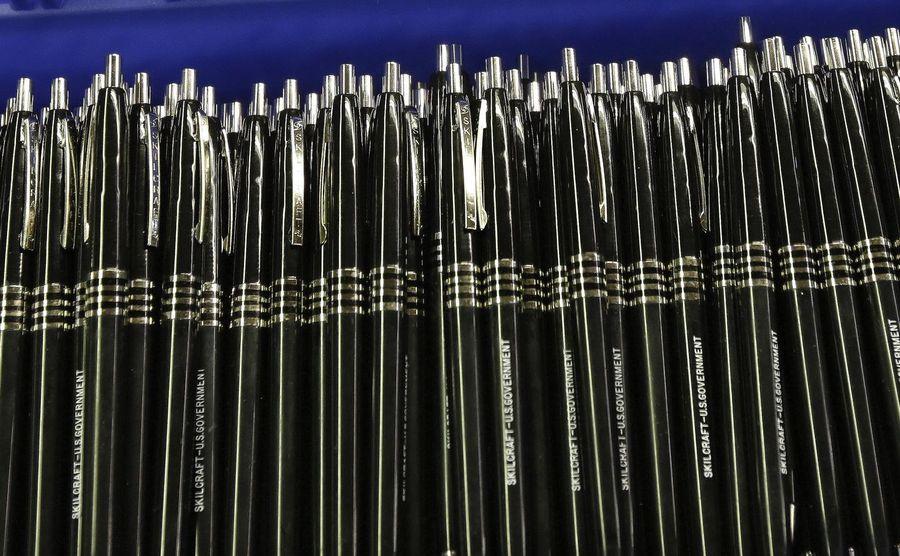
Iconic Pen Used by Military, Made by Blind People Turns 50
Last updated 05:28 PM EDT • Read time: 4m
GREENSBORO, N.C. (AP) — Clifford Alexander scoops a handful of black ballpoint pens, drops them into a small box and shakes it with a blackjack dealer’s nonchalance. He slides in the next handful to make an exact dozen, and sends the box down the assembly line.
Alexander, who is blind, performs the quick act again, box after box.
Anyone who’s served in the military, worked for the federal government or addressed a package at the post office is familiar with the handiwork. But they might not have realized that all the ubiquitous SKILCRAFT U.S. Government pens were made by the visually impaired. The pens turn 50 this month.
The pen’s history traces back to April 20, 1968, when it was introduced to government buyers, said the National Industries for the Blind. The nonprofit organization was tapped to supply pens after another manufacturer made 13 million defective ballpoints in 1967.
The pens have stringent requirements — 16 pages worth. The pens must be able to write a continuous line 1 mile (1.6 kilometers) long and keep the ink flowing despite extreme temperatures — from 40 degrees below zero to 160 degrees (4 to 71 degrees Celsius).
For five decades, the task of making those pens has been entrusted to blind workers.
The pens, used by government employees, must be able to write a continuous line 1 long and keep the ink flowing despite extreme temperatures - from 40 degrees below zero to 160 degrees Fahrenheit. (April 27)
“It may take us longer to learn it, but once we learn those jobs we do those jobs very well,” said Alexander, who supervises about 30 Greensboro pen workers. “And we turn out a top quality garment or writing instrument.”
The pen is well-known among military and government families after finding its way into purses and backpacks for years. It’s also been used by the military as improvised devices to plug holes in pipes on boats or perform emergency medical procedures.
The pens are sold to the federal government through a program started in 1938 to create jobs for people with disabilities. In 2016, the AbilityOne program sold $3.3 billion in goods and services, with more than half coming from military orders.
Alexander said his 47 years at the North Carolina plant has helped him to buy a home and educate his children. The plant employs about 140 visually impaired people to make products ranging from Army combat jackets to clipboards.
In the pen’s heyday, the government bought about 70 million per year. Now the Greensboro plant and a second in Milwaukee combine to produce about 8 million of the flagship retractable ballpoints annually, with parts supplied by a third site in Missouri. All three employ visually impaired workers.
Lynn Larsen, who’s worked at Greensboro Industries of the Blind for 40 years, said the job helped her support her family after her father died. More recently, it was a source of pride when her nephew deployed to Afghanistan with the Army.
“He would tell the other soldiers that his aunt Lynn made that pen, and they thought it was real cool,” she said.
The Greensboro workers earn well above minimum wage and can reach around $24 per hour, said Richard Oliver, the site’s director of community outreach and government relations.
The benefits go beyond the pay, said Oliver, who is legally blind himself: “We didn’t get the opportunity to serve in the military ... so this is our way to serve.”
“It gives our people a really big sense of pride,” he said.
Steven Gray, a retired Navy lieutenant commander, said he read a number of accident reports about the pens being used aboard ships for emergency tracheotomies during a stint at the Naval Safety Center in Norfolk.
“It was an achievement to actually have your pen run out before you lost it,” said Gray, who also served at sea on five vessels. “That was something everybody noticed, ‘Hey I actually burned through a SKILCRAFT pen this morning.’”
Follow Drew at www.twitter.com/JonathanLDrew
© Copyright 2018 Associated Press. All rights reserved. This material may not be published, broadcast, rewritten or redistributed.
2949 Marine Prisoners, Hostages, and Peacetime Governmental Detainees Since Our Corps' Founding
By Jon Couch • RealClearDefense
America Must Win the Biotech Race Against China
By Rob Maness • RealClearDefense
How Digital Twins Can Strengthen Naval Readiness Before a Crisis Begins
By Carl Napoletano • RealClearDefense
The Uninsured Sky
By Joe Sandri • RealClearDefense
Counterterrorism and the Growing Convergence in Homeland Security and Homeland Defense
By Austin Doctor • RealClearDefense
How Digital Twins Can Strengthen Naval Readiness Before a Crisis Begins
By Carl Napoletano • RealClearDefense
F-16s Build on Iran Combat Lessons to Prepare for China Threat
By Rebecca Grant • Lexington Institute
U.S. Aircraft Evacuated From Second U.K. Base Due to Iran Threat
By Holliday, et al, WSJ
US Marine Corps Acquires Textron’s Ripsaw M3 Uncrewed Ground Vehicles
By DPost
U.S. Navy’s First San Antonio Flight II USS Harrisburg Completes Sea Trials
By GDN