
A Monroe Doctrine for AI
Published March 31, 2026 • Read time: 4m
Why American AI Must Power the Western Hemisphere, and How
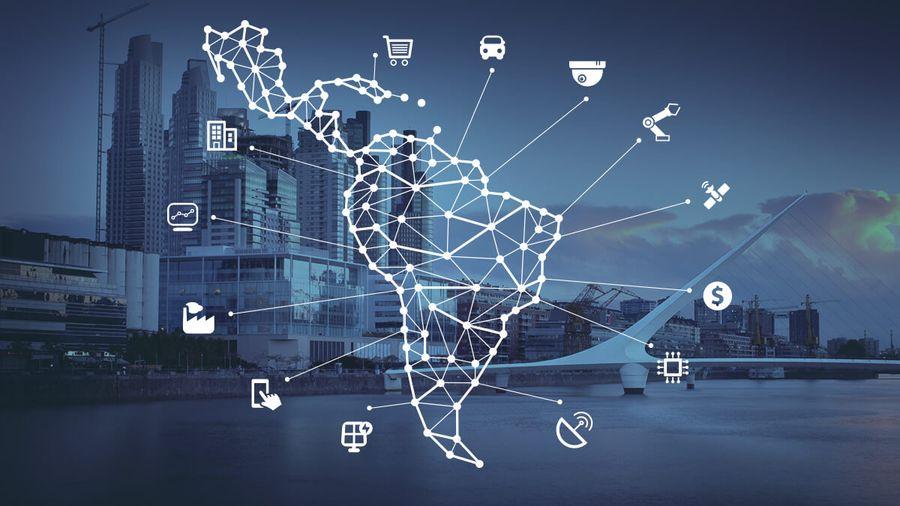
Secretary of State Marco Rubio recently observed that American security and prosperity are inextricably tied to the Western Hemisphere. This will be even more true in the age of artificial intelligence, where the global race for supremacy will be won or lost in our own neighborhood. To prevail, the United States must ensure that the Americas, from Canada to Chile, run on American AI and U.S.-aligned AI infrastructure. The Monroe Doctrine, which barred foreign powers from encroaching in the Americas, is as relevant in the Age of AI as it was in the 19th and 20th centuries.
If China supplies Latin America’s AI infrastructure, it won’t just sell cloud services, it will set the technical standards, lock in long-term revenue streams, and embed political leverage into the region’s digital backbone. If the United States leads instead, it secures markets for its companies, reinforces a rules-based digital ecosystem, and anchors the hemisphere’s economic future in American innovation. This is not just a commercial competition; it is a contest that will determine the dominant superpower of the 21st century.
There is no time to waste. China is already deep at work in the Western Hemisphere’s most crucial markets. Huawei Cloud operates in five Latin American countries, doubled its Brazil revenue last year, and is deploying Spanish- and Portuguese-language AI models purpose-built for the region. Right on our own southern border, Alibaba opened its first Latin American data center in Mexico. Mexico City already runs on Huawei.
The Color Revolution Came Home
Dispatch From New York: Latin America Has Opened a New Chapter With Washington
Senate Defense Bill Shines Spotlight on Latin America
Canada's Broken Immigration Gate Is an American Security Problem
Even more worrisome is China’s rush to lock down energy in power-rich countries like Brazil. Powered land is the foundation of the AI stack, and supply is falling far short of demand, especially in the U.S. Reliable energy infrastructure to power massive data centers, which is already becoming the dominant bottleneck in the global AI competition. Powered land that is not with us will be used against us. In Brazil, the largest market in the Western Hemisphere outside the U.S., Tencent and ByteDance are already negotiating entry under a new tax-incentive regime. A February report from Geopolitical Intelligence Services found that Huawei controls 44.6% of Brazil’s 5G infrastructure, the network layer over which AI services will run. This is the telecom playbook: cheap state-backed financing, turnkey packages, dependency on Beijing.
To illustrate this opportunity in terms of energy, Bernstein Research estimates that one gigawatt of AI data center capacity costs about $35 billion to build, with roughly $50 billion per gigawatt more in recurring GPU revenue every replacement cycle. This means that Brazil’s projected 13 gigawatts, based on converging projections from Brazilian industry sources, Industrial Info Resources, and U.S. government estimates (trade.gov), alone represent a half-trillion-dollar market that is ours to lose.
Michael Kratsios, President Trump’s science and technology advisor, has emphasized that the United States must pursue both “promotion and protection” to maintain leadership in critical technologies. This means not only making superior American solutions available but protecting our competitive advantages. One advantage is the Western Hemisphere, where supply chains are shorter and more secure and American influence more deeply rooted.
A Monroe Doctrine for the Age of AI offers Latin American governments their fastest route to AI-enabled modernization without ceding sovereignty to Beijing. It mitigates the risks of AI diffusion by controlling deployment, not just chip supply, ensuring advanced compute in the region runs on trusted U.S. infrastructure, standards, and access controls. It bolsters demand the American semiconductor industry needs to stay ahead in the AI race.
Carl Meacham is Head of Sovereign AI & Business Development at Hydra Host, where he leads partnerships and government engagement to deploy sovereign AI infrastructure—scalable, bare-metal GPU compute that supports national security and economic competitiveness.
Kai Golden leads Sovereign Finance and Capital Markets at Hydra Capital, a distributed investment platform powering the next generation of cloud operators across sovereign governments and private wealth.

Iron Raven: Remembering Colonel Joseph B. Conmy, Jr.
By Louis Marano • RealClearDefense
Stand Proud of the Force
By Jay Rogers • RealClearDefense
How a Dying Agency Turned Fentanyl Into a Weapon of Mass Destruction
By Barry Angeline • RealClearDefense
The Pressure Is the Message: What Xi and Putin Faced in Shenzhen
By Emzari Gelashvili • RealClearDefense
China’s Revised Mobilization Law and the Expanding Reach of National Defense
By Muhammad Shoaib • RealClearDefense

Marine Corps Hero Under Federal Investigation
By Laporta, Burnham & Watson, CBS
A Postmortem of Maneuver Warfare in the U.S. Marine Corps
By Donald Vandergriff
U.S. Putting Weapons in Space: A Strategic Blunder?
By Ajey Lele • RealClearDefense
U.S. Senate Seeks to Exchange Shipbuilding Funds for More Munitions
By Naval News
F-35C Completes First Launch and Recovery Trials on a Ford-Class Carrier
By Navy T.