
F-35: Strengthening U.S. Alliances With 5th Generation Interoperability
Last updated 08:13 AM EST • Read time: 5m
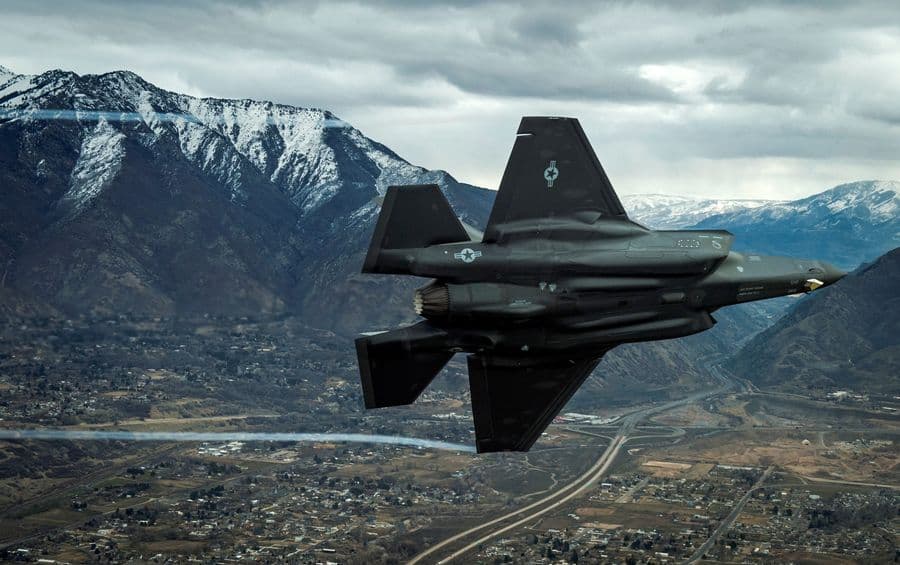
The U.S. State Department recently gave the green light to Finland and Switzerland to purchase the F-35 aircraft. It’s not a fait accompli – the F-35 still needs to win each country's competitions. Still, it's telling that two friendly but non-NATO European countries are seriously considering adopting America's 5th generation, front-line fighter as their own.
The interest of Finland and Switzerland in the F-35 is driven at least in part by the desire for a fighter that won’t be virtually obsolete upon delivery. But moreover, it further underscores the recognized necessity among our allies, partners, and friends to improve our collective interoperability, especially among our air forces.
The public tends to associate the F-35 with stealth, and indeed its small signature makes it far more survivable and lethal than 4th generation legacy airframes when pitted against advanced Russian-made anti-aircraft missile batteries.
But in addition to survivability and lethality, more countries are seeking interoperability with friends and allies, and the F-35 delivers in this crucially important area.
The Royal Navy’s HMS Queen Elizabeth demonstrated the power of the F-35’s interoperability only a few weeks ago. The Royal Navy’s battle group featured escort vessels from the Netherlands and the United States, but the centerpiece of the battle group was two squadrons of F-35B aircraft - one from the Royal Navy, and one from the U.S. Marine Corps.
Capt. James Blackmore, the U.K.'s Carrier Air Wing Commander, noted the importance of the learning experience gained in working side by side with the Marines. But, he said, "This is much more than that; this is the alliance in action, demonstrating that two close allies can not only fly from each other's carriers but can fight alongside each other should we need to. This level of integration offers a decisive flexibility in times of crisis, conflict or war."
A recent RAND Corporation study commissioned by the U.S. European Command hails the interoperability of the F-35 as a key element in Europe’s collective defense. The study asserts that “modernization among a number of European air forces, including through the introduction of fifth-generation aircraft, could offer an essential contribution to transatlantic security, enhance deterrence, and provide commanders much-needed combat power and flexibility in the event a major conflict ensues.”
The RAND study notes that NATO members are beginning to learn how to leverage “the F-35's unique capability to provide battlefield situational awareness in highly contested environments.” The overall takeaway: The F-35 plays a critical role, now and for many years to come, in binding the United States and our European allies together, in peace, competition, or conflict.
Baroness Goldie, the U.K. Minister of State for Defense, has underscored the points made in the Rand study, highlighting our shared strategic interests in "upholding the rules-based international system." When carried on a platform consisting of Britain's newest aircraft carrier with embarked F-35B's from both the Royal Air Force and US Marine Corps, this message carries particular weight and emphasis.
Meanwhile, on the other side of the world, America and its allies face a growing challenge from China, as it asserts claims to neighboring lands and sea lanes, and pursues rapid military modernization to back up those claims and deny access to U.S. and allied ships and planes in international waters. The HMS Queen Elizabeth’s maiden deployment with F-35s is expected to include the Indo Pacific, demonstrating that all nations with maritime interests have a stake in meeting the maritime challenges occurring in this region.
The United States' ability to deploy well within harm's way, side by side with our allies, is critical to maintaining a credible deterrent posture in the Indo-Pacific. Again, the interoperability of the F-35 plays a key role.
Very recently, the USS America, a flat-topped amphibious assault ship, conducted integrated air defense and sea control operations with F-35s from Japan’s Air Defense Command.
Capt. Luke Frost, the commanding officer of America, said, “These are the most advanced capabilities to ever sail or fly. America is a fifth-generation amphibious assault platform, built from the keel up to optimize the most advanced capability of the fifth-generation F-35 platform. We are forward-deployed to integrate exactly these advanced capabilities with Japan.”
Allies from Norway to Poland in Europe and Australia to the Republic of Korea in the Pacific are already realizing the F-35's interoperability's tangible benefits.
The F-35's 5th generation interoperability helps create connective tissue that reinforces relationships with allies, partners, and friends who share common views and commitments. Operating side by side, we are simultaneously broadening and deepening those relationships through demonstrated commitment to each other. That interoperability makes the F-35 a unique and indispensable contribution to improving foreign relations with our allies and friends.
Admiral Scott Swift, USN (Ret.) served 39 years in the United States Navy and retired as a four-star Admiral. During his career, he served as the commander of the U.S. Seventh Fleet, Director Navy Staff, and Commander U.S. Pacific Fleet.
General Philip Breedlove, USAF (Ret.) served 39 years in the United States Air Force and retired as a four-star General. During his career he served as NATO's 17th SACEUR, Supreme Allied Commander Europe, as the Commander of U.S. European Command, and as the 32nd Vice Chief of Staff of the Air Force.

Eight Months of Epic Fury and Still No Internal Alternative
By Stephen D. Cook • RealClearDefense
The Readiness Cliff: Pacific Lessons Drawn from the Middle East
By Brian McSorley • RealClearDefense
The Pentagon’s Real Modernization Problem Is Time, Not Technology
By Bruce Allen Lubbering • RealClearDefense
The World His Mother Opened
By Carlo J.V. Caro • RealClearDefense
Wake Island Lessons for Expeditionary Advanced Base Operations
By Brian J. Dunn • RealClearDefense
Wake Island Lessons for Expeditionary Advanced Base Operations
By Brian J. Dunn • RealClearDefense
U.S. Navy Expands Unmanned Mine Hunting
By Global Defense News
MRF-SEA Will Maintain Continuous Presence in the Philippines
By Mahadzir, USNI News
Space Force Weighs Proliferated Cislunar Satellite Constellation
By C. Albon, A&SF
America-Class Amphibs Enable New Ship-to-Shore Attack Strategies
By Warrior M.