
Ukraine: What Are Putin's Options Now?
Published March 2, 2022 • Read time: 5m
Deluded by a belief he would win quickly and cleanly,
Putin must now weigh the pros and cons for his next steps.
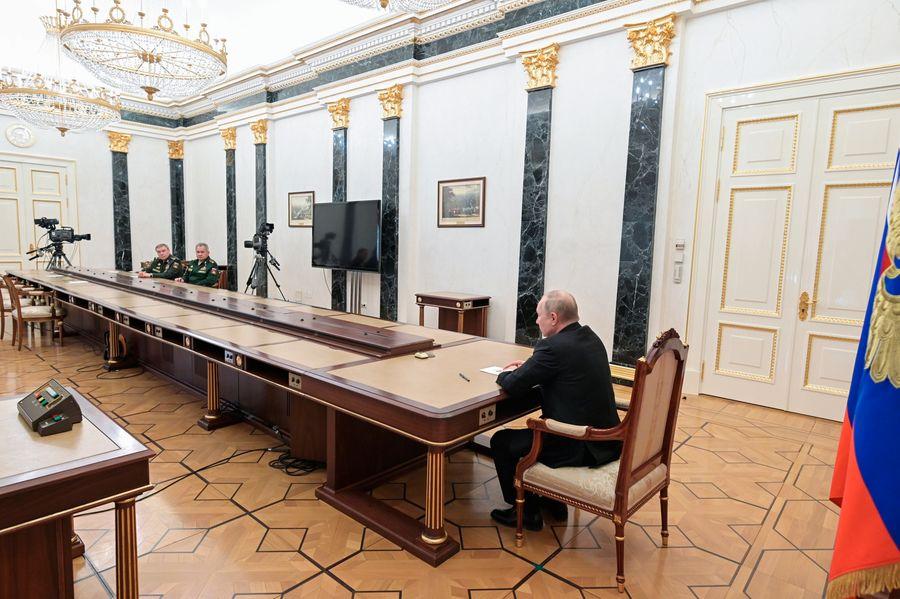
Vladimir Putin’s second invasion of Ukraine has not gone to plan. He has overestimated the capability of his own armed forces, while underestimating the strength of Ukrainian resistance, and the unity of the Western response.
After failing to take Kyiv with a lightning raid that would have forced Ukraine to sue for peace, his army is getting bogged down. And while he retains the upper hand in terms of qualitative military superiority, he faces the prospect of a long insurgency against a Ukrainian population and military that have proven more than keen to fight.
An extensive sanctions regime threatens to rapidly empty his $620 billion sovereign wealth fund war chest, squeezes the ability of his inner circle – not to mention Putin himself – to access their vast fortunes, and degrades the Russian aerospace and resource extraction industries via export controls.
Rather than splintering NATO and the European Union Putin has given both organisations a new sense of focus that can comes with recognition of a clear existential danger rather than just an irritant to be managed. With Finland and Sweden actively considering joining Western alliance structures, Putin may even have inadvertently succeeded in bringing about further NATO enlargement. Deluded by a belief he would win quickly and cleanly against an enemy with no stomach for a fight, and with minimal consequences from a fragmented West, he has also clearly not considered what he would do if things went wrong. That’s one of the most basic errors of strategic planning.
Russia Says Its Defenses Intercepted Over 1,300 Ukrainian Drones
How Seoul’s Break With Kyiv Serves Trump’s Russia Turn
The First Test of Peace Lies in Ukraine's Borderlands
Ukraine Abandons Truce and Attacks Russian Oil Refinery
So what are Putin’s options now? Here are some alternatives, with pros and cons listed for each one. Obviously there are others: readers might want to suggest some of their own.
Massively ramp up violence in Ukraine, reverting to the guiding principle of Russian offensive military doctrine: trap enemy forces; treat cities as hostages; and use indiscriminate bombardment to pulverise resistance.
- Pros: Wins the conflict swiftly, gets the charismatic Ukrainian President Volodymyr Zelensky out of the picture, and achieves Putin’s nationalistic vision of a unified “Russian” people.
- Cons: Will result in massive civilian loss of life. Guarantees a spirited Ukrainian insurgency. Boosts international outrage that would turn Russia into a pariah. Will send its economy beyond the nadir of the mid-1990s. Raises the real prospect of a threat to Putin’s power from within.
Likelihood: Possible. Putin’s appetite for risk has always been high and he has no qualms about committing horrific abuses. But he will be acutely concerned about his political fortunes. That may make him pause, but probably only after he tests it out.
Look for a face-saving way out by suing for peace, and then declaring a great victory.
- Pros: Temporarily gets Putin out of a mess that he alone created. Might come with some sweeteners: for example an enlarged and independent Donetsk and Luhansk; a semi-neutral Ukraine; relaxation of the toughest sanctions.
- Cons: Will badly damage Putin domestically and internationally. Nobody at home will buy a “victory” narrative from such an outcome after the scope of his invasion. And Western leaders will know that he is vulnerable to united push-back.
Likelihood: Unlikely in the short term but might ultimately be necessary. Depends on how “rational” Putin is (and that’s a subject you could fill books about).
Escalate not only against Ukraine, but NATO as well. Conduct a demonstration of power and resolve – such as detonating a nuclear weapon in the North Sea, or arranging a “provocation” against NATO forces. Ramp up the Ukraine invasion effort with massive violence.
- Pros: Shows determination and represents the ultimate test of the West’s willingness to match Putin’s escalatory moves.
- Cons: Would likely result in a Russia-NATO war which he is unprepared to fight and would probably lose. The only viable next escalatory step would be WMDs. His inner circle may eventually decide that enough was enough.
Likelihood: Fairly low, but possible. See previous observation about Putin’s rationality. And while Kremlin clans may dislike Putin, they remain immensely fearful of him.
And some wildcards: Putin agrees to an impartial third party to mediate (but whom?). Zelensky is assassinated (but that may turn him into a martyr). Or Putin himself clumsily falls out of a window (the inner circle is probably not there yet).
The conundrum: in all these scenarios the outcome for Putin is bad. Will he choose the “least worst” outcome of de-escalation? Or roll the dice? Some closing advice: as has often been said of a crisis, anyone who isn’t confused really doesn’t understand the situation.
Matthew Sussex is Senior Fellow at the Centre for Defence Studies, Australian Defence College, and Adjunct Associate Professor at the Griffith Asia Institute, Griffith University. He was formerly a Nonresident Fellow at the Lowy Institute. His research specialisations include international security, Russian politics and foreign policy, strategic studies and international relations theory. His most recent publications have been in the areas of energy security, power relations in the Asia Pacific, security in the former Soviet space, and Australian strategic policy.
This article appeared originally at Lowy Institute's the interpreter.

Iron Raven: Remembering Colonel Joseph B. Conmy, Jr.
By Louis Marano • RealClearDefense
Stand Proud of the Force
By Jay Rogers • RealClearDefense
How a Dying Agency Turned Fentanyl Into a Weapon of Mass Destruction
By Barry Angeline • RealClearDefense
The Pressure Is the Message: What Xi and Putin Faced in Shenzhen
By Emzari Gelashvili • RealClearDefense
China’s Revised Mobilization Law and the Expanding Reach of National Defense
By Muhammad Shoaib • RealClearDefense

Marine Corps Hero Under Federal Investigation
By Laporta, Burnham & Watson, CBS
A Postmortem of Maneuver Warfare in the U.S. Marine Corps
By Donald Vandergriff
U.S. Putting Weapons in Space: A Strategic Blunder?
By Ajey Lele • RealClearDefense
U.S. Senate Seeks to Exchange Shipbuilding Funds for More Munitions
By Naval News
F-35C Completes First Launch and Recovery Trials on a Ford-Class Carrier
By Navy T.