
Mau-Mauing the Tech Bros
Published Oct. 25, 2022 • Read time: 8m
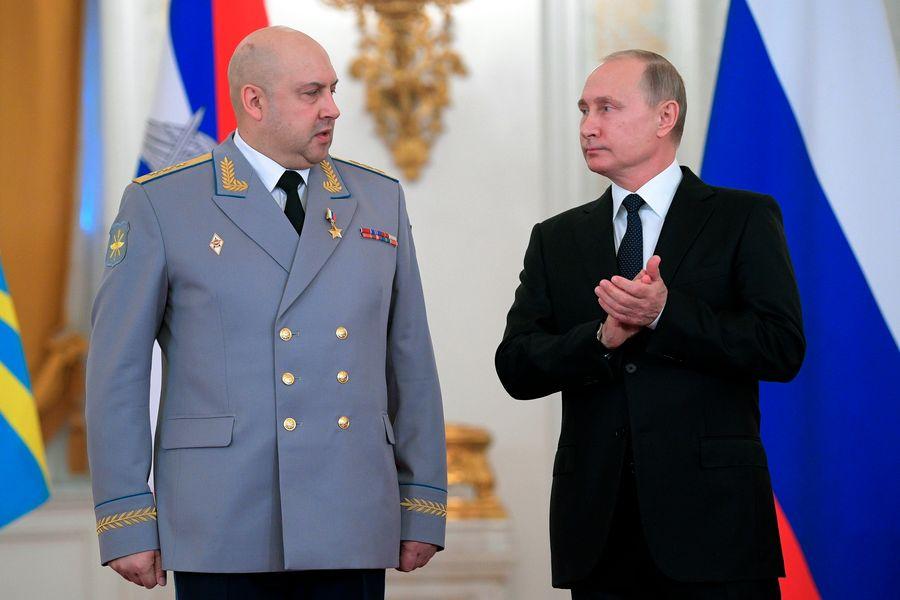
Russian President Vladimir Putin, right, applauds Col. Gen. Sergei Surovikin during an awards ceremony for troops who fought in Syria, in the Kremlin, in Moscow, Russia, Dec. 28, 2017. Surovikin has become the face of Russia’s new strategy in Ukraine, which includes unleashing a barrage of strikes against the country's infrastructure. (Alexei Druzhinin, Sputnik, Kremlin Pool Photo via AP, File)
Nuclear Bluff and Bluster as Psychological Warfare
Nuclear threats are back in vogue, as is atomic unease. The West again stares down the barrel of the nuclear gun with a madman on the trigger. Elon Musk informs the public that the probability of nuclear war is rising. David Sacks, another of the PayPal Mafia, accuses a “neocon-woke alliance” of championing nuclear war. Russia’s nuclear rhetoric is intended to accomplish just this – sow division in the Western camp and trigger doubt over a long confrontation.
Foreign policy is the layman’s activity, at least in the Western political imaginary. American missteps in Iraq and Afghanistan, epitomized in the remark attributed to Barack Obama “don’t do stupid (stuff),” have justified all manner of commentators’ engagement in foreign policy debates. The intelligent financier should be equally capable—perhaps more capable—of conducting foreign affairs than the odious Washington and partisan establishment.
This assumes that foreign policy is not unique, a realm defined by contradiction and confusion, in which ethics and power are in tension, and judgment requires decades to cultivate. Arthur Vandenberg’s comment, that “politics stops at the water’s edge,” stemmed as much from a recognition of the demands international affairs impose as from genuine patriotism. In fact, politics ought to stop at the water’s edge: the international environment differs so radically from the domestic one.
As Allies' Capabilities Grow, They Need To Work With U.S. on Nuclear Signalling
President Kennedy: MAD & the Lessons of Berlin and Cuba
The Pope of FEMA
Over-Feminization of Journalism and Modern Woke Reporting
Hence assessing Russian nuclear threats requires situating them in their context: both in the context of the current war and the far more crucial context of Russian strategic thought. Armed with these, it becomes clear that Russian threats are a form of manipulation targeting the West’s own proclivities and contradictions.
Nuclear use has no strategic purpose in the Ukraine War. Clear boundary conditions, stemming from Russian nuclear and Western conventional-nuclear capabilities, limit means and geography of violence, albeit predictably not its viciousness. Russia, increasingly cognizant of NATO’s overwhelming conventional superiority, wants to avoid a Russia-NATO war. NATO, recognizing that Russian nuclear weapons can cause significant damage, wants to avoid the same. Hence Russia strikes only within Ukraine and refrains from CBRN use, and NATO does not intervene directly in Ukraine despite providing the UAF with all manner of weapons and ISR/T support.
The rub is the nature of that support. A limited war’s boundary conditions create incentives for each combatant to apply leverage within that space, guided by current and foreseeable battlefield conditions. Russia’s battlefield situation is poor. Ukraine now holds the operational initiative, has retaken significant territory in the east, and presses Russia in the east and south. It has even hit the Kerch Strait Bridge, the crucial logistical node between Russia proper and Russian forces in the political and strategic prize of Kherson Oblast.
Russia’s current goal is to survive, hold its gains, and play for time. Putin has mobilized and is receiving support from Iran. He is likely receiving some assistance from Xi Jinping’s China despite its public balancing act. Yet the Russian Army is battered, its morale low, and its supplies poor. Sergey Surovikin, Russia’s new commanding general in Ukraine, is known for brutality more than competence. But even he has indicated that Russia may need to revise its territorial position, that is, abandon conquered ground in the face of Ukrainian pressure, or risk a far worse operational situation.
There is, however, a distinction between a re-consolidation and a rout. At this point, Russia is likely to withdraw from Kherson and Nova Kakhovka soon – Surovikin, unlike his predecessors, has the authority to impose some military logic on the Kremlin’s strategic calculations. But even absent Russia’ Dnieper bridgehead, the Kremlin’s military remains in a tenuous situation. It has one rail route, the Kerch Strait Bridge route, that links occupied Kherson and Zaporizhzhia Oblasts to Russia, and thereby to Russian military supplies. The Donbas’ dense rail network thins out the farther west it expands. The Donetsk City branch does run to Melitopol and then onward to Kherson, but it is far too close to the front line in Zaporizhzhia Oblast to be reliable. Road transport may help, but the Russian military—like its WWI and WWII predecessors—is overwhelmingly reliant upon rail movement. Since literally the war’s first days, it has struggled to sustain any combat operations with road-bound supplies. Crimea’s ports link to the railway network. But Russia does not have the military or merchant fleet to replace the Kerch Bridge in this manner.
Ukraine’s current Western-provided rocket artillery, the HIMARS systems that have caused so much damage to Russian logistics, can target Russian supply lines in Kherson and Zaporizhzhia. However, the warheads are too small, and rockets themselves too short-ranged, to hit targets in the Azov Sea, northern Crimea, or the very south of Zaporizhzhia Oblast, let alone destroy the Kerch Strait Bridge. Ukraine can launch an offensive into Zaporizhzhia Oblast regardless that forces Russia to contract its lines. But unless it can collapse the Russian logistical system, it cannot compel a Russian withdrawal.
Russia’s objectives are therefore twofold: to prevent Ukraine from receiving long-range artillery and to block a major Ukrainian offensive. Russia lacks the hard power to do either – it cannot interdict arms shipments nor resist serious Ukrainian pressure.
The Kremlin instead seeks a political solution. Nuclear weapons will not halt a Ukrainian advance. A single tactical device would not cause enough damage to stop an offensive. Nor would an attack on isolated supply lines prevent the flow of Western arms. To do serious nuclear damage, Russia would need to use some dozen or more nuclear weapons, either to disrupt an offensive or to hit major western Ukrainian cities. All this would raise the odds of NATO intervention. Even non-kinetic escalation, for example direct NATO electronic disruption of Russian air defenses and communications, would destroy Russia’s position. Meanwhile, a single “demonstrative” strike would not change the military situation while still raising the odds of NATO intervention.
Russia can, however, shape Western perceptions. Indeed, Russian strategy and doctrine are informational in emphasis, an outgrowth of sophisticated Soviet strategic-psychological theory termed Reflexive Control. The objective of Reflexive Control is to convince a target, unwittingly, to make a choice in Russia’s interest. Russia has employed Reflexive Control throughout its confrontation with the West and against Ukraine. In 2014-2015, the Kremlin timed its negotiation attempts with major offensives, thereby convincing Kyiv to pause combat operations just before it attacked. In Syria, Russia moved rapidly enough, and cultivated the impression of air defense dominance, to deter US intervention in another example of Reflexive Control.
The current war bears the imprint of informational strategy. Russia invaded along multiple axes after a deliberately public military buildup. This, alongside Russia’s air interdiction campaign and the bungled Hostomel Airport assault, should have paralyzed Kyiv and the West, either driving Zelensky from Kyiv or halting the flow of NATO arms.
Russian manipulation works on a far longer timeframe than simple brinksmanship. The Kremlin has cultivated its nuclear image for decades. When Putin came to power, Russia began to release doctrinal statements implying a low nuclear use threshold. This accelerated in the 2010s – Western analysts naturally parsed every document and professional journal article, reinforcing this image internationally. Russia has also created the perception of irrationality, including in Putin’s speeches, the Kremlin’s various external statements, and supposed leaks about Putin’s mental state. Additionally, there is now information intimating that Putin is under severe internal pressure and faces challenges from his inner circle.
When combined, it becomes clear that Russia has sought and largely succeeded in manipulating Western perceptions.
The average American tech billionaire has no understanding of Russian information doctrine or Soviet and Russia strategic and military-intellectual history. Yet this is crucial to understand Russian policy and strategy. Unwittingly, those who regurgitate Russian nuclear threats and demand negotiations are part of a broader informational campaign to undermine Western morale. At best, the West cracks, and forces Kyiv to concede territory. Or the West buckles and either restrains Kyiv from mounting another offensive or refuses to supply the long-range weapons that would accelerate Russia’s military collapse. The Kremlin needs time to repair its army of conquest, stabilize the front lines, and let the context shift internationally. Western fear-mongers aid in this endeavor. The tech giants whose great wealth is mistaken for great wisdom about war and international relations hasten the process.
They should be ignored. The solution is to keep up pressure and keep Russia on the back foot. Force Putin to fight for every inch of territory in Ukraine. Give the Russian army no rest and ensure it remains off-balance throughout the winter. Taking Ukraine will not sate Putin. It will stir him to expand Russia further and snap NATO. This war is far from over: the West cannot let up now.
Seth Cropsey is the founder and president of Yorktown Institute. He served as a naval officer and as deputy Undersecretary of the Navy and is the author of Mayday and Seablindness.

Iron Raven: Remembering Colonel Joseph B. Conmy, Jr.
By Louis Marano • RealClearDefense
Stand Proud of the Force
By Jay Rogers • RealClearDefense
How a Dying Agency Turned Fentanyl Into a Weapon of Mass Destruction
By Barry Angeline • RealClearDefense
The Pressure Is the Message: What Xi and Putin Faced in Shenzhen
By Emzari Gelashvili • RealClearDefense
China’s Revised Mobilization Law and the Expanding Reach of National Defense
By Muhammad Shoaib • RealClearDefense

Marine Corps Hero Under Federal Investigation
By Laporta, Burnham & Watson, CBS
A Postmortem of Maneuver Warfare in the U.S. Marine Corps
By Donald Vandergriff
U.S. Putting Weapons in Space: A Strategic Blunder?
By Ajey Lele • RealClearDefense
U.S. Senate Seeks to Exchange Shipbuilding Funds for More Munitions
By Naval News
F-35C Completes First Launch and Recovery Trials on a Ford-Class Carrier
By Navy T.