
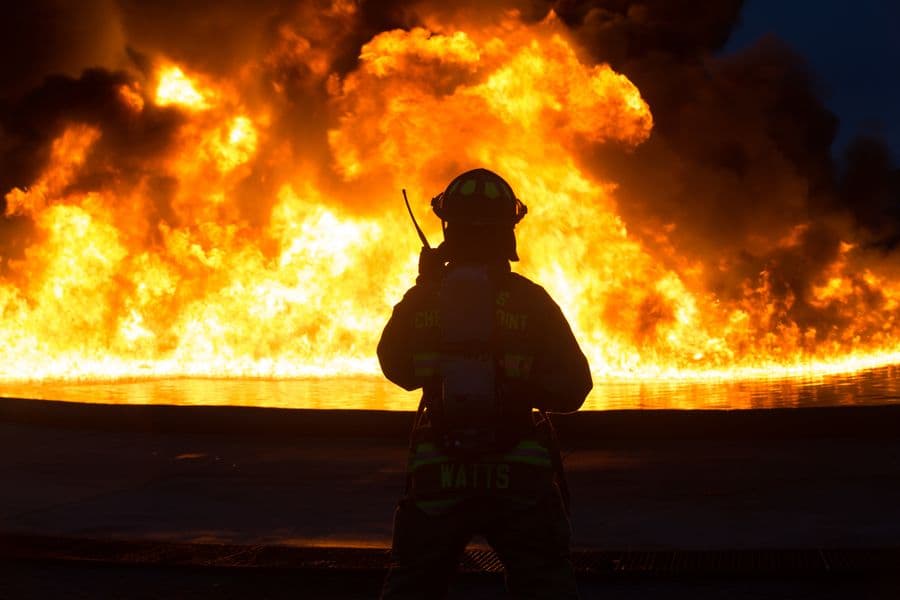
AI As (Wild)fire Support
Last updated 08:14 PM EST • Read time: 5m
It's time to leverage defense industry capabilities to modernize how we fight forest fires
This week, the National Wildfire Coordinating Group formally welcomed the Department of Defense as a primary member of its executive board. The group “provides national leadership to enable interoperable wildland fire operations among federal, state, local, Tribal and territorial partners.”
It’s a smart choice, as the capabilities, skills, and mind-set needed to effectively fight wildfires overlap significantly with those required to protect the nation. But to make the most of it, responsible parties should harness defense sector artificial intelligence (AI) capabilities to modernize offensive and defensive wildfire response capabilities.
The capabilities already exist for greater situational awareness to fight wildfires smarter, faster, and safer – to reduce staging and response times in a fire’s crucial early hours. What’s needed is mass adoption and deployment – and the mindset that AI is now as essential a tool as the layflat fire hose.
The climbing costs of wildfire
Wildfire statistics from the Congressional Research Service paint a grim picture: from 2012-21, an average of more than 61,000 wildfires impacted more than 7.4 million acres per year. Last year, nearly 59,000 wildfires burned 7.1 million acres – a devastating amount, but still less than that recorded in just the first ten months of 2022.
Nor is the physical damage all. In October, the Wall Street Journal reported on research from the University of California which concluded that “wildfire emissions in 2020 alone were two times higher than the state’s greenhouse gas reductions from 2003 to 2019.” Yes, a decade and a half of greenhouse gas reductions were wiped out in a single year by wildfire emissions.
The data exist – it’s taking us too long to leverage it
Mapping a wildfire traditionally can take hours. After determining the size, location, high-heat signatures, shape, that data must be synchronized with the type of terrain, possible accelerants, and wind and weather conditions to provide actionable intelligence for the fire command and control team to make educated decisions on their strategy. Often, by the time the data is relayed, the fire has shifted, and people are forced to make decisions with outdated information.
In short, the process is archaic and arduous; it that takes too much time when time is often the factor between life and death – and billions of dollars in structural damage.
Enabling collaboration and integration through AI
Data from satellites, software-enabled AI can predict the location, speed, and direction of fire-prone conditions. An AI algorithm can then confirm fires once they exist, where it will spread, and what fuel or accelerants are in its pathway. It can relay that information in minutes. That allows fire commanders to immediately start moving assets into place with a rapid mobilization.
The tools exist to combat wildfires more efficiently and effectively. It’s time for forestry services as well as state and federal firefighting agencies to leverage them.
For example, in 2021, NVIDIA and Lockheed Martin partnered with the U.S. Forest Service and Colorado Division of Fire Prevention & Control to stand up the world’s first AI lab for predicting and responding to wildfires. The companies leverage “digital twin” technology to assesses a fire’s magnitude and environment. An AI application combines this information with data on topography, wind, and other factors to predict the fire’s spread. With real-time simulations, responders can engage fires faster and more effectively.
Leveraging capabilities like these, fire commanders can communicate to operations teams faster, enabling quicker, smarter on-the-ground decisions in deploying assets – like fixed-wing or rotor aircraft. AI can also be used to predict weather patterns through partnerships with satellites that help predict fire conditions (vegetation types, heat patterns, and dry conditions), sometimes even before the fire even starts.
Joint All-Domain Operations
To effectively reform firefighting operations proven military skills, techniques and technology can and should be used in the civilian sector for faster and more informed decision-making. Tackle the fire the same way the military tackles combat operations against the enemy. When using joint all-domain operations, multiple domains are integrated to provide the most accurate and current data available. Operators and commanders can utilize joint assets – AI, aircraft, satellites – in a fully integrated system to make a decision and act in a multifaceted operation and fast-changing environment.
Reducing the element of surprise
As a former U.S. Army helicopter pilot, one of the earliest lessons you learn in combat is that human beings have a limitless ability to surprise you. But while people are inherently unpredictable, fire is not. As a physical phenomenon, even the largest blazes behave in knowable ways. Given a set of conditions – terrain, heat index, wind direction, etc. – wildfire data can be analyzed to shorten response times, saving lives, homes, and businesses.
As General Eisenhower said, “Plans are nothing; planning is everything.” With AI, wildfire first responders have an incredibly powerful tool for planning and responding. We should use it.
This is not to argue that natural disasters are not enormously complex and dynamic, or that their rapidly changes can’t catch even the most veteran responders by surprise. It is to argue that we should deploy every available tool to reduce the number and frequency of those surprises.
AI is at the top of that list.
Amber Smith is the bestselling author of Danger Close, former Deputy Assistant to the Secretary of Defense and U.S. Army Kiowa Warrior helicopter in Iraq and Afghanistan. Visit her at OfficialAmberSmith.com and follow on Twitter.

A Passage to the Middle East: India as a Mediator and Security Partner
By Irina Tsukerman • RealClearDefense
South China Sea is Key to Invigorate Positive U.S.–Malaysia Relations
By Brent D. Sadler • RealClearDefense
The Necropolitics of the Wasteland
By Yunus Emre Tumen • RealClearDefense
AI, Robotics, and Marines
By Gary Anderson • RealClearDefense
The Emerging SQUAD
By Muhammad Shoaib • RealClearDefense
AI, Robotics, and Marines
By Gary Anderson • RealClearDefense
AUKUS Partners Test Autonomous Maritime Systems
By Jangoulun Singsit, Naval Tech
AUKUS: USS Colorado Announced as First Submarine for SRF – West
By USNI News
Navy, Marine Corps Simulate Ship Strikes From Air and Land
By Alex Wilson, S&S
Air National Guard To Stand Up a New Special Tactics Squadron
By Patty Nieberg, T&P