
Are We Led By Foolish People?
Last updated 01:00 AM EDT • Read time: 12m
Robert D. Kaplan has traveled across the world as a foreign correspondent.
For more than three decades, his writing has blended observation and history, a taste for contemporary politics with a curiosity about what comes next in human affairs. Kaplan’s 21 books have touched on subjects that range from the Iraq War and the United States military, to travel dispatches from the Balkans, Asia and even the American West. The frequency of his output is so high and the quality of the work so good that Kaplan was once included as a “top 100 global thinker” by someone at Foreign Policy magazine. Regardless of how he finished in that tournament of "top" global thinkers, it is enough to say Kaplan ranks among our most thoughtful reporters on world affairs, that his writing has the power to enlighten readers with greater knowledge and understanding. And his newest book is no exception.
The Tragic Mind: Fear, Fate, and the Burden of Power (Yale, 2023), which measures an efficient 150 pages, is a deep meditation on the concept of tragedy as developed by the Greeks, German philosophers, and an array of Western literary figures from Shakespeare to Camus. The book is engrossing, both as literary survey and personal essay on what it takes to navigate crises. Kaplan’s insights on developing one’s judgment make for profitable reading, especially for people serving leadership roles in government and the military. I spoke with Robert by telephone. What follows is a lightly edited transcript of our conversation.
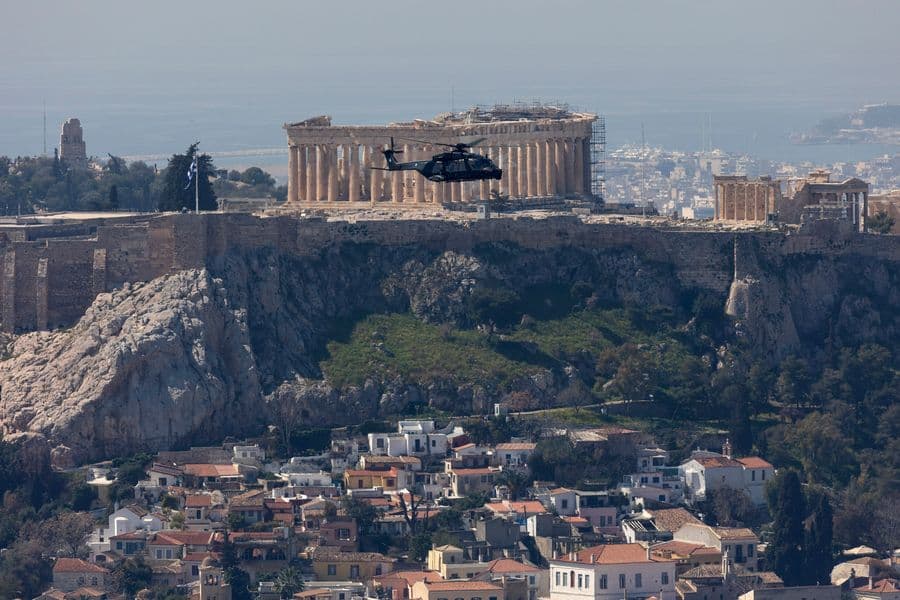
A love affair with the Greeks continues in your latest book. Euripides. Sophocles. Aeschylus. Homer. The Greeks are good for all times but why are they especially good right now?
I think we need prudence and pragmatism to a degree we have not needed it before. I spent years of my life in Greece as a freelance journalist, and Greece has always been on my mind. I picked them right now because their idea of tragedy is apropos for our time. When I say tragedy, I mean the notion that anarchy is worse than tyranny and that no man is lucky until he dies, meaning that no nation is lucky indefinitely.
Insights from Greek tragedy ought to help us respond to emerging crises. But what is the greatest crisis of our times? Is it polarization? Technology?
The greatest crisis of our time is internal division. The right believes in conspiracies. The left believes in conformity—if you don’t agree, then something is wrong with you. Each is as bad as the other. You can see the problem in the tremendous oscillations we’ve had at the White House in the past 20 years. There seems to be little continuity in our political leadership at the White House and so we are less trusted abroad as a result. Everyone criticizes Biden because of his age, but I think because he has been in Washington for so long, he has a certain amount of wisdom. He’s sending tens of billions of dollars to Ukraine for weapons and arms, but he is doing it deliberately and slowly. He’s trying to avoid WMD deployment on the battlefield. He’s taking a middle-of-the-road policy that doesn’t satisfy anybody but may turn out to be the right path.
Political division is the great crisis, and this comes from social and economic division. The American middle class has been dividing into an upper-middle-class “globally” oriented group that is connected to the world and increasingly elite. Meanwhile, the lower-middle-class is becoming trapped in the nation-state and very conservative and working class. Globalization has swept half of America into the wider world and left the rest of them behind.
There has always been chaos. You write that there is something “irremediably wrong in the world.”
That's right.
In the West, chaos and human suffering happen because “the state comes before humanity.” Is that another way of saying our interests come before our values?
Yes, interests come before values. Order comes before freedom. If you do not defend your interests, then it is impossible for you to project your values. Everyone is always arguing about values. And everyone is always arguing about freedom, but that presupposes that order already exists and you just take it for granted. That’s true in the West but not in other parts of the world where order either does not exist or it is so strong it becomes oppressive. We live in one of the least oppressive times in human history because most of human history was under empire. It’s only within the last 100 years or so, because of decolonization, that empire petered out and humanity welcomed in one of its freest moments. But that is relative—it doesn’t get you very far.
Let me say that a foreign correspondent sees the world in gray shades, realizing that most countries are some sort of hybrid. Take the Gulf states as an example. Certainly, there are absolute dictatorships but there is also a social contract. People expect competent governance, smooth transitions of power and relative personal freedoms. In return, they do not question who the leader is, and they do not question the substance of his policies. In the last few years, I’ve spent time in the Gulf states and notice that they are very stable societies. We have few if any lessons to offer these states. You could say, “well, it’s oil wealth.” Yes, that’s part of it. But if you take the Saudi leadership over the last 100 years, they’ve had different leadership transitions and those leaders have all been, by Saudi terms, moderate conservative leaders. And so, they look at countries that experienced the Arab Spring, and they want no part of it. They have peace and no bloodshed.
What I’m trying to say is that when America tries to demand that all countries become democracies, we are saying that our own historical experience with democracy is more relevant than the historical experiences of Syria, Libya or wherever else. We are seeing this with the Biden Administration in Ukraine.
What is your critique of the Biden Administration?
I disagree with how the administration has framed the Ukraine War. For example, when James Baker III put together a coalition of three dozen countries to help eject Iraq from Kuwait, most of those countries were autocracies but James Baker didn’t care. There was enough of a common interest to work together but not a demand that everyone align totally on ideology. Now, we’ve framed the struggle in Ukraine as “democracy versus autocracy” and that is wrong. It should be framed as an invasion of a sovereign nation and a violation of the rules-based order.
Your book is instructive to political leaders and policymakers. Both have committed many errors since the end of World War Two. I’ll spare you the list of failed foreign interventions. But do you believe we are led by foolish people?
No. We’re led by brilliant people who are part of a technocratic elite. They are specialists. They know all about specific regimes and histories, and they know a lot about dictators. It’s all you read about in the newspapers. Elites live in the realm of ideas and dictators repress ideas and so they think these people are in fact the worst thing possible. Elites take their order and well-to-do lives for granted. But the problem in most of the world is how to erect an orderly system in the first place. Anarchy is something elites have never personally experienced. I argue that if you don’t have a “tragic mind” beforehand, to avoid catastrophe, you will acquire one at greater cost when your actions do lead to tragedy.
And the “tragic mind” is learned primarily through experience. “It is only fear and shame that discipline us,” you write. We mature through mistakes. But elites seem to avoid accountability for their failures, and so perhaps they are not learning the lessons of your book. Do you agree?
It’s true that elites don’t pay a career penalty and that’s because America is so wealthy and so blessed with two oceans and an internal river system larger than anywhere in the world. We’re blessed with an economy of scale. We can have terrible mistakes every few decades—mistakes like Vietnam and Iraq—but we don’t really pay a price. The elites just go on and on as a result. And yet, smaller countries, if they made mistakes of a similar magnitude, those smaller countries would not exist anymore.
You write that “the level and quality of misjudgments in Iraq and Afghanistan could lead to catastrophe in a more serious era when the stakes are so much higher.”
Yes. What I notice today is that the elites in our society are demanding things. They demand democracy. They demand capitalism. I believe we’re in for a rocky road ahead. It is impossible to predict what will happen with respect to Taiwan or Ukraine, but I question the elite’s assumption that the fate of the world will be determined by America’s experience.
Your book can be read as a repudiation of elite assumptions. You relate the flaws in their assumptions to gaps in their life experience. Tell me about the generation of elites that led us into Iraq and Afghanistan.
Our current American elite is a very protected group.
For most of history, people have seen violence in their lives. The 1960’s generation—the 60’s youth generation was the first generation in world history that was financially secure and physically secure and that led to the youth rebellion. I think our current generation in Washington has hardly any experience in war and, yes, there is an urge to be close to violence. We have had a volunteer military since the 1970’s. This group has likely studied violence and appreciates the consequences of violence, but I think there is a romanticization. Great writers and novelists can convey the feeling of warfare, and so I try to read novels and poetry because fiction can more easily tell the truth. What I mean is that a writer can hide behind his characters to say truthful things, whereas the nonfiction writer must be careful not to offend the reviewer or the reader. If you’ve seen war or chaos, it’s impossible to convey except through great literature.
And so, where do we go from here?
The world is increasingly anxious and claustrophobic. There is a connectedness about the modern world right now, as attrition of “the same” eventually adds up to big change. Still, we do not have a world government. There is no world governance but there is a world system where a crisis in Asia can interact with a crisis in Africa and South America to multiply to a point that was impossible decades ago. In geopolitical terms, the more connected we are means the more factors and elements there are that can interact and cause crises. All the while, our leadership class in Washington is either technocrat or ideologue, meaning they hold a view that either every problem has a solution (it doesn’t) or they are already convinced of a solution as soon as the problem presents itself.
America was a very well-functioning mass democracy in the print and typewriter era. It is unclear if America can function as well in the digital media era. Mass democracies function best in the middle, in the moderate center, but digital media tends to encourage the extremes and hurt those in the center.
Let’s shift to a different set of questions. I want to talk about you. Tell me about a great book you read recently.
Amitav Ghosh in his “Ibis trilogy” about the Indian Ocean. This was an inspiration. It just completely creates the world of the Indian Ocean.
What is your greatest regret?
That I did not learn extremely well or perfectly another foreign language. If you are truly bilingual, you have an extra sensibility. You have an extra expertise, an extra insight into another culture. I admire Gary Saul Morson a great deal. He knows Russian so well that it reflects something brilliant in his writing. If I could be someone else, I would be him.
What are you most proud of?
I am most proud of work that is ahead of the curve. Monsoon. Revenge of Geography has stood up well. Asia’s Cauldron has stood up well. Balkan Ghosts stood up well, too. It was excerpted before the Balkan War and the Berlin Wall…even before the crisis happened that led to the fall of the Berlin Wall.
You have spent time with and around the military. What is one thing that is totally unique in history about the United States military?
The noncommissioned officer corps. We have the most competent and educated NCO corps of any military force in history. This does not mean they are intellectuals, but they are very capable and serious in their profession. The NCOs are what make the American military as great as it is. Russia and Ukraine do not have a professional NCO corps. The corporals, sergeants, and petty officers are the backbone of America’s military.
What is the single greatest weakness of the United States military?
Hmm. I observe it more among the general officer corps. The general officer corps is sometimes asked to be strategic and understand the world beyond their capability. David Petraeus and Jim Stavridis understand the world, but many general officers are quite technocratic and bureaucratic. They are creatures of systems and lack the imagination to truly understand the world.
What was the last work of art that moved you?
While I was traveling in the Middle East for this book, I re-read Boris Pasternak’s Doctor Zhivago. The book is so different from the movie. It’s a great movie but the book is so much deeper and so much more radical than I remembered. The idea that someone wrote this story in a communist, Soviet country—the bravery it took to write Zhivago is beyond symbolism.
John Waters is a writer in Nebraska.
Eight Months of Epic Fury and Still No Internal Alternative
By Stephen D. Cook • RealClearDefense
The Readiness Cliff: Pacific Lessons Drawn from the Middle East
By Brian McSorley • RealClearDefense
The Pentagon’s Real Modernization Problem Is Time, Not Technology
By Bruce Allen Lubbering • RealClearDefense
The World His Mother Opened
By Carlo J.V. Caro • RealClearDefense
Wake Island Lessons for Expeditionary Advanced Base Operations
By Brian J. Dunn • RealClearDefense
Wake Island Lessons for Expeditionary Advanced Base Operations
By Brian J. Dunn • RealClearDefense
U.S. Navy Expands Unmanned Mine Hunting
By Global Defense News
MRF-SEA Will Maintain Continuous Presence in the Philippines
By Mahadzir, USNI News
Space Force Weighs Proliferated Cislunar Satellite Constellation
By C. Albon, A&SF
America-Class Amphibs Enable New Ship-to-Shore Attack Strategies
By Warrior M.