
A View From the Trenchline
Published July 3, 2024 • Read time: 11m
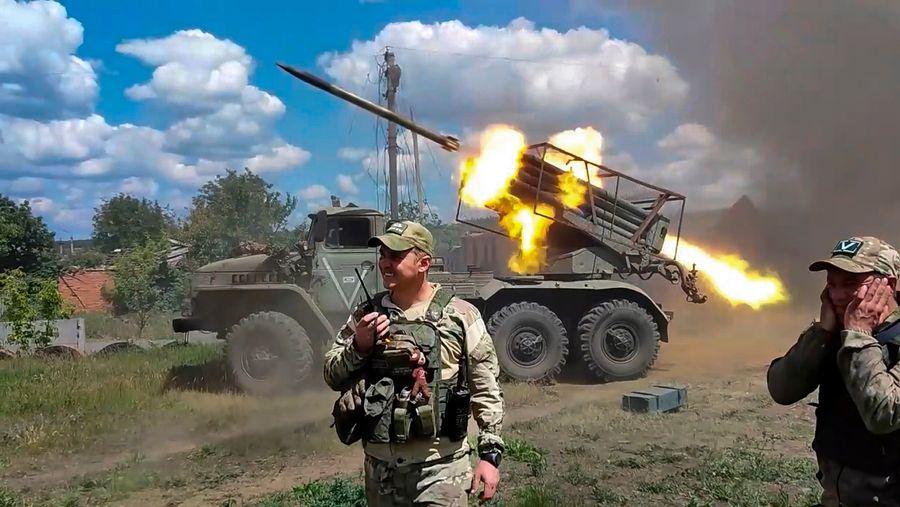
In this photo, taken from video released by the Russian Defense Ministry Press Service on Monday, July 1, 2024, Russian soldiers fire from the BM-21 "Grad" self-propelled 122 mm multiple rocket launcher in an undisclosed location in Ukraine. (Russian Defense Ministry Press Service via AP, File)
Victory in Ukraine Will Not Occur on the Battlefield, but in the Hearts of Men
Earlier this year, while funding for military aid to Ukraine was stalled in the U.S. Congress, critics of the Biden administration rightly pointed out that their country was now more than two years into bankrolling this war, yet their government still had no strategy for how that money was being spent. The critics’ argument was understandable. Because Kyiv had not translated previous aid packages into a clear battlefield victory, the time had come for President Joseph Biden and his advisors to produce a definite strategy for victory in Ukraine. Otherwise, there was no sense in sending even more aid to yet another losing forever war.
It is unfortunate that this legitimate criticism was drowned out by the overwhelming noise of U.S. populist isolationism, because it raises a very important issue, and not just an American problem. The West’s ambiguity in its war aims, and its apparent lack of a strategy, have resulted in ad hoc and piecemeal actions meant to virtue-signal political support for Ukraine rather than achieve any decisive results on the battlefield. Even the steps taken to arm the Ukrainian military have been gestures mostly driven by Western leaders’ need for political announceables, not any concrete plan to enable battlefield success. The West’s military approach to a political problem is directly responsible for Ukraine’s failure to achieve any decisive political victories.
This problem is not new nor unique to the war in Ukraine. There is, among those who study war, a long and venerable tradition of theorizing about the difficult relationship between military necessity and political reality. According to Karl von Clausewitz, author of Vom Krieg (1832), “war is politics by other means,” therefore, military strategy, or the use of the instrument of force, must be subordinated to the precepts of grand strategy, which is focused on the political aim. One cannot overstate the importance of a well-understood political objective to the success of military operations. The description of such an “end state,” which is basic to all NATO battle procedures and operational planning, is vital to directing combat efforts and committing scarce resources.
Unlike most of the wars in recent memory, such as the U.S. led wars in Iraq and Afghanistan, the problem Ukraine faces is not a debate over the nature of the end state that they are seeking. In this they have never wavered. Their aim is the liberation of all Russian-occupied territory within their country’s internationally recognized borders, including Crimea. All other aims – such as prosecution of Russian war crimes, reparations, and security guarantees – hinge on expelling the invaders from their land. Ukraine’s problem is its dependence on Western support to pursue this end state. To put it as bluntly as possible, unless Western leaders endorse the Ukrainian definition of victory, the supporters of Ukraine will never truly be supporting Ukraine. The equipment donated, the initiatives funded, the sanctions imposed – all of these will continue to be disconnected from the needs of the actual mission.
Nor is it a contradiction that Ukraine will never possess the military capacity to defeat and push back the Russian army, let alone drive to the Sea of Azov or recapture Bakhmut, and yet rightfully and logically insist on seeking the whole of Ukrainian territory liberated. Was the battle of Avdiivka, for example, a worthwhile engagement for Ukraine, even though it is widely believed to have inflicted more Russian casualties than the decade-long campaign in Afghanistan? It is a difficult calculation for leaders to make, because the war should not primarily be about fighting over visible towns, around hills, and across rivers, as these are merely the setting for the savage grinding between Ukrainian and Russian morale. As inevitably as every war eventually ends, the morale of the weaker side will at first flutter, and then shatter, leaving the defeated, either Ukrainian or Russian, in irrecoverable humiliation.
Morale is the center of gravity for both adversaries. What would further steel Ukrainians resistance, and cause the Russians to recognize their wasted effort, is a signal by Ukraine’s democratic allies that they are willing to discard their timid strategy of providing only enough military aid to prolong Ukraine’s survival, and instead begin to entertain the idea of inflicting massive losses on the Russian army, naval and air forces. The total economic and domestic political costs of an acute rise in aid to Ukraine by the U.S., Germany, France, the UK, Italy, and other NATO members, will be far less than the costs of intermittent and indecisive assistance dragged out over a half-decade. The tragic wars of the breakup of Yugoslavia in the 1990s is an indictment of the frequency with which democracies can condone atrocities, but also a testament to how powerfully democracies can act once a formula is found for organizing collective action. Nationalist autocracies gather their morale from persecution complexes, historical missions of civilizational conquest driven by arrogance, and militaristic glory. Democracies, quite differently, have no automatic advantage over autocracies in technology, combat skill, or even numbers. Instead, what makes democracies powerful, is that once they have been aroused to defend human rights and freedoms, their coalitions are overwhelming and single-minded in their pursuit of unconditional victory.
Of equal importance, the average citizen of a NATO country cannot understand the psychological effect that the West’s lack of strategy has on those fighting in Ukraine. The operational consequence of a lack of an agreed strategy for victory between Kyiv and its donors, is that brigades, all along the front, are each fighting their own local war, individual fights without the unity of an overall commander’s intent. Without that strategic direction, tactical activity becomes meaningless busy-work. To the soldier crouching at the front, it is an agonizing wait without a discernable end, every passing day and week of which makes more likely their maiming or death.
The why of the fight underpins the morale of the soldiers who are risking, and frequently, sacrificing their lives. Without a higher purpose, soldiers in the unforgiving trenches are left with a fatalistic sense of hopelessness in the defense, and meaninglessness in their attacks. Its absence is fatal to an army’s will to fight. Soldiers lose any sense of control over their own lives. Eventually, they embrace the absurd pointlessness of every action they are compelled to take. Categories of right and wrong slowly evaporate. Initiative disappears. Finally, they submit to the futility. They accept that they will die. And many do. Weaponizing this hopelessness and inflicting it on Ukraine is a key piece of the Kremlin’s war strategy. Ukrainians are aware of this and were it not for the characteristic Ukrainian stubbornness, Russia would have reached the Dnipro River long ago. Nevertheless, Ukraine’s reduced morale is evident in the vigorous political debates over mobilization currently underway in Kyiv.
Even before the full weight of democratic resources would come to bear on the war, the boost to Ukrainian morale would shift the battlefield. Russian propaganda takes succor in the strategic divisions within Europe, which would turn into despondency if it were to unite. Once the campaign in Ukraine is seen as pointless, key Russian opinion makers will progressively withdraw their support from the Kremlin, and while this may not lead to the overthrow of Putin, it will make it politically unsustainable to continue the war. It is precisely through this pointlessness that the Cold War ended in 1989 and the Soviet Union collapsed in 1991. And this pointlessness is not directly achievable by shock on the battlefields of Ukraine, such as in a Ukrainian Tet, Al Faw, or Seine, but in the demonstrated determination in Western capitals to make the sacrifices to support the Ukrainian soldier defending their freedom in the trenches.
This does not mean neglecting military assistance or battlefield strategy, so long as it is linked to sapping Russian military and popular morale. Ukraine needs a well-designed active defense to hold the line in the interim, much like General Mark Clarke’s successful U.S. attrition strategy, described in detail by Carter Malkasian, which inflicted grievous losses on Communist Chinese and North Koreans during the latter phase of the Korean War from 1951 to 1953. To obtain the most favorable exchange rates of equipment and lives, which the Ukrainians deserve, the goal of NATO allies should be to make Ukraine substantially superior to Russia in artillery, armored vehicles, aircraft, and munitions, and to abandon the timid policy of providing only enough material to keep Ukraine from collapsing.
Russia will not simply concede when the costs exceed the military investment. As Fred Charles Ikle has argued in his text Every War Must End, most wars become protracted because of the sunk cost fallacy, wherein countries try to recover their losses in blood and treasure through revenge policies by increasing their demands for unconditional surrender, reparations, and territorial changes, but these conditions are eventually reduced by war weariness. Ukraine’s demanding strategy of holding out until some exogenous systemic shock, like Yevgeny Prigozhin’s revolt of the Wagner group (who seemed to be popular among the Russian people), is valid. H.E. Goemans, in his 2020 War & Punishment, showed that most wars end through negotiation when punishment causes war aims to converge. The nine year Iran-Iraq War, and the eight year contest between the U.S. and North Vietnam, both ended with political shocks that drove the realization in one side that the war could not be won at an acceptable cost.
There are explanations (none of them politically courageous), for the West’s ambiguity in its war aims, and reluctance to push for immediate victory. First, the West is divided. Some state are more concerned with anti-nationalist social engineering and immigration policies of the European Union, than with Moscow’s security threats (such as Hungary, Slovakia, and Bulgaria). Many states, such as Germany, Canada, Italy, and Spain, have electorates that are largely unconcerned with the crisis, and are wary of an expenditure similar to that of an actual war. Second, Western countries are seeking the overthrow of Vladimir Putin, but concurrently need to ensure there is no sudden escalation to the widespread use of chemical or tactical nuclear weapons. NATO’s granting of permission for Ukraine’s use of Western weapons for long-range attacks into Russian territory, is dangerous. Third, Western states are unwilling to engage in invasive internet propaganda within Russia, or Kremlin intrigue, because this may trigger a rally-around-the-flag effect that strengthens Putin, and it could lead to a highly escalatory response as he gambles for resurrection.
Although Ukrainian breakthroughs and visible battlefield successes are popular with the general public, they play into the narrative of focusing on military strength favored by Russian propagandists, rather than comparing the respective popular wills to fight. High profile supporters of Ukraine, including policy decision-makers and those with a media presence, need to de-emphasize the battlefield expectations of military aid, and focus instead on undermining the legitimacy of the war in Russia, and among those states that facilitate Russian trade. The very fact of continued Ukrainian resistance after two years of incessant war, is an indication of the central importance of combat motivation and morale. Every Western policy, declaration and aid program, must be designed to play to this strength.
MAJ David Smith (Royal Canadian Army, ret.) is a former Canadian Army infantry Major who retired in 2023, and now serves in the frontline with the Belarus Battalion of the Ukrainian Army. He is a defiant protector of people whose freedoms are endangered by tyrants.
Dr. Julian Spencer-Churchill is associate professor of international relations at Concordia University, and author of "Militarization and War (2007) and of Strategic Nuclear Sharing (2014)." He has published extensively on Pakistan security issues and arms control, and completed research contracts at the Office of Treaty Verification at the Office of the Secretary of the Navy, and the then Ballistic Missile Defense Office (BMDO). He has also conducted fieldwork in Bangladesh, India, Indonesia, and Egypt, and is a consultant. He is a former Operations Officer, 3 Field Engineer Regiment, from the latter end of the Cold War to shortly after 9/11.
Operation Epic Fury and the Illusion of Victory
By Stephen D. Cook • RealClearDefense
Previewing The Shenzen Summit: A Critical View
By Stephen Blank • RealClearDefense
How to Win Without Military Victory
By Kevin Eyer • RealClearDefense
We Keep Funding ‘Shared Infrastructure.’ Nobody Has Defined It.
By Frederick Gale • RealClearDefense
Congress Must Reauthorize Section 702 of the Foreign Intelligence Surveillance Act
By Bryce G. Poole • RealClearDefense

Five Takeaways From Navy Nominee’s Rocky Hearing
By Seligman & Weisgerber, WSJ
U.S. Air Force Taps Anduril for Containerized Launcher
By Global Defense News
Time To Say Goodbye to the NMESIS and NSM
By Marine Corps Compass Points
HII and U.S. Navy Break Ground on Shipyard Complex
By George Allison, UKDJ
Rare U.S. Air Force Spy Plane Spotted Over the Black Sea
By D. Malyasov, Defence Blog