
America Surrendered in Afghanistan
Last updated 07:05 PM EDT • Read time: 4m
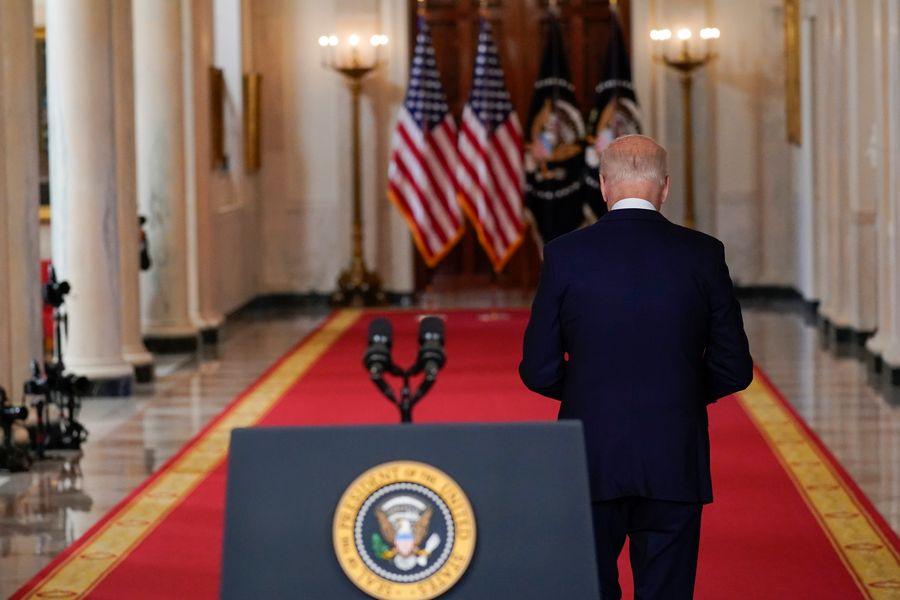
President Biden said he ended the war in Afghanistan.
In truth he abandoned it.
Over 20 years, 800,000 young Americans did their duty to country by serving in Afghanistan. Of those, 20,000 were wounded, and more than 2,000 were killed.
Our mission was twofold: defeat the Taliban on the ground; and build a new military, a democratic government, a new Afghanistan.
The first part of the mission was clear, and when we killed Osama bin Laden in May 2011, there was a feeling among many in the armed forces that we had finished the harder task.
The mission’s second objective, however, proved to be the more difficult. If building a nation sounds ambitious, complex, even foolhardy, it was all those things. For conventional troops, it was often unclear whether we were fighting a war, investigating a crime, or participating in a massive public works project to build a modern nation-state brick-by-brick, road-by-road.
Ask anyone who trained Afghan conventional troops and they will say progress was slow, excruciatingly so. But because it is not in the nature of U.S. soldiers and Marines to shirk a task, we just kept working, persisting in our effort to complete the counterinsurgency mission, believing success was possible, even if took 100 years.
Three years ago this week, President Biden ended that effort, relinquishing ground, gear, friends, and the future to our enemy of more than 20 years. We left behind $7 billion worth of weapons and equipment. We stranded thousands of American citizens, and discarded many thousands more of our Afghan allies. Thirteen American service members were killed at Abbey Gate. The chaos and abandonment surrounding our final flight from Afghanistan overshadowed many individual acts of heroism.
Biden’s response to that dishonorable conclusion was prevarication.
“Our mission in Afghanistan was never supposed to have been nation building,” he asserted last August, disowning a mission he helped create while serving as U.S. Senator and chair of the U.S. Senate Foreign Relations Committee. Even CNN called his statements “inaccurate,” given that Biden “explicitly and repeatedly” advocated nation building in the early years of the war in Afghanistan.
Biden is a president heavily invested in symbols and optics, and history will hold his decisions to account by one picture: a swarm of Afghan peasants hanging off the wings of a plane, striving to not be abandoned to a future under the Taliban. Biden failed to do a hard thing the right way, winding down the war with the same care and seriousness taken by a generation of Americans who walked patrols in that country since 2001.
Watching events unfold on television, many veterans recognized not only that our effort had been in vain, but that we had labored under a delusion—that the Afghan war was worth fighting, that our leaders believed in the mission, that there were good reasons to take lives on the battlefield.
Once the scales fell from our eyes – not for the first time in the country’s history – we resented the politicians whose words and decisions guided our actions.
Worst of all, we began to doubt ourselves. I remember the first time I saw a dead Afghan fighter. I’d expected a seasoned warrior – ribbons of ammunition strung across his chest, eyes burning with extremist fervor – not the thin, crumpled body of a peasant boy in a ditch.
The shame has intensified, not abated, in the years since that discovery.
Having poured ourselves into a cause that never should have been, the patriotism of youth is overtaken by the uncertainty of living in an America that is not what it claims to be. The mission vacated, many veterans no longer know who we are, or who we were, or why we did the things we did. We broke promises to our Afghan partners, but more importantly to those killed and wounded, and to their families.
So, what kind of country does that make us?
In his novel A Long Long Way, Irish writer Sebastian Barry tells the story of Willie Dunne, a boy from Dublin who leaves his family to fight for the Allies in World War I. Willie returns from war to find his country changed, divided into factions, ripping itself apart over politics and more.
“How could a fella go out and fight for his country,” Willie wonders, “when his country would dissolve behind him like sugar in the rain?”
John J. Waters is author of the postwar novel River City One. He serves on the board of directors for At Ease USA, a nonprofit that supports military service members, veterans and their families.
2949 Marine Prisoners, Hostages, and Peacetime Governmental Detainees Since Our Corps' Founding
By Jon Couch • RealClearDefense
America Must Win the Biotech Race Against China
By Rob Maness • RealClearDefense
How Digital Twins Can Strengthen Naval Readiness Before a Crisis Begins
By Carl Napoletano • RealClearDefense
The Uninsured Sky
By Joe Sandri • RealClearDefense
Counterterrorism and the Growing Convergence in Homeland Security and Homeland Defense
By Austin Doctor • RealClearDefense
How Digital Twins Can Strengthen Naval Readiness Before a Crisis Begins
By Carl Napoletano • RealClearDefense
F-16s Build on Iran Combat Lessons to Prepare for China Threat
By Rebecca Grant • Lexington Institute
U.S. Aircraft Evacuated From Second U.K. Base Due to Iran Threat
By Holliday, et al, WSJ
US Marine Corps Acquires Textron’s Ripsaw M3 Uncrewed Ground Vehicles
By DPost
U.S. Navy’s First San Antonio Flight II USS Harrisburg Completes Sea Trials
By GDN