
Protracted Iran-War Parleys: Is It Part of U.S. Strategy?
Last updated 06:44 AM EDT • Read time: 5m
Throughout history, a siege usually ended in surrender only when the defenders ran out of food and water. Till then, it was more expensive for the attackers to get close to the fort walls. Something similar is playing out in the Iran war; the most important factor holding Trump back from resuming attacks on Iran is the cost of Iran’s attacks on U.S. allies in that neighbourhood. Trump has no antidote to that threat of unacceptable damage to oil, gas, and water infrastructure in those countries. It is perhaps in this context that the apparently interminable delays in negotiating a deal have to be seen.
Is Trump deliberately delaying a deal to bring Iran to an economically and logistically weak state where it has no option but to drop insistence on some of the so-called “red lines”? Three of these lines are very obvious; not surrendering the already enriched uranium with the enrichment facilities, control over the Strait of Hormuz and sanctions relief. At present, only the last two appear to be somewhat negotiable. The first one is considered by the theocracy as contrary to affirmation of its sovereignty and consequently tantamount to the loss of legitimacy of the regime.
An indication of the conditions inside the fortress is the muted response of Iran to the recent attacks on two successive days. On 25 May, the U.S. attacked missile sites and boats allegedly trying to place naval mines along the Iranian coast. Next day, a military site at Bandar Abbas came under attack and Iranian drones were shot down over the Strait of Hormuz. Iran responded by sending a missile over Kuwait which was intercepted. Both sides described their actions as defensive while those of the adversary as violations of ceasefire. Meanwhile, the drama of back and forth messages in the so-called “negotiations” continues uninterrupted.
Analysts have noted that even Iran does not seem to be in a hurry for a deal as it is also waiting for the pain of Hormuz Strait closure exceed the tolerance threshold of not only the oil and gas exporting U.S. allies but also of the likes of India that are suffering price increases of everything that uses hydrocarbons and fertilisers. Both Iran and these others have tried to find alternatives. Iran is getting its electronics and chemicals for missiles and drones by air and land routes but there are hardly any workable options for bulk of its oil exports. That stranglehold on its economic lifeline discounts deliberate delay as a strategy for Iran.
Unlike other nations affected by the Hormuz crisis, Iran did not enter the present situation with a healthy economy; its economy was already weakened by decades of sanctions and was kept alive only by oil exports to China by the “ghost fleet” of tankers. The complete collapse of its economy, shortage of goods and the resultant inflation had resulted in large-scale civil unrest and harsh repression by the state shortly before the war. Now with the clandestine oil trade substantially reduced due to the U.S. blockade, markets are anticipating continued devaluation of the rial. The cycle is accelerating as people rush to put their money into dollars, gold, or real estate, further reinforcing the spiral. The state is printing more money adding fuel to the inflation fire. Soon oil production facilities will outrun the storage capacity, and oil wells shall face permanent damage if production is stopped. The fact that Iran’s economy prioritises security forces, who mainly control it, creates added pressure on the civilian economy. For Iran, every day of the blockade is eating into the space between guns and butter, and hence, impacting the morale of security forces as their rial wages buy less and less for their households.
In spite of reports of the resilience of production capacity of Iran in Missiles and drones, the 13,550 U.S. strikes augmented by 8500 Israel attacks have reduced Iran’s military industrial complex to a shell containing less than 20% of its defence production capacity and stocks with even higher losses for air-defence systems, naval assets and naval mines. Iran may replenish its low-tech arsenal but, with the blockade, its advanced systems are bound to falter for lack of maintenance and spares.
Prolonged negotiations are giving the U.S. an opportunity of having a peep into Iran’s increasing vulnerabilities and it appears certain that they see an extended bargaining phase as useful by itself. The U.S. can allow economic pressure to degrade Iran’s war-sustaining capabilities and morale resilience to increase the efficacy of force that may have to be ultimately used. Thus, from a strategic-logic point of view, this combination of extended talks, economic strangulation and the available-at-call kinetic option seems to be Trump’s recipe to square the circle between coercion and escalation control. If there is one way out of the dilemma faced by Trump of preventing debilitating damage to its allies’ infrastructure in the region, protracted parleys and continued blockade may be providing that.
R.N. Prasher has studied physics, economics and law and served as an Indian Administrative Service officer for 34 years. He writes extensively on geopolitics and published the 2025 book, “Geopolitics: Impact on Energy Transition and Energy Security.”
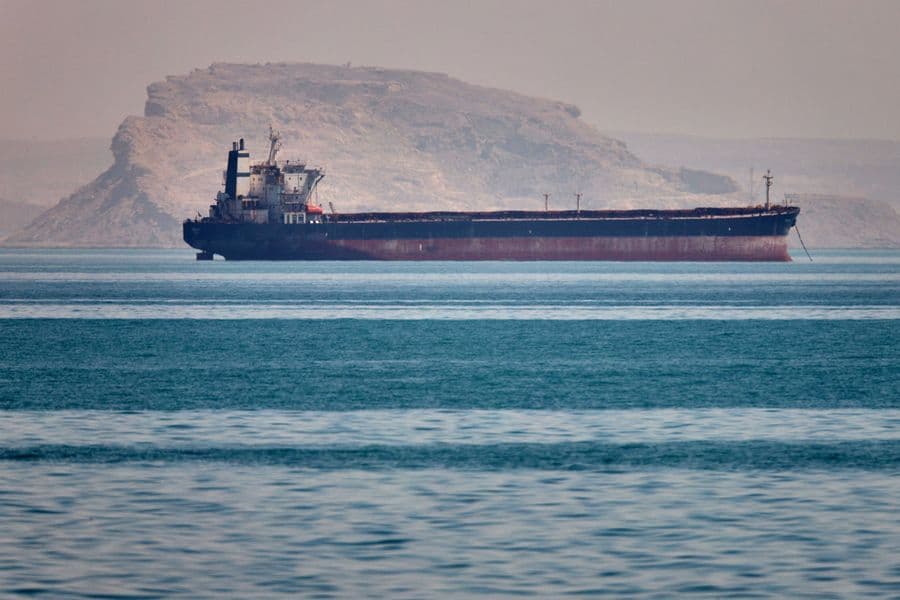
image: A bulk cargo ship sits at anchor in the Strait of Hormuz off Bandar Abbas, Iran, Saturday, May 2, 2026.(Amirhosein Khorgooi/ISNA via AP)

The Services Do Not Need a Four-Star Autonomous Warfare Command
By Steven Wills • RealClearDefense
Honor Them While There Is Still Time
By Jeffrey Rosales • RealClearDefense
From Siberia to Fairford: How Operation Spider’s Web Has Changed the Rules of Airpower
By Frank A. Rose • RealClearDefense
Faster Simulations, Better Defense Decisions
By Rut Lineswala • RealClearDefense
Will HASC Have an Oversight Subcommittee in the Next Congress?
By Christopher J. Bright • RealClearDefense

Hegseth Barred Trans Troops. Military Boards Are Rejecting Those Orders.
By NYT
Closing the Sea: Lessons from Ancient Mediterranean Blockades
By DeCasien, CIMSECFrom Siberia to Fairford: How Operation Spider’s Web Has Changed the Rules of Airpower
By Frank A. Rose • RealClearDefenseFaster Simulations, Better Defense Decisions
By Rut Lineswala • RealClearDefense
Bombers Could Have a Major Air-to-Air Combat Role
By Joseph Trevithick, The WarZone