
The Cost of a Holiday From History
Last updated 06:08 AM EDT • Read time: 8m
Is the old nuclear order dead? Ambassador Gottemoeller says Iran and Ukraine are not deterred by the nuclear forces of Israel or Russia. China is building new nuclear weapons reaching at least 1500 after the end of this decade. Russia is building and sustaining an arsenal of at least 4400 strategic and theater nuclear weapons, 250% of the deployed American arsenal and continually threatens to use battlefield nuclear weapons against NATO. North Korea keeps building more missiles and more nukes. And Iran plays nuclear rope-a-dope with the “international community,” unable to disavow any “right to enrich” uranium which former Senator Kerry wrongfully gave them in 2008. So certainly things look dangerous.
As a result, non-nuclear weapons states in Europe and Asia – such as Germany, the Republic of Korea, Poland, and even Japan – are discussing whether to build their own nuclear arsenals, which would certainly blow up the Nuclear Non-Proliferation treaty. And produce maybe a dozen new nuclear weapons states. And on top of which there would be no arms limits such as in SALT and START. And as many warn the current nuclear weapons powers could be sleepwalking into a new nuclear arms race.
So how did we get where we are today?
With the end of the Soviet empire, it was widely assumed the great powers would begin an era of cooperation and restraint. In 1991, President Bush (understandably) took down thousands of U.S. theater nuclear weapons throughout the Pacific and Europe, securing a pledge from the Soviets that Moscow would do likewise. The USSR was officially ended in December 1991 but did not reciprocate. Today Moscow has between 1900-4000 such battlefield nuclear weapons that can range all of Europe, even as it threatens to transfer such weapons to Belarus.
While NATO did expand after the USSR, the defense of the new nations of Europe was neglected. Ukraine, Belarus, and Kazakhstan all gave up their Soviet era nuclear weapons to preserve START I (1991) and the ABM treaty (1972). The Budapest agreement did pledge to defend Ukraine, but the agreement lay fallow. Russia was invited to be a security partner with the rest of Europe. Dr. Kissinger called for Russia to remain armed and a formidable nuclear power, with a drop in troops but only in stages over time. George Kennan insisted that Germany remain divided so as not to antagonize Moscow. And Senator Nunn of the Armed Services Committee insisted that the U.S. had to more rapidly withdraw its forces from Europe, again so as not to antagonize Russia. Too few---such as AFPC’s Sven Kraemer---saw the necessity of tearing down the evil that remained which had been at the heart of the Soviet empire.
As for China, the dominant narrative remained that trade with and investment in China would develop a democratically inclined middle class. Actually, according to one recent analysis, China prepared for war slashing “its troop headcount – including 500,000 personnel in 1997” – but to free up research and development funds and “reallocate capital towards the navy, air force, strategic missile forces and space programs.” This strategy was led by the abandonment of conscripts “in favor of engineers and technical specialists capable of operating advanced, computer-guided systems including emergency mobile units geared towards counter-separatist operations and deterrence in the Taiwan Strait.”
Four events over 7 months in 1993 illustrate the folly of the U.S. reaction to the disintegration of the USSR. First, on February 13 the defense budget was sent to Congress with dramatic cuts particularly in nuclear weapons programs, and with a two front war being dismissed as the basis for future defense planning; second, on February 23, just 10 days later, the World Trade Center was bombed, by a Islamic terror group led by Ramzi Yousef, whose uncle Khalid Sheik Mohammed would help the attacks of September 11 some 8 years later; third, on May 13, with nuclear arms control deals START I and START II in place, the “stars” or space based elements were taken out of “Star Wars” (SDI), as the likelihood of any threats to use nuclear weapons was considered so remote as to make missile defenses unnecessary; and fourth, incongruously seven months later on September 13 the “Oslo” deal was enshrined, with the West [including Israel] embracing the fanciful idea that Islamic terrorism was amenable to land for peace deals and thus a waning threat if Israel simply shared its homeland. All these actions were based upon widely accepted and popular assumptions, that were held so firmly that over the next three decades they would dramatically harm American security.
It is true that as Yankee legend Yogi Berra told us, “It’s tough to make predictions, especially about the future.” But it is not as if the United States wasn’t warned about the wrongheadedness of its policies.
USAF Maj Gen Garret Harencak warned that the decline in the defense budget reflected a foolish embrace of an assumption that the U.S. would not have any enemies in the post-Cold War era. Particularly worse was the resulting near four-decade long neglect of our nuclear deterrent. With the U.S. facing two, near peer nuclear armed adversaries, and the once dismissed two-front war now a very real possibility. Harencak nailed it—the decline in defense and nuclear acquisition was a foolish “holiday from history” which the U.S. is still even today paying for in lost deterrence.
From 1993-2021, the U.S. fought terrorisms sponsors in Yemen, Iraq, Iran, Syria, Lebanon, Pakistan, and Afghanistan, at a cost of $6 trillion and over 7000 dead American servicemen and women. Withdrawing from Gaza only made terrorism worse. Yet we kept thinking “Islam was a religion of peace” as the U.S. embraced “Oslo” for the entire decade.
Iran and North Korea built missile systems that sought the ability to reach the United States. The missile threat was initially dismissed as just old, Soviet era harmless short range “Scuds.” But since 2015, together Iran and its partners China and North Korea have produced and launched including in warfare more ballistic missiles, drones, and rockets than any other trio of nations. Iran’s proxies have just since 2015 launched some 50,000 rockets, drones and ballistic missiles at Israel, U.S. interests, and U.S. allies throughout the Middle East. U.S. and allied missile and air defenses, deliberately curtailed, truncated and limited by the same legislative people that now complain the inventory of defense systems is dangerously low, have successfully intercepted 85-98% of such launches, savings thousands of lives, and hundreds of billions. [Ted Postol, one top naysayer, complained the low casualty rate among Israeli citizens from these attacks was not due to improved defenses but only showed Israelis could run faster to the shelters. To which missile expert Dr. Uzi Rubin quipped the only thing Israelis had gotten over the past decade was probably older, fatter, and slower!]
Throughout the years after the collapse of the evil empire, Claremont’s Larry Arnn and Brian Kennedy warned we needed to build missile defenses. David Horowitz, Clare Lopez, and Jack Spencer warned us that Islamic terror was the coin of the Islamic realm which we had to take seriously. Stephen Blank, Mark Schneider, Mike Pillsbury, and Gordon Chang warned us that Russia and China were rebuilding empires bristling with nuclear weapons. General Hyten and Brad Roberts warned us that Putin’s new strategy was escalate to win—using battlefield nuclear forces to coerce the U.S. and its allies, while hiding in a perceived sanctuary behind huge inventories of strategic nuclear forces.
Going forward, a bilateral nuclear deal in a multipolar world may not be in the cards, but full transparency may be. One can hardly fashion a limit to arms if no one knows how many arms there are. While the U.S. nuclear inventory is a relatively open book that is not the case for our adversaries. Requiring missile launch notification is already an international diplomatic norm but extending it to all nations makes sense. Improving extended deterrence makes sense as a means of forestalling nuclear proliferation, but only if U.S. allies across the board markedly improve their own defense and the U.S. speeds up its own deployments. While NATO has fully $1 trillion added to its collective defense investments over the next decade in addition to U.S. modernization, more commitment is needed as there are still laggards. What is good for NATO also must be mirrored in the Middle East and the Indo-Pacific. Given the missile launch time to target is often in minutes, it is imperative to build air and missile defenses, finally rejecting the idea that building a shield is simply a prelude to an attack, or that being completely vulnerable to missile, drone and rocket attacks is a diplomatic virtue. Finally, and critically important, the U.S. is not as some have charged creating an arms race as even our full-up nuclear modernization and sustainment plans add only modestly to the 2010 New START planned nuclear force levels. China and Russia are not, however, nuclear sleepwalking as they are wide awake, deliberately adding thousands of nuclear warheads to their current inventory, with which to blackmail the West to standdown.
Peter Huessy is President of GeoStrategic Analysis and Senior Fellow at NIDS and the Gold Institute for International Strategy.
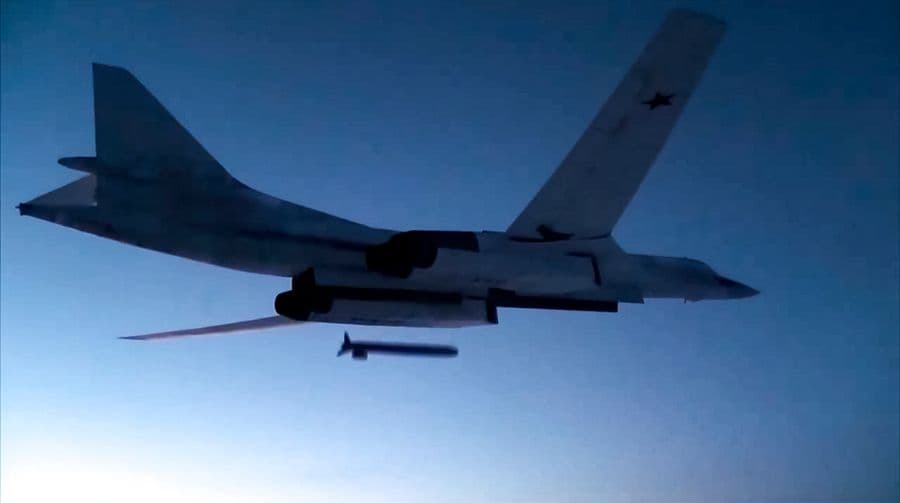
image: A Russian Tu-160 strategic bomber fires a cruise missile at test targets, during a military drills, Russia. The Russian military has conducted sweeping drills of its strategic nuclear forces that featured several practice missile launches. (Russian Defense Ministry Press Service via AP)

A Passage to the Middle East: India as a Mediator and Security Partner
By Irina Tsukerman • RealClearDefense
South China Sea is Key to Invigorate Positive U.S.–Malaysia Relations
By Brent D. Sadler • RealClearDefense
The Necropolitics of the Wasteland
By Yunus Emre Tumen • RealClearDefense
AI, Robotics, and Marines
By Gary Anderson • RealClearDefense
The Emerging SQUAD
By Muhammad Shoaib • RealClearDefense
AI, Robotics, and Marines
By Gary Anderson • RealClearDefense
U.S. Military Gives Elon Musk’s SpaceX Access to Sensitive Tracking Data
By Guardian
USS McFaul Returns to Norfolk After 332 Day Deployment
By Sam LaGrone
The U.S. Shipbuilding Revival Is Taking Lessons Halfway Around the World
By WSJ
Hypersonic -Firing B-1B Lancer To Fly Into the 2040s
By Kris Osborn, Warrior Maven