
BRICS Grits Its Teeth Through a New Delhi Breakthrough
Last updated 07:45 PM EDT • Read time: 5m
A New Delhi declaration nearly 140 clauses long shows what BRICS can do well: keep rivals talking.
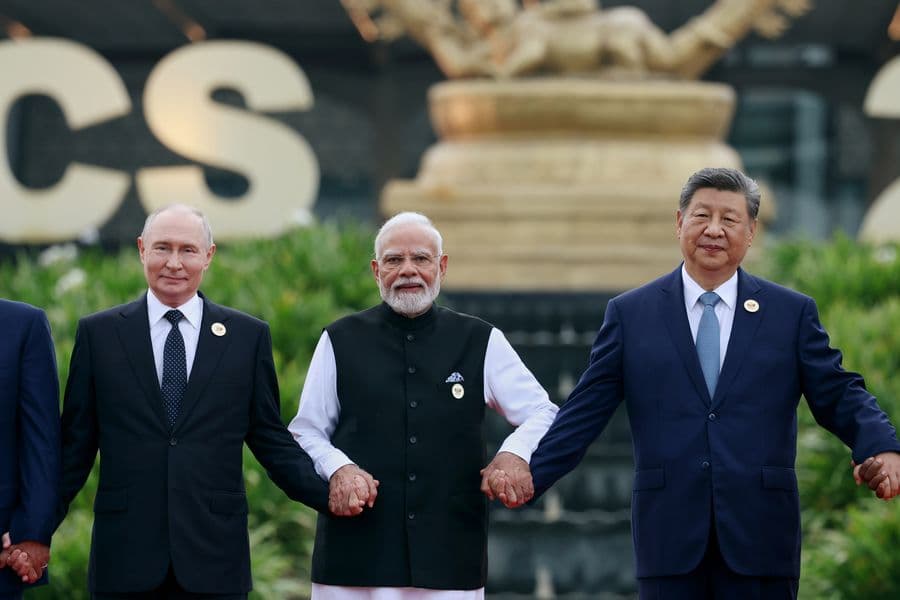
What do you get when Modi, Xi and Putin walk into a room?
You get a photo op for the ages, showing the three most powerful non-Western leaders holding hands and closed-mouth smiling, sending a clear message that, whatever their internal dissonance, a new world order beyond the West is taking shape.
You also get a hefty joint declaration along with the eight other member states that expresses concern over conflicts in the Middle East and West Asia, the risks of nuclear danger, international money laundering and welcomes deeper cooperation between the group’s members.
There’s probably a cracked molar in there too, such are the difficulties of trying to find consensus between states that are not natural bedfellows and, in some cases, have hostilities between them. But that’s just collateral damage in the tense world of geopolitics.
In this photo provided by the Indian Foreign Ministry, From left, Brazil Foreign Minister Mauro Vieira, the leader of the United Arab Emirates Sheikh Mohammed bin Zayed Al Nahyan, Indonesia President Prabowo Subianto, Egyptian President Abdel Fattah el-Sisi, Russian President Vladimir Putin, Indian Prime Minister Narendra Modi, Chinese President Xi Jinping, South African President Cyril Ramaphosa, Iranian President Masoud Pezeshkian and Ethiopian Prime Minister Abiy Ahmed Ali pose for a group photo during the BRICS summit in New Delhi, India, Saturday, Sept. 12, 2026. (Indian Foreign Ministry via AP)
The two-day BRICS summit in New Delhi, held over the weekend, brought together leaders from the Global South including India, China, Russia, Iran, the UAE, Brazil, South Africa, Indonesia, Egypt, Ethiopia.
It was the 18th such summit, and was watched closely around the world, coming at a time when there is recognition that the existing order is waning. A long-running war in Ukraine, the war in Iran entering its sixth month, a flaccid international response to an alleged genocide in Gaza, intensifying U.S.-China rivalry and frustration over U.S. tariffs have combined to create a vibe that perhaps we should make space for multipolarity.
India would love for BRICS to be the vehicle for this, working overtime to ensure Xi’s appearance, despite the tensions over borders and territory between them. It succeeded, with Xi’s first visit to India in seven years. This summit was a definite step forward, particularly with the long and detailed New Delhi Declaration that was reached on Sunday.The declaration was a breakthrough as the bloc had been unable to reach consensus at a May meeting of foreign ministers.
The declaration called for, along with the aforementioned things, reforms to the United Nations and the Security Council, the World Bank and the International Monetary Fund. It also sought to strengthen the financial positions of the Global South, opposing sanctions and coercive economic measures, and favoured more use of local currencies in international trade. It voiced concern over drug production and trafficking, reaffirmed commitment to humanitarian cooperation, and called for space research (Opens in new window) to be used for peaceful purposes. In all, there are almost 140 clauses. It is wide ranging and there is a lot in there, and the throughline is that the Global South wants a greater say in how the international system operates, how global institutions are run, and how their own states are treated.
This is, of course, where things get tricky. The 11 member states span democracies and authoritarian states, energy exporters and customers, friends and antagonists of the United States. There are spats and conflicts between them, and deeply divergent interests and goals. There is a chance that, without intervention, BRICS could be manipulated into becoming an explicitly anti-American bloc, which would not augur well for those members who would prefer to deflect further conflict.
The declaration is proof that India succeeded in keeping the summit focused on areas of cooperation and agreement (although there was a last-minute disagreement between Iran and the UAE over the wording). A close read shows careful phrasing, particularly in the clauses referring to conflicts in the Middle East.
This reveals how BRICS might have its best value: to be the venue that allows states that disagree with each other, to keep talking. China and India talked this weekend, amid their unresolved issues around dominance and borders. (Also, it has been reported (Opens in new window) that there was no hugging between the leaders.) Iranian President Masoud Pezeshkian and Abu Dhabi’s Crown Prince Khaled bin Mohamed bin Zayed also met, the highest-level contact between the countries since the start of the Middle East war, a sign of progress.
Will this be the summit that propels India to kingmaker-of-the-Global-South status and solidifies the bloc as one that can take on Western dominance of global institutions? Hardly. But as one that sets the terms on cooperation and rules for future encroachment by the Global South into the institutions that govern them, it’s a solid step forward.
Aarti Betigeri is a multi-platform journalist and former foreign correspondent with a keen interest in India.
This article appeared originally at Lowy Institute's the interpreter.

Eight Months of Epic Fury and Still No Internal Alternative
By Stephen D. Cook • RealClearDefense
The Readiness Cliff: Pacific Lessons Drawn from the Middle East
By Brian McSorley • RealClearDefense
The Pentagon’s Real Modernization Problem Is Time, Not Technology
By Bruce Allen Lubbering • RealClearDefense
The World His Mother Opened
By Carlo J.V. Caro • RealClearDefense
Wake Island Lessons for Expeditionary Advanced Base Operations
By Brian J. Dunn • RealClearDefense
Wake Island Lessons for Expeditionary Advanced Base Operations
By Brian J. Dunn • RealClearDefense
U.S. Navy Expands Unmanned Mine Hunting
By Global Defense News
MRF-SEA Will Maintain Continuous Presence in the Philippines
By Mahadzir, USNI News
Space Force Weighs Proliferated Cislunar Satellite Constellation
By C. Albon, A&SF
America-Class Amphibs Enable New Ship-to-Shore Attack Strategies
By Warrior M.