
China: Xi, the Party, and the Endless Struggle
Last updated 07:10 AM EDT • Read time: 5m
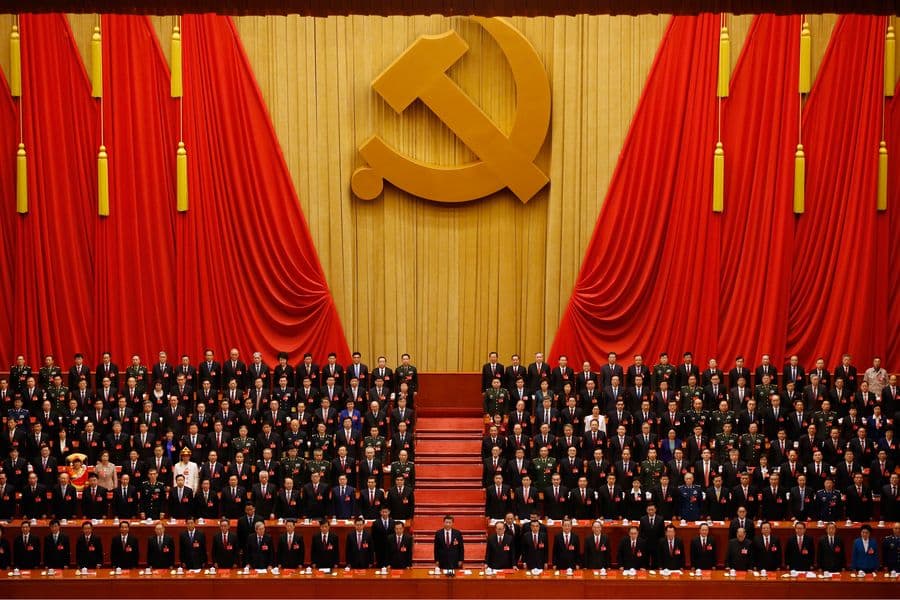
Chinese President Xi Jinping, front row center, stands with his cadres during the Communist song at the closing ceremony for the 19th Party Congress at the Great Hall of the People in Beijing on Oct. 24, 2017. China's ruling Communist Party is holding its twice-a-decade national congress starting Sunday, Oct. 16, 2022. That's where President Xi Jinping is expected to receive a third five-year term as the uncontested head of the party, government and military of the world's second-largest economy. (AP Photo/Ng Han Guan, File)
The latest national congress declares ambition for the
people central to all reforms – with the Party’s guiding hand.
With the Chinese Communist Party’s 20th National Congress in full swing, President Xi Jinping this week delivered his work report confirming, unsurprisingly, the centrality of the Party. The tone was one of celebration, extolling the Party’s achievements, notably, eradicating absolute poverty and achieving a moderately prosperous society. Having accomplished these “historic feats” of the Party’s centenary, Xi and the Party are now focused on the goals of the second centenary – building a modern socialist nation and to advancing the rejuvenation of China.
Despite the triumph, Xi spoke about the “dangerous storms” ahead that may challenge China’s development. The idea of “struggle” (fendou) – one that permeated much of Chinese society and politics during Mao’s rule – was brought back in reference to the task said to be in front of the Party. While China and the world maybe at the “crossroads”, Xi declared that it is the leadership of the Party that will allow the Chinese Dream to come to fruition. But the Party’s internal work of improving its self-governing measures is not over.
The Party may be presented as the beacon for the Chinese nation and its people, but Xi warned its members can be a source of the Party’s weakness. He spoke at great length about maintaining vigilance against corruption within the Party: “As long as the breeding grounds and conditions for corruption still exist, we must keep sounding the bugle and never rest, not even for a minute, in our fight against corruption.”
The rule of the Party and its continued control is in part dependent on it adopting a people-centred approach to all aspects of China’s development. Putting people at the heart of development and in the Party’s thinking is no longer about incorporating a variety of stakeholders in the policy consultation process. Social policy initiatives, once the realm of local level innovation with contributions that included civil society have now shifted to the political realm. Organisations that are affiliated with the Party-state are much more likely to be contracted to deliver social and welfare services. Whether tied to the Party or not, civil society stakeholders are no longer part of the policy design, they are now given the job of collecting information and channelling it upwards.
This political control is paired with a continuation of the reform rhetoric that has characterised China’s four decades of “opening up and reform”. Xi’s report to the Congress noted the significance of continuing to deepen reform across all aspects Chinese society and economy, but claimed this must be people-centred.
This development philosophy includes the need to further improve China’s “multi-tiered social security system”. The theme was present five years ago in Xi’s report to the 19th Congress and again echoed in his speech to the CCP’s Central Committee in February 2021, where the Political Bureau of the Central Committee is given the role to evaluate and reform China’s social security system for “improving public wellbeing, safeguarding social fairness, and enhancing people’s welfare”.
China’s growth model, one funded by debt, is unsustainable. Thus, the emphasis must now shift. This requires unleashing “the tremendous creativity of the Chinese people in their hundreds of millions” and tap into the energy of the Chinese youth. But make no mistake, the Party is central to all of this.
As Xi notes, this cannot happen without equipping the youth with “the Party’s theories, inspire them with the Party’s original aspiration and founding mission”.
As the Congress draws to a close, Xi has sought to clearly lay out the work and challenges for the Party. This is not a time to rest, was his message. Challenges to China’s rejuvenation will come from both within and external to the country. The Party’s second centenary will be one of struggle.
Jennifer Hsu is a Research Fellow in the Public Opinion and Foreign Policy Program. She is currently working on a project which explores the intersections of Australia’s multiculturalism and foreign policy. Prior to joining the Institute, Jennifer was a Policy Analyst with China Matters. After completing her PhD at the University of Cambridge in Development Studies, she researched and taught in development studies, political science and sociology in universities in North America and the UK. Jennifer is also a Visiting Fellow at the Social Policy and Research Centre at the University of New South Wales. Her research expertise broadly covers state-society relations, state-NGO relations, civil society and the internationalisation of Chinese NGOs, and she has published widely in these areas.
This article appeared originally at Lowy Institute's the interpreter.

The Emerging SQUAD
By Muhammad Shoaib • RealClearDefense
Somebody Has to Hold the Ground
By Jay Rogers • RealClearDefense
U.S. Navy Shipbuilding: The Good, the Bad and the Ugly
By Brent Ramsey • RealClearDefense
The Services Do Not Need a Four-Star Autonomous Warfare Command
By Steven Wills • RealClearDefense
Honor Them While There Is Still Time
By Jeffrey Rosales • RealClearDefense

U.S. Military Gives Elon Musk’s SpaceX Access to Sensitive Tracking Data
By Guardian
USS McFaul Returns to Norfolk After 332 Day Deployment
By Sam LaGrone
The U.S. Shipbuilding Revival Is Taking Lessons Halfway Around the World
By WSJ
Hypersonic -Firing B-1B Lancer To Fly Into the 2040s
By Kris Osborn, Warrior MavenU.S. Navy Shipbuilding: The Good, the Bad and the Ugly
By Brent Ramsey, RCDefense