
Collision Course: What the Guilin Incident Reveals About PLA Readiness
Last updated 06:11 AM EST • Read time: 4m
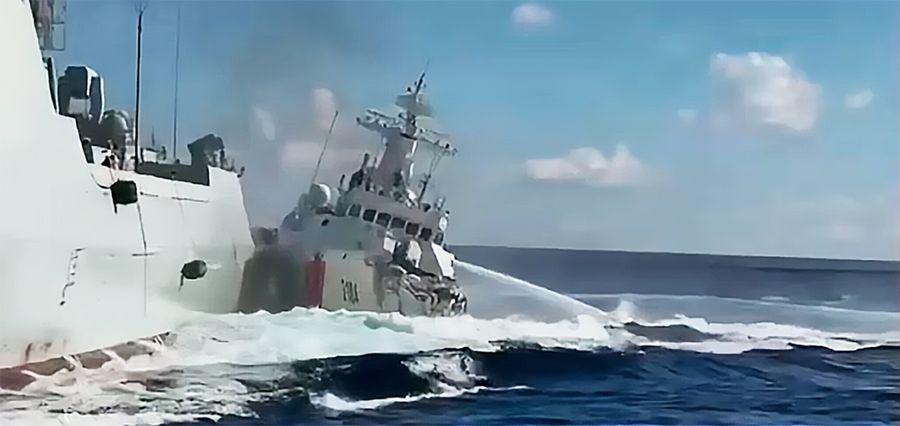
On August 11, 2025, the People’s Liberation Army Navy (PLAN) destroyer Guilin (Hull 164) collided with China Coast Guard (CCG) vessel 3104 near Scarborough Shoal. The incident occurred in broad daylight, in calm seas, while both vessels were aggressively maneuvering to shadow and interfere with a Philippine resupply mission.
Western analysts initially dismissed the crash as a seamanship error—an embarrassing fender-bender for a navy rapidly expanding its hull count. This assessment is dangerously simplistic and naive because it ignores a deeper pathology at work. The Guilin incident was not a failure of navigation so much as a catastrophic failure of Command and Control (C2). It provides undeniable open-source evidence that Xi Jinping’s political purges of military officers are shattering the "Jointness" of the Chinese armed forces.
The "Jointness" Trap
For a decade, the PLA has preached the doctrine of "Military-Civil Fusion" and joint operations. The Navy and the Coast Guard (now under the People's Armed Police) are doctrinally required to operate as a seamless "gray zone" force. In theory, they share a Common Operating Picture (COP) and deconflict maneuvers instinctively.
The Guilin collision proves this doctrine is fiction. For two modern vessels to collide in a non-combat environment implies a total breakdown in horizontal communication. Why did the Guilin not yield? Why did the CCG cutter maintain its course? The answer lies not in their radar systems, but in their personnel files.
The Paralysis of the OODA Loop
The recent purge of General Zhang Youxia and ongoing "anti-corruption" sweep of the officer corps has fundamentally altered the risk calculus for PLA commanders. In the current political climate, "caution" is synonymous with "disloyalty." A rational captain observes a collision risk and slows down (Observe-Orient-Decide-Act). A PLA Navy captain in 2026 observes the risk, but Orients on the political consequences of looking weak. He knows that if he yields right-of-way to the Coast Guard, he risks being reported by a Political Commissar for insufficient "fighting spirit."
The result is an OODA Loop paralysis: The captain fears the internal purge more than the external collision. He chooses to maintain a dangerous course because a hull repair is survivable, but a question about his loyalty is not.
Hardware vs. Software
This has potentially profound implications for US deterrence. We spend billions analyzing the "Hardware" of the PLA—the throw-weight of the PLARF and the VLS cell count of the Type 055 cruisers. But the Guilin incident reveals that the "Software"—the human decision-making capability—is bugged. We have known about this phenomenon among the militaries of autocratic nations and have observed it for years, but what have we done to incorporate this insight into our tactical and strategic analyses?
The PLA is building a force that is theoretically capable of complex joint operations but culturally incapable of executing them. If a Navy destroyer cannot coordinate with a Coast Guard cutter in peacetime without fratricide, how will it coordinate complex amphibious landings under fire?
The Bursting Bombard
A military that relies on hyper-compliance rather than distributed command is not a "Paper Tiger"; it is a bursting bombard, evoking the fatal flaw of the early hoop-and-stave artillery that killed King James II of Scotland in 1460: a weapon powerful enough to crush a castle wall, but structurally prone to exploding in the face of the king who orders it fired. The PLA is building a force that has immense theoretical throw-weight, but which is liable to catastrophic self-destruction the moment the friction of combat is applied.
The Deterrence Gap
The "Davidson Window" for a Taiwan invasion is often framed as a question of capacity: Does China have enough ships? The Guilin answers a different question: Can the PLA be trusted to execute Xi's plan for reclaiming Taiwan? The answer is no.
As we assess the threat environment of 2027, we must prepare for an adversary that lacks off-ramps. When the "enemy gets a vote"—when friction enters the battlespace—the new generation of terrified PLA technocrats will not have the capacity to adapt. They will double down on the original plan, regardless of the tactical reality, because following the plan is the only safe political choice, for themselves and their families.
We are no longer deterring a flexible, thinking enemy. We are deterring a runaway truck with the brake lines cut.
Jim Lowder is a Kansas rancher, retired Naval Aviator, former federal contractor, and independent defense analyst and cybersecurity auditor.
2949 Marine Prisoners, Hostages, and Peacetime Governmental Detainees Since Our Corps' Founding
By Jon Couch • RealClearDefense
America Must Win the Biotech Race Against China
By Rob Maness • RealClearDefense
How Digital Twins Can Strengthen Naval Readiness Before a Crisis Begins
By Carl Napoletano • RealClearDefense
The Uninsured Sky
By Joe Sandri • RealClearDefense
Counterterrorism and the Growing Convergence in Homeland Security and Homeland Defense
By Austin Doctor • RealClearDefense
How Digital Twins Can Strengthen Naval Readiness Before a Crisis Begins
By Carl Napoletano • RealClearDefense
F-16s Build on Iran Combat Lessons to Prepare for China Threat
By Rebecca Grant • Lexington Institute
U.S. Aircraft Evacuated From Second U.K. Base Due to Iran Threat
By Holliday, et al, WSJ
US Marine Corps Acquires Textron’s Ripsaw M3 Uncrewed Ground Vehicles
By DPost
U.S. Navy’s First San Antonio Flight II USS Harrisburg Completes Sea Trials
By GDN