
Revolting for the CCP: Seizing Taiwan Could Drive Japan to Nuclear Weapons
Published Sept. 28, 2026 • Read time: 4m
Potential Japanese acquisition of nuclear weapons is an under-appreciated deterrent to a Chinese attempt at seizing Taiwan.
If China took Taiwan, Japan would surely activate what we must presume to be well-established plans to rapidly equip itself with nuclear weapons.
The prospect of a nuclear-armed Japan is unappealing to the Chinese Communist Party not just because a neighbouring rival would thereby become much harder to handle. Facing that situation, Beijing would have to choose between, on the one hand, the domestic and regional political cost of acquiescence and, on the other hand, the enormous international cost of pre-emptive war on Japan.
Contemplating their options over Taiwan, all this must already be on the minds of China’s senior leaders, including President Xi Jinping.
China annexing Taiwan by force would constitute a survival-threatening situation for Japan, even if the action failed to precipitate the full removal of the United States from Asia. If the US were pushed out of Asia, Japan’s position would be worse still.
China’s leaders have long known this to be the case, and Japanese Prime Minister Sanae Takaichi publicly said as much shortly after taking office in late 2025.
Takaichi’s remarks (and China’s typically overblown reaction to them) were in some ways the playing out of the provocative signalling that occurs between Beijing and Tokyo when a new Japanese leader is elected.
But there’s more to this than posturing. In relation to possible war over Taiwan, there’s real strategic weight in Beijing’s perceptions of Japan’s perceptions.
In thinking through the consequences of winning a Taiwan scenario, certainly one that led to a US withdrawal from the region, China’s leaders would know that their next step would have to be accepting or forcibly preventing the emergence of a nuclear-armed Japan. They would know that Japan’s technical expertise and existing infrastructure, including the facilities supporting its long-running nuclear energy program, would enable the country to quickly form a formidable nuclear weapons capability.
Whether to accept this would create a great dilemma for China’s leaders, one that would cut to the heart of their own fears about the sustainability of their domestic political model and the limits of Chinese power abroad.
Looking outward, a China that has annexed Taiwan and forcibly removed the US from Asia will want to portray itself as a largely benign regional hegemon – that is to say, one that can rely on economic inducements and only a background threat of force to get others to do what it wants.
Pretty clean, no fuss.
Pre-emptively attacking Japan to ensure it does not develop nuclear weapons would not fit that bill. Rather, it would galvanise international support against China, particularly among distant countries.
China will not get a second chance to make a good first impression as a regional hegemon, and Xi knows it.
On the other hand, tolerating the emergence of a nuclear-armed Japan would carry great domestic political risks. The CCP’s domestic support owes much to its decades-long promotion of the idea that it has lifted China from an era of historic national shame. Maintaining a legacy of hatred and bitterness from Japan’s military invasion of China some nine decades ago has been central to this.
To a Chinese polity hardened by conflict and high on emotion and expectation about what a China-centric region should look and feel like, giving Japan a free pass to a nuclear deterrent at such an historical juncture would be a hard sell domestically, to say the least. The Chinese people would be appalled at this policy failure.
At worst, it could fracture Chinese society in ways that pose an existential threat to the party.
Beijing would rather not have to make this choice at all, certainly not when China is centre stage of world politics, and upholding the status quo allows that.
This doesn’t mean China’s leaders will shy away from attempting to take Taiwan. But their decades-long propaganda use of the history of conflict with Japan has created a difficult corner that they would drive into if they succeeded in taking the island.
The propaganda campaign has always been dangerous and unhelpful. But, looking one step ahead, we see that it is in fact a constraint on aggression against Taiwan. It gives Xi reason to pause and think.
Andrew Forrest is a former policy adviser on China in the international division of the Department of the Prime Minister and Cabinet.
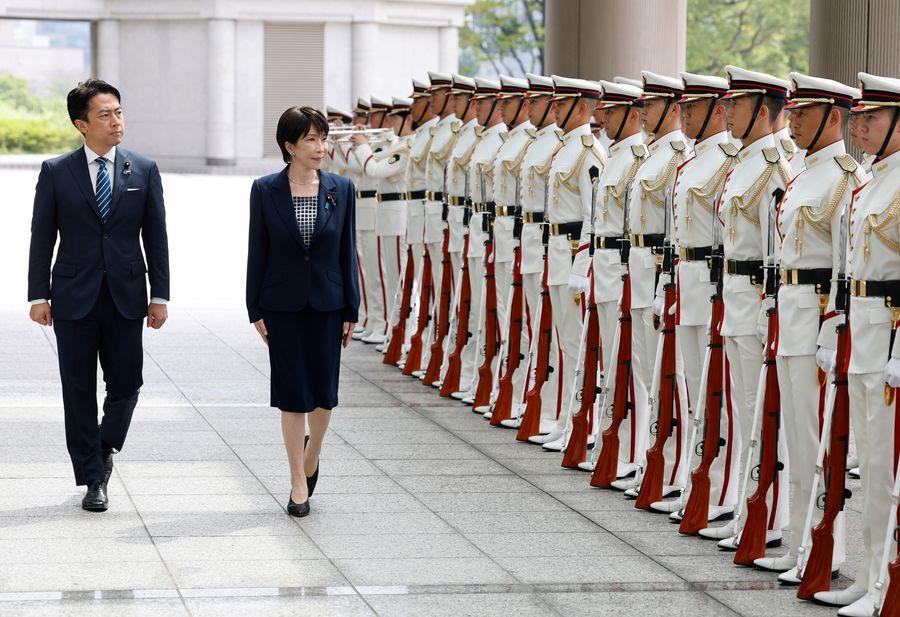
Image: Japanese Prime Minister Sanae Takaichi, right, and Defense Minister Shinjiro Koizumi inspect honor guard at the Self-Defense Forces Senior Commanders' Conference in Tokyo Wednesday, Sept. 2, 2026. (Kim Kyung-Hoon/Pool Photo via AP)
AI contributed no ideas to this article – Andrew Forrest.
This article appeared orginally at The Strategist (ASPI).
South Korea’s Nuclear-Powered Submarines After the Midterms
By Jihoon Yu • RealClearDefense
Why Build a Billion-Dollar Warship if a Cheap Drone Can Sink It?
By Ege Can Gün • RealClearDefense
Megaspeed Proves: Congress Must Act on Chip Security
By Michael Groen • RealClearDefense
Creating a MEF Insurance Policy
By Steven Bancroft • RealClearDefense
Operation Epic Fury and the Illusion of Victory
By Stephen D. Cook • RealClearDefense
South Korea’s Nuclear-Powered Submarines After the Midterms
By Jihoon Yu • RealClearDefenseWhy Build a Billion-Dollar Warship if a Cheap Drone Can Sink It?
By Ege Can Gün • RealClearDefenseCreating a MEF Insurance Policy
By Steven Bancroft • RealClearDefense
U.S. Navy Used Expired Munitions During Iran War
By Riley Ceder, Navy Times
The Coast Guard Icebreaker Nobody Wanted
By David Roza, Task & Purpose