
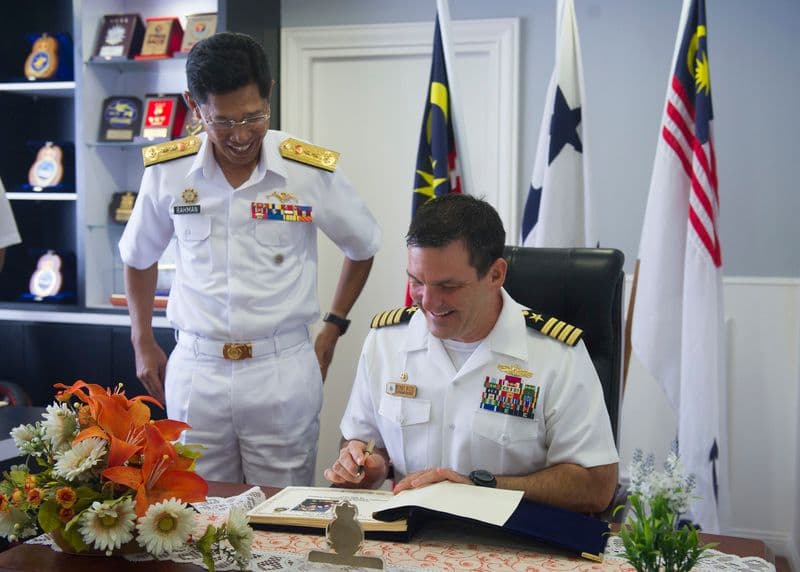
Malaysia: Building Better Relations in the Indo-Pacific
Last updated 05:46 PM EDT • Read time: 6m
While President Obama won publicity for his 'pivot to Asia,' Asian leaders never really warmed to the president's entreaties. By contrast, President Trump's Asia outreach is much quieter and, so far, seems to be getting better reception. President Trump’s recent outreach to Malaysia offers the chance to improve relations with a crucial counter-terrorism partner and ally. Indeed there are several concrete steps the Defense and State departments should take to strengthen this necessary alliance and send important signals to other Southeast nations that have grown distant from the United States.
The signs are already encouraging. Last month President Trump welcomed Malaysia’s Prime Minister Razak to the White House. The two leaders announced a significant deal for Malaysia to purchase U.S. jets and discussed joint counter-program efforts. Behind closed doors, China likely made up a substantial part of the discussion.
The White House meeting was, in fact, the second of Trump’s presidency as the two leaders reportedly also met at the U.S.-Islamic-Arab Summit in Riyadh in May. The two leaders also share a passion for golf, and the two leaders played around before Trump became president when Razak was in New York for a session of the United Nations.
Malaysia has found a U.S. administration it can work with after of years of apparent frustration with President Obama.
Razak came to office only a few months after Obama in 2009. Razak supported Obama-era initiatives against nuclear proliferation, for Iranian sanctions and the troop surge in Afghanistan. Some of these positions were unpopular in Kula Lumpur given traditional economic ties between Iran and Malaysia. Razak received little public recognition and was never granted the honor of a White House visit.
Though President Obama visited Malaysia in 2014, his administration gradually worked to keep Razak at a distance as Razak was investigated as part of an ongoing corruption scandal.
“From the Malaysian perspective, this was offensive because there had been no conviction and the investigation was still ongoing. I think the Trump meeting was important because it signaled a way forward for ties between America and Malaysia,” said a Malaysian diplomat in Khartoum.
Under President Obama, Russia seized the Crimea and supported insurgents in Eastern Ukraine. While in Asia many long-time American allies watched as China used a “Great Wall of Sand” to slowly turn coral reefs into fortified Chinese outposts in the South China Sea. When the U.S. failed to react forcefully, Asian allies noticed.
Given Obama's approach and domestic politics, it's little surprise that one of the Islamic world's strongest democracies sought to diversify its defense relationships last year in signing the country's first major arms deal with China in buying four Chinese patrol ships weeks ahead of the 2016 U.S. presidential election.
The cases of the Thailand and the Philippines two other longtime U.S. allies in the region offer cautionary tales.
The recent actions of Filipino President Rodrigo Duterte are symbolic of declining U.S. defense influence in Asia. The Filipino populist has been vocal in his shift away from the US and toward China. Duterte has announced $500 million in arms deals with Beijing and in May this year dispatched 20 Philippine coastguard officers for training in China.
Thailand – another traditional U.S. ally - has grown closer to Beijing since the death of King Adulyadej in October 2016. This year Thailand’s ruling military junta agreed to a roughly $68-million-dollar deal for Chinese armored personnel carriers. That deal at least appears logical but, Thailand has also agreed to a roughly $1 billion for Chinese submarines.
The submarines in Thailand’s shallow coastal waters make little operation sense. Even less so given the fact that Thailand is unlike most of its neighbors not involved in the South China Sea dispute.
Thailand’s navy, however, is no stranger to white elephants. The country’s Spanish built aircraft carrier is the world’s smallest and as Business Insider has pointed out currently does not carry any aircraft.
We can send a clear and decisive message to allies like Malaysia by signing the sort of defense deals that make sense and providing our partners in ASEAN and elsewhere with equipment and training they need.
The Trump administration should work on that goodwill to expand U.S.-Malaysian defense dies. Luckily for Trump a, few easily available steps are readily at hand.
The U.S. State Department could approve the sale of Hellfire missiles to Malaysia a weapon system which falls under the Foreign Military Sales Program. Malaysia’s agreed to purchase six U.S.-made MD 530G scout/light attack helicopters from the United States last year. The deal marked the first significant Malaysian arms purchases from the United States since June 1993 when Malaysia purchased F-18 fighter jets. At present those helicopters do not include the capacity to fire Hellfire missiles but, the Trump administration may want to revisit the sale. Nearly 30 U.S. allies already operate the system. Those include Singapore and Indonesia – two of Malaysia’s allies and there would be no significant national security threat or disruption to the power balance in the region. If anything it might keep more countries from moving away from the Hellfire system as Israel recently did in a provocative move.
Hellfire missile sales to Malaysia would give it a capability in counter-terrorist operations both for defense purposes and as part of any expeditionary effort.
The development of Malaysian expeditionary capacity is in the best interest of both countries. Malaysia has moved away from a plan by which the U.S. Marine Corps would train and aid in developing Malaysia’s own naval infantry capacity. Britain, the former colonial ruler of Malaysia, might have had an inside track for such a role if not for a Royal Marine TV advertisement that accidentally portrayed Malaysia as an enemy
In a promising development days after the Trump-Razak summit, U.S. forces and their Royal Malaysian counterparts participated in a naval exercise that included the use of littoral combat ships and a contingent of U.S Marines in the straits of Malacca.
Those maneuvers come just days after the U.S. Navy, and Singapore completed Pacific Griffin – the first ever bilateral exercise between Singapore and the United States to take place outside of Singapore. Pacific Griffin which included anti-submarine, anti-surface and anti-air warfare elements held off in Guam and could serve as a model for a similar bilateral exercise with Malaysia.
U.S.–Malaysian ties are deeper than they might first appear. During the 1993 “Black Hawk Down” Battle of Mogadishu Malaysian soldiers fought alongside American forces and more recently the Royal Malaysian Navy has taken part in counter-piracy operations. The Trump-Rizak provides an opening to further build those ties and the opening of a new chapter in defense relations between Washington and Kuala Lumpur. It will also send a signal to other allies in Southeast Asia that the United States remains committed to the future of the region.
Joseph Hammond is a senior contributor with the American Media Institute. As a former Cairo correspondent for Radio Free Europe during the 2011 Arab uprisings, he has also reported from four continents on issues ranging from stability in Somalia to the M23 rebellion in the Eastern Congo.

A Passage to the Middle East: India as a Mediator and Security Partner
By Irina Tsukerman • RealClearDefense
South China Sea is Key to Invigorate Positive U.S.–Malaysia Relations
By Brent D. Sadler • RealClearDefense
The Necropolitics of the Wasteland
By Yunus Emre Tumen • RealClearDefense
AI, Robotics, and Marines
By Gary Anderson • RealClearDefense
The Emerging SQUAD
By Muhammad Shoaib • RealClearDefense
AI, Robotics, and Marines
By Gary Anderson • RealClearDefense
AUKUS Partners Test Autonomous Maritime Systems
By Jangoulun Singsit, Naval Tech
AUKUS: USS Colorado Announced as First Submarine for SRF – West
By USNI News
Navy, Marine Corps Simulate Ship Strikes From Air and Land
By Alex Wilson, S&S
Air National Guard To Stand Up a New Special Tactics Squadron
By Patty Nieberg, T&P